
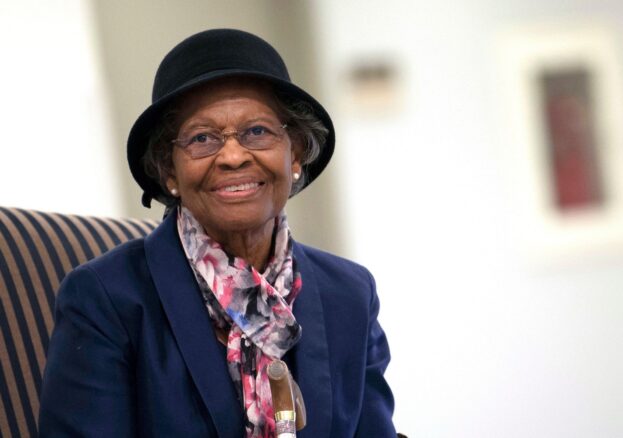
As Black History Month is marked in the United States and Canada, we pause to pay tribute to Gladys West, who died on 17 January 2026, aged 95 — a mathematician whose work quietly reshaped the modern world. Gladys West was one such figure — a mathematician and computer scientist whose research helped form the scientific foundations of satellite navigation systems used across the globe.
Born in 1930 in rural Dinwiddie County, Virginia, Gladys Mae West grew up in a family of sharecroppers, where life was defined by physical labour and limited opportunity. From an early age, she understood that education was the most reliable route to a different future. She excelled academically, often finishing at the top of her class, and earned a scholarship to Virginia State College, a historically Black institution with a strong tradition in science and teacher training.
At Virginia State, West studied mathematics, graduating in 1952. Choosing mathematics as a career path was unusual for any woman at the time, and rarer still for a Black woman. She later completed a master’s degree, deepening her expertise in a discipline that demanded precision, logic, and sustained concentration.
Entering Military Research and Early Computing
In 1956, West began work at the United States Navy’s research facility in Dahlgren, Virginia, now known as the Naval Surface Warfare Center. The Cold War was intensifying, and scientific research had become central to military strategy, particularly in areas such as missile guidance, satellite tracking, and global surveillance.
West was one of only a small number of Black employees at the facility and one of very few women working in highly technical roles. Her work placed her at the intersection of advanced mathematics, geophysics, and early computer science — fields that were still developing and often inaccessible to people like her.
She worked with some of the earliest large-scale computers, programming with punch cards and batch-processing systems. This was computing before screens or instant feedback. Errors were costly, time-consuming, and difficult to trace. Her work required exceptional care, planning, and mathematical confidence.
Measuring the Shape of the Earth
West became increasingly involved in satellite geodesy — the science of measuring the Earth using satellite data. This work addressed a fundamental problem: the Earth is not a perfect sphere. It has bulges, flattening at the poles, and subtle variations caused by gravity and geology.
Accurately modelling these irregularities was essential for predicting satellite orbits and calculating precise positions on the Earth’s surface. Small inaccuracies in Earth models could result in large positioning errors over long distances.
West worked on mathematical models that processed satellite altimeter data to calculate the Earth’s geoid — the most accurate representation of the planet’s shape. This involved analysing vast datasets and refining equations that accounted for minute variations across continents and oceans.
Much of this work was slow and highly technical. Calculations often took hours or days to complete. Debugging meant re-running entire sequences. West’s role demanded not only mathematical skill but resilience and adaptability as computing technology evolved.
Foundations of Global Navigation
Satellite navigation systems rely on predictable satellite behaviour and accurate Earth models. The Global Positioning System, developed over several decades, was the result of collaborative work by many scientists and engineers. Gladys West was not the sole creator of GPS, but her research formed part of the essential scientific groundwork that made it reliable.
Her work ensured that satellite-based positioning could function consistently across the entire planet. Without accurate geoid models, navigation systems would drift and lose precision, particularly over long distances or across different regions.
This global accuracy is what allows navigation systems to operate seamlessly between countries and continents. It is why a satellite navigation signal works just as reliably in Europe as it does in North America.
A Global Impact
Although West worked within the United States, the impact of her research has always been international. Satellite navigation is inherently global. Satellites orbit the Earth as a whole, and accuracy in one region depends on accuracy everywhere.
Her work underpins systems used worldwide — in aviation, maritime navigation, emergency response, infrastructure planning, telecommunications, and scientific research. The reliability of these systems rests on the same geodetic principles and Earth models that West helped refine.
Global navigation systems work because they are built on shared scientific standards. West’s research helped ensure that satellite positioning could operate accurately and consistently across borders, supporting modern life far beyond the context in which the work was first carried out.
Recognition and Later Life
West worked at Dahlgren for more than 40 years, rising to senior positions and contributing to long-term research programmes. Much of her recognition during her career remained internal, recorded in technical reports and institutional acknowledgements rather than public honours.
In 2018, her contribution was formally recognised when she was inducted into the United States Air Force Space and Missile Pioneers Hall of Fame. The honour acknowledged her role in developing satellite geodesy models that helped make modern navigation systems possible.
Gladys West died on 17 January 2026, aged 95.
Legacy
Today, satellite navigation supports everyday life across the world — from smartphones and transport systems to emergency services, aviation, and scientific research. These technologies rely on accuracy at a level most users never see.
Gladys West’s career illustrates how foundational scientific work shapes the modern world without fanfare. Her research helped ensure that global navigation systems could be trusted, regardless of location.
Gladys West’s life stands as a reminder that global progress is often built through sustained, careful work carried out far from the spotlight — and that such work can shape lives far beyond the place in which it began.
References and Further Reading
- United States Air Force Space and Missile Pioneers Hall of Fame — Gladys West induction and citation
- National Geodetic Survey (NOAA) — history of satellite geodesy and Earth modelling
- Naval Surface Warfare Center, Dahlgren — background on satellite navigation and geophysical research
- Virginia State University — alumni records and institutional history
- Smithsonian National Museum of African American History and Culture — profiles on Black scientists and mathematicians