
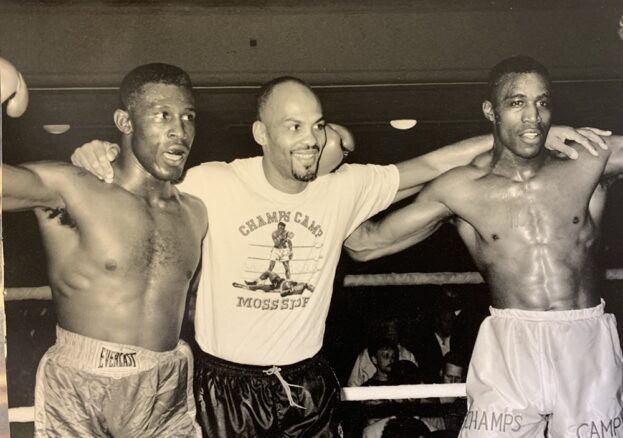
For more than four decades, Champs Camp has been about far more than boxing. Founded by the late Phil Martin, the gym became a place where young people could find purpose, confidence and direction.
Today, Maurice Coore carries that legacy forward. From memories of the early days at Champs Camp to reflections on Moss Side, community and opportunity, he looks back on the values that shaped one of Britain’s most influential boxing gyms.
When Phil Martin first started the gym, did he realise at the time that he was building the UK’s first Black-led boxing gym, or was he primarily focused on the immediate needs of the young people in Moss Side?
He knew that he could tap into something by starting a gym in Moss Side, but he might not have realised until later that he was the first Black boxing promoter and trainer in the country. That realisation came later. But his first concern was to help the young people in Moss Side.
Even when he first started fighting, as a boxer himself, he was always asking, “Why is there no gym in Moss Side?” so in the end he decided to start one himself. He was interested in giving young working-class kids a break. He thought the kids in Moss Side were as good as the kids anywhere, they just needed somewhere to train and to focus their energies.
He and his wife Audrey were socialists, and they believed in that, in equality no matter where you were from.
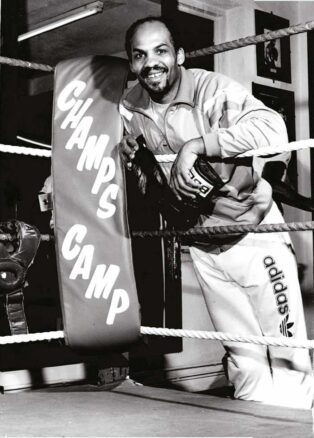 People often talk about the vision Phil had, but can you tell us about the day-to-day work behind the scenes? How did he keep the gym running?
Phil was more than just a trainer and former boxer and manager, as we found out. He was more a people person, he wanted to find out how he could get the best out of you and the best out of the gym.
He could see that potential in us – we couldn’t see that we were destined to be something good, and that some of us were destined to be something great. We couldn’t see it, but he could. Phil made us believe that.
And he gave us that work ethic in the gym, and though Audrey was in the background, she was the driving force behind a lot of it, she and Phil. Phil knew everything about boxing, things that most trainers at the time, including the ones at Boxing England, didn’t know.
Phil went to university and studied the body. He was 20 years ahead of his time. He focused on fitness and nutrition. All his fighters were much fitter than anyone else. They used to say if you’re going to fight a Champs Camp boxer you’d better be in shape.
If we could step back into the Phil Martin Centre in the 1980s, what was the atmosphere like? What would we hear, see and feel the moment we walked through those doors?
First you had to walk up the steep stairs, and there were pictures of fighters on either side. There was no space for any more. Phil was always banging a picture up and could tell you what all the pictures meant.
Then you got in the gym and you’re met with work. You could tell it was a serious gym. It smelled of hard work and grind, perspiration and leather. It wasn’t one of these fancy gyms, it was a real hardworking, down-to-earth gym.
And you just wanted to be the best, to get the best out of yourself.
The first time I went there was with another lad and I had a cigarette in my hand, which Phil didn’t like. I basically ran away, but I came back after a few weeks and Phil said, “Are you still smoking?” and when I said no he said I’d better start training, and I never left.
A boxing gym is often viewed as a place for combat, but you treated it as a place for community development. What was the most important life lesson you and Phil tried to teach the youth that had nothing to do with throwing a punch?
The biggest thing that I try to instil in young people is that you only get out what you put in in life. And that was Phil’s ethic too.
There are other things, like discipline, manners and how you conduct yourself, but they’re all part of putting the idea that if you put the hard work in you get results.
Moss Side faced significant social and economic pressures during that era. Did you ever feel like the gym was “up against it”, and how did you and Phil keep the community’s spirits up when things got difficult?
Phil was always up against it. He knew that the whole system was against him, especially with what he was doing with the boxing.
He tried to make things work through the boxing – and he was doing it. We were meeting fighters from Boxing England, and we were beating them, most of the time, and getting a name.
He knew that if you came from Moss Side, you were never going to get no favours off anyone, and it was us and them.
It was Moss Side against the rest of the world.
Is there a specific person you mentored who, when they first walked in, seemed completely lost but then went on to achieve something incredible, either in or out of the ring?
I wouldn’t want to name a specific person, but there are many individuals whose lives were turned around at Champs Camp.
Where you walked in there at 15 years old, you’re not sure what you want to do, but Phil brought people back. Some lads were from broken families, were involved in gangs and other stuff, but Phil tried to steer people towards the right path.
Now that the Champs Camp Archive Project is officially documenting your history, how does it feel to see Phil Martin and Champs Camp being recognised as a vital part of Manchester’s heritage?
I feel immensely proud.
I still ask myself every day, “What would Phil do?”
And there’s plenty of people who have taken on the Champs Camp model and repeated it elsewhere.
And Champs Camp isn’t just known in Manchester. I was in Jamaica the other day and someone stopped me in the street because he recognised me. He couldn’t wait to find out about the project.
For the young people across Greater Manchester who are now seeing this history at the Manchester Histories Festival, what do you want them to understand about the power of standing up for your own community?
All I’ve seen in the press about Moss Side has been negative reports – from the ’80s to now. Even when Champs Camp was all over the papers and we had become a national centre of boxing. As soon as anything happens it’s in all the papers.
I say to the young people, and to everyone, don’t listen to the negative – you know yourself when you’re being positive, and if everyone does a bit that makes a whole.
I’ve been asked to go elsewhere as a trainer, but I always say, “No man, I’m going back to Moss Side”.
I’m a millionaire there in friends, why would I go anywhere else?