
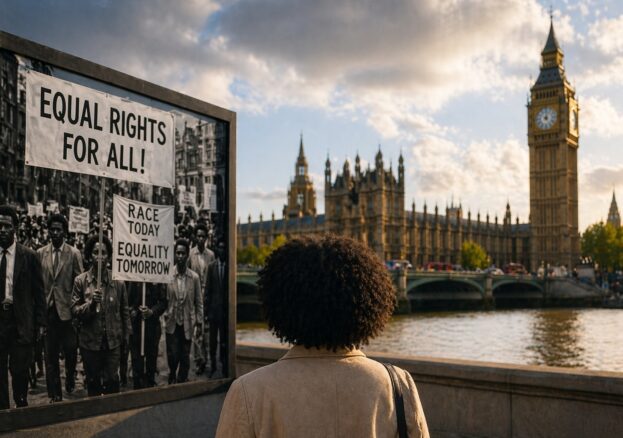
Civil rights here in the UK have never unfolded as a simple or settled story. They have developed over centuries through law and political reform, but just as importantly through struggle, resistance, and the lived experiences of those excluded from the rights Britain claimed to uphold.
Britain is often presented as a nation with a long tradition of liberty. Yet that tradition has always been partial. Rights were extended gradually, and rarely without pressure. For many—particularly those connected to Britain’s empire and its Black communities—equality was not something granted, but something that had to be insisted upon.
Foundations of Liberty and the Limits of Inclusion
The origins of civil liberties in Britain are often traced to the Magna Carta of 1215, which established the principle that the monarch was subject to the law. While significant, its protections were narrow, intended for a small, propertied class rather than the population as a whole.
Later developments, including the Bill of Rights in 1689, helped to define the balance of power between Crown and Parliament. These moments are often understood as milestones in the development of British democracy. Yet they did not create a society of equal rights. Political participation remained restricted, and entire groups—working-class people, women, and those living within Britain’s empire—remained excluded.
Throughout the 19th century, reform expanded the franchise and widened participation. But progress was uneven. Rights were extended cautiously, often in response to pressure rather than principle. The idea of liberty existed alongside deeply rooted hierarchies of class, race, and power.
Empire, Slavery and the Black Presence in Britain
The development of civil rights in Britain cannot be separated from the history of empire.
Britain’s global influence was built in part on systems of exploitation, most notably the transatlantic slave trade. These systems shaped not only Britain’s economy, but also its ideas about race and belonging. By the early 18th century, there was already a visible Black presence in Britain, with thousands of Black men and women living in cities such as London.
Yet presence did not equate to protection. Black lives in Britain existed within a society that lacked clear legal equality and was shaped by racial assumptions carried from empire. Freedom, where it existed, was often fragile and conditional.
The abolition of slavery in 1833 marked a significant moral and political shift. However, it did not dismantle the structures that had supported it. The end of slavery did not bring an end to racial inequality, nor did it resolve questions of belonging within British society.
By the late 19th century, figures such as Dadabhai Naoroji, elected as the first Indian Member of Parliament in 1892, suggested a gradual opening of political institutions. But such moments were limited, and for most Black people in Britain, access to power and representation remained restricted.
War, Migration and the Re-shaping of Britain
The 20th century brought significant change, particularly in the aftermath of the Second World War.
Britain’s need for labour led to the recruitment of workers from across the Commonwealth. Men and women from the Caribbean, South Asia, and Africa arrived to help rebuild the country. This migration was not separate from Britain’s past—it was a continuation of imperial relationships, now taking place within Britain itself.
The arrival of the Windrush generation is often seen as the beginning of modern multicultural Britain. Yet those who arrived entered a society that had not fully reckoned with its imperial history, nor with the presence of Black people within its national identity.
Discrimination in housing, employment, and public life was widespread. Skilled workers were often confined to lower-paid roles, not because of ability, but because of race. In this sense, legal citizenship did not guarantee social equality. Belonging remained contested.
Resistance, Community and Civil Rights Activism
Civil rights in Britain were not simply extended through legislation—they were shaped by those who challenged exclusion.
Black communities, alongside allies, organised to confront discrimination in everyday life. Activism emerged not only in response to individual acts of prejudice, but to wider patterns of inequality that structured opportunity.
The Bristol Bus Boycott of 1963, led by Paul Stephenson, is one of the clearest examples. By challenging a company that refused to employ Black and Asian workers, the boycott exposed the routine nature of discrimination and forced it into public view.
The success of the boycott demonstrated that change could be driven from outside formal institutions. It also reflected a wider, transnational moment, connecting struggles in Britain to civil rights movements taking place elsewhere.
This period saw the emergence of a more visible and organised challenge to racial inequality in Britain, rooted in community action and collective pressure.
Law, Reform and the Limits of Change
The British state responded to these pressures with legislation.
The Race Relations Acts of 1965, 1968, and 1976 made discrimination in public spaces, employment, and housing unlawful. These laws marked an important shift in recognising racial inequality as a matter of public concern.
However, legal change did not automatically produce social equality. Laws could prohibit discrimination, but they could not easily dismantle the structures that sustained it. Enforcement was uneven, and many of the inequalities identified by activists persisted.
At the same time, immigration policy became more restrictive, reflecting ongoing tensions about race, identity, and national belonging. In this way, inclusion and exclusion operated side by side within British policy.
Continuing Struggles and Black British Experience
For many Black Britons, the decades that followed confirmed that civil rights were not secured once and for all.
Inequality remained evident in everyday life, particularly in employment, housing, and policing. These were not isolated problems, but part of broader patterns that shaped how rights were experienced in practice.
In 1981, tensions between Black communities and the police came to a head in Brixton. The uprisings that followed reflected years of frustration with over-policing, unemployment, and social marginalisation. Similar events in other cities underscored the national scale of these concerns.
The murder of Stephen Lawrence in 1993, and the failures of the subsequent police investigation, marked another turning point. The Macpherson Report in 1999 concluded that the Metropolitan Police was institutionally racist, bringing the concept of systemic inequality into mainstream public discourse.
These moments highlighted a central reality: that civil rights could not be understood only in terms of law. They had to be measured against lived experience.
Human Rights and the Question of Belonging
By the late 20th century, civil rights in Britain were increasingly framed through the language of human rights.
The Human Rights Act 1998 incorporated the European Convention on Human Rights into UK law, providing individuals with new mechanisms to challenge injustice. This marked an important development in the legal framework of rights.
Yet the question of how those rights are experienced remains open. Legal protections do not automatically resolve deeper questions about belonging, equality, and recognition. These continue to be shaped by history, by institutions, and by the ongoing actions of individuals and communities.
A History Still in Motion
The history of civil rights in the United Kingdom is not complete.
It is a history shaped by tension—between principle and practice, inclusion and exclusion, law and lived experience. Progress has been made, but it has rarely been straightforward, and it has seldom been uncontested.
For Black Britons, civil rights have often been experienced not as something given, but as something that must be claimed and defended. Change has come through persistence, organisation, and a refusal to accept the limits placed on belonging.
To understand civil rights in Britain is to recognise both the distance travelled and the work that remains.
Further Reading
For those wishing to explore the history of civil rights and Black British experience in greater depth, the following works provide valuable insight and context:
- David Olusoga – Black and British: A Forgotten History
A landmark work tracing the long history of Black presence in Britain, from Roman times to the present day. - Peter Fryer – Staying Power: The History of Black People in Britain
One of the most comprehensive accounts of Black British history, documenting centuries of presence, resistance, and contribution. - Kennetta Hammond Perry – London Is the Place for Me
An exploration of Black Britons and citizenship, focusing on identity, belonging, and post-war migration. - Reni Eddo-Lodge – Why I’m No Longer Talking to White People About Race
A contemporary reflection on race in Britain, including historical context on structural inequality. - Paul Gilroy – There Ain’t No Black in the Union Jack
A key text examining race, nationhood, and identity in modern Britain. - The Stephen Lawrence Inquiry (Macpherson Report, 1999)
A significant public inquiry that introduced the concept of institutional racism into mainstream British discourse. - The National Archives (UK)
Primary sources and records relating to migration, legislation, and civil rights developments in Britain. - Black Cultural Archives (Brixton)
A leading institution dedicated to preserving and sharing Black British history and heritage.