
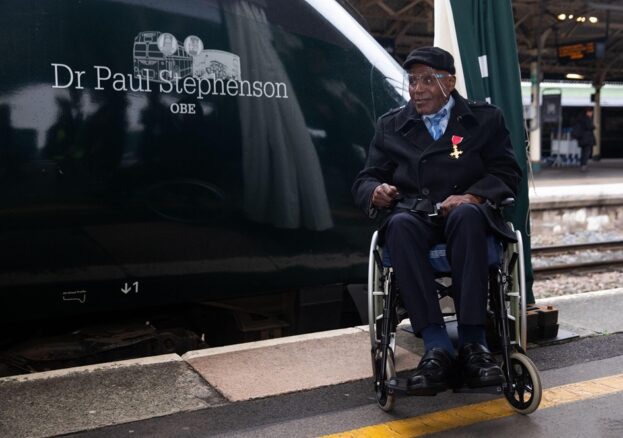
The decision marks the tenth anniversary of the lecture series and coincides with a period of renewed national focus on race equality. It also serves as a moment of remembrance for Dr Paul Stephenson, the civil rights campaigner whose role in the 1963 Bristol Bus Boycott helped shape modern equality legislation in the UK. Dr Stephenson died in November 2024.
The announcement was made at the start of Race Equality Week, held this year under the theme #ChangeNeedsAllOfUs, and follows the formal transfer of the lecture from equality charity Diversity UK to Bristol-based organisation Curiosity UnLtd, which will oversee its future development.
The lecture has its roots in Bristol, the city where the Bus Boycott challenged racial discrimination in public transport and contributed to the passage of the Race Relations Act 1965, the UK’s first law to address racial discrimination. Campaigners have long argued that the boycott placed Bristol at the centre of Britain’s civil rights history.
Commenting on the move, Lopa Patel MBE, Chair of Diversity UK, said returning the lecture to Bristol reflected both its origins and its future role, describing it as a space for public accountability grounded in the city where this history was made.
The Bristol Bus Boycott has continued to receive national recognition in recent years. During a visit to Westminster by surviving boycott pioneers, the Prime Minister, Sir Keir Starmer, pledged to introduce a Race Equality Act. Following the visit, he wrote to campaigners to acknowledge their contribution, stating that “the race equality movement stands on your shoulders.”
In addition, a 2025 report commissioned by the Department for Culture, Media and Sport recommended that the Bristol Bus Boycott be included in the national curriculum, citing its importance in understanding Britain’s social and political history.
Despite Bristol’s international reputation as a centre of creativity and innovation, the city continues to face persistent racial inequalities. Data highlights a 24 per cent ethnicity pay gap, higher rates of school exclusion for Black Caribbean pupils, and the 2023 admission of institutional racism by Avon and Somerset Police.
Speaking about the future focus of the lecture, Julz Davis, Founder of Curiosity UnLtd, said the series must remain focused on outcomes as well as history.
“Sixty years on from the Race Relations Act 1965, and with a new Race Equality Act on the horizon, the challenge is how legislative change translates into lived experience,” Davis said. “The lecture should ask how equality is felt in schools, workplaces, leadership and policing, and how the legacy of the Bristol Bus Boycott can continue to drive progress.”
Curiosity UnLtd said the Paul Stephenson Lecture will form a central part of its ambition to help establish Bristol as the UK’s Civil Rights Capital by 2029, aligning with — but remaining distinct from — the city’s wider cultural ambitions, including its bid for UK City of Culture.
Further details about the 2026 lecture programme are expected to be announced at a later date.