
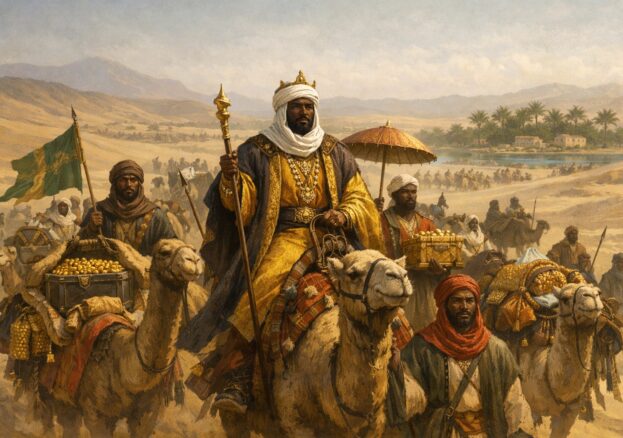
In 1324, a ruler from West Africa crossed the Sahara on pilgrimage to Mecca. His name was Mansa Musa. The journey took months. Along the way, in Cairo, he distributed so much gold that contemporary observers later remarked upon its effect on local markets. Whether the economic consequences were quite as dramatic as later chroniclers suggested remains debated. What is beyond doubt is that the pilgrimage announced the presence of a powerful West African empire to a wider world.
Within decades, European mapmakers would depict Musa seated on a throne, holding a nugget of gold. For those who encountered the image without context, it might have appeared symbolic or exaggerated. Yet it reflected political and economic reality. The Mali Empire was one of the great powers of the medieval period.
At its height, Mali encompassed much of present-day Mali and extended into parts of Senegal, Mauritania, Guinea, Burkina Faso, Niger and The Gambia. From the 13th to the 15th century, it controlled key trade routes linking the forests of West Africa to the cities of North Africa and the Mediterranean.
Foundations
The empire emerged in the early 13th century following the victory of Sundiata Keita over the Sosso ruler Sumanguru Kanté. The events survive in Mandinka oral tradition, preserved by griots whose role was to maintain historical memory across generations.
Stripped of epic detail, what remains is clear: a regional consolidation of power along the Upper Niger River that produced a durable political structure. A capital was established at Niani. Authority was organised through provincial leadership and alliances rather than constant military occupation. The empire expanded not simply by force, but by incorporating existing political systems into a broader framework.
This administrative flexibility was one of Mali’s strengths. It allowed diverse communities to coexist within imperial boundaries while maintaining relative stability.
Gold and Exchange
Mali’s power rested in large part on its access to gold. During the medieval period, West Africa supplied a significant proportion of the gold circulating in North Africa and Europe. Gold mined in regions south of the Sahel travelled northward by caravan, crossing the Sahara to cities such as Tunis and Cairo.
From there it entered Mediterranean markets. European coinage, struck far from West Africa, was nonetheless connected to its mines.
The Sahara, often imagined as a barrier, functioned instead as a corridor. Caravans transported gold north and salt south. Alongside goods travelled merchants, scholars and religious ideas. Mali’s position within these networks gave it leverage. Control of trade routes translated into political authority.
Trade wealth supported urban growth. Markets developed in cities such as Timbuktu and Djenné. Craft production expanded. Governance was reinforced by economic capacity.
Mansa Musa
Mansa Musa’s reign, from approximately 1312 to 1337, marked the high point of imperial influence. His pilgrimage to Mecca was devotional, but it was also diplomatic. It signalled Mali’s integration into the Islamic world and affirmed its legitimacy among other Muslim rulers.
Accounts of his generosity in Cairo became part of the empire’s reputation. Whether embellished or not, they reveal how Mali was perceived beyond its borders — not as peripheral, but as wealthy and consequential.
Musa’s legacy also includes patronage of scholarship and architecture. Under his rule, Timbuktu expanded as a centre of learning. Mosques were constructed or enlarged. Scholars travelled to and from North Africa. Intellectual exchange deepened.
Timbuktu
By the 14th and 15th centuries, Timbuktu had developed into a recognised centre of scholarship. Associated with institutions such as the Sankore Mosque, the city supported study in theology, law, mathematics and astronomy.
Manuscripts were copied and preserved in private libraries. Thousands survive today. They testify to a literate tradition that existed alongside oral history.
Griots continued to maintain genealogies and epic narratives. Written scholarship did not displace oral memory; the two operated in parallel. Knowledge was preserved in multiple forms.
Timbuktu’s scholarly networks linked West Africa to North Africa and the wider Islamic world. Intellectual life in the Sahel was neither isolated nor derivative. It formed part of a broader medieval conversation.
Governance and Belief
The Mali Empire governed a vast and varied territory. Authority flowed from the mansa through appointed governors and allied rulers. Tributary arrangements allowed local autonomy within imperial structures.
Islam was closely associated with the court and urban centres, particularly during Musa’s reign. Yet indigenous spiritual practices remained embedded in community life. Religious identity was layered rather than uniform.
Political cohesion depended less on centralised bureaucracy than on negotiated relationships. That system proved effective for generations.
Gradual Decline
From the late 14th century, internal rivalries weakened central control. Provincial leaders asserted independence. The rising Songhai state gradually absorbed key territories, including Timbuktu.
By the 15th century, Mali’s political dominance had receded. The Moroccan invasion of Songhai in 1591 marked another regional transformation, but Mali’s decline had already unfolded over decades.
Empires rarely vanish at a single moment. They contract, fragment and evolve. Mandinka influence persisted across West Africa long after imperial authority diminished.
Legacy and Perspective
The Mali Empire occupies an essential place in medieval history, not as an anomaly, but as part of a connected world shaped by commerce, faith and political ambition.
During the centuries when European kingdoms were consolidating authority, West Africa was home to a state that commanded substantial gold reserves, regulated trans-Saharan trade and fostered recognised centres of scholarship. The medieval world was not divided into sealed civilisations. It was bound together by exchange.
For a long time, such histories sat at the margins of European narratives of the past. That marginality reflected perspective, not substance. The evidence — archaeological, written and oral — has long pointed to the scale and durability of West African power.
The caravan that crossed the Sahara in 1324 was not a spectacle from a distant frontier. It was a moment within a shared medieval world. Mali was not outside that world. It helped to shape it.