
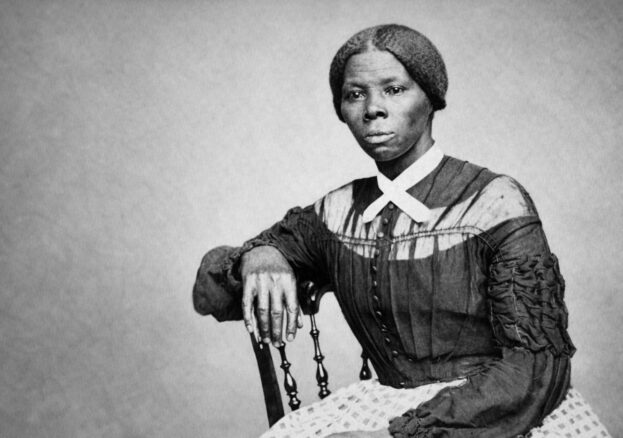
There are few figures in nineteenth-century history whose lives so powerfully challenge the limits placed upon them as Harriet Tubman. Born into slavery, denied formal education, and subjected to violence from childhood, she would become one of the most effective and determined freedom fighters in American history. Her name is inseparable from the Underground Railroad — the secret network that helped enslaved people escape to freedom.
Harriet Tubman was born Araminta Ross around 1822 on Maryland’s Eastern Shore. Her parents, Harriet “Rit” Green and Ben Ross, were enslaved, and from an early age she was hired out to work for different households. She endured harsh physical punishment, hunger and relentless labour. As a teenager, she was struck in the head by a heavy iron weight thrown by an overseer. The injury left her with seizures and severe headaches for the rest of her life.
In 1849, fearing she would be sold further south, Tubman made the decision to escape. Travelling alone and largely at night, she followed the North Star northwards. With assistance from abolitionists and free Black communities, she reached Pennsylvania. For the first time in her life, she was legally free.
Freedom, however, did not end her struggle. It marked the beginning of her life’s work.
The Underground Railroad and War Service
Over the next decade, Tubman returned repeatedly to Maryland to guide others to safety. Historians estimate she undertook around thirteen rescue missions and personally led approximately seventy people to freedom, including members of her own family. She also provided instructions and support that enabled many others to escape.
The Underground Railroad was not a literal railway, but a covert network of safe houses, churches, abolitionists and ordinary citizens willing to defy the law. After the Fugitive Slave Act of 1850 made it even more dangerous to assist escapees, the risks intensified. Capture could mean imprisonment, violence or death. Tubman carried a pistol for protection and insisted that those travelling with her remain committed to the journey. She later stated that she had “never lost a passenger.”
Her leadership earned her the nickname “Moses,” a reference to the biblical figure who led his people out of bondage. The title reflected not only courage but careful planning. Tubman possessed detailed knowledge of terrain, timing and trusted contacts. Her missions were strategic acts of resistance against a system that treated human beings as property.
When the American Civil War began in 1861, Tubman’s role evolved again. She worked with the Union Army as a nurse, cook and scout, drawing upon her experience and local knowledge. In 1863, she helped plan and guide the Combahee River Raid in South Carolina. The operation destroyed Confederate supplies and resulted in the liberation of more than 700 enslaved people. It remains one of the few military campaigns in United States history led by a woman, and the only one during the Civil War led by a Black woman.
Legacy Beyond the Underground Railroad
After the war, Tubman settled in Auburn, New York. She married Nelson Davis, a veteran, and remained active in public life. She supported the campaign for women’s suffrage, working alongside figures such as Susan B. Anthony. Despite her wartime service, she struggled financially and fought for years to secure a military pension from the US government.
In her later years, she established the Harriet Tubman Home for the Aged, providing shelter and care for elderly African Americans with limited resources. It reflected her enduring belief that freedom must include dignity and security.
Harriet Tubman died in 1913. By then, slavery had been abolished, yet racial inequality persisted. Her life stands as a reminder that progress is often achieved not through grand speeches alone, but through persistent and practical action.
Today, Tubman is remembered as a symbol of courage and moral clarity. Yet she was also a strategist, organiser and leader who understood risk and responsibility. The Underground Railroad was sustained by many individuals, but few embodied its determination as completely as she did.
To study Harriet Tubman is to confront the realities of slavery, resistance and the ongoing struggle for equality. Her legacy endures not simply in legend, but in the enduring principle that freedom is worth the risk of pursuit.
References & Further Reading
- National Park Service. “Harriet Tubman Biography.”
- Larson, Kate Clifford. Bound for the Promised Land: Harriet Tubman, Portrait of an American Hero. Ballantine Books, 2004.
- Clinton, Catherine. Harriet Tubman: The Road to Freedom. Little, Brown, 2004.
- Library of Congress. “Harriet Tubman.”
- Harriet Tubman Underground Railroad National Historical Park.