
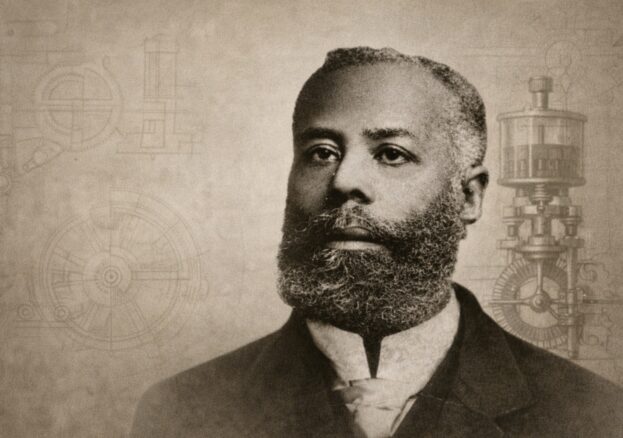
There are few phrases in the English language as widely used — and as little understood — as “the real McCoy.” It has come to mean authenticity, quality, the genuine article. Yet behind the expression stands a man whose ingenuity helped power the industrial age, and whose life reveals both the promise and prejudice of the nineteenth century.
Elijah McCoy was born in 1844 in Colchester, Ontario, Canada West, to parents who had escaped slavery in Kentucky via the Underground Railroad. His father, George McCoy, had once been enslaved; his mother, Mildred, had fled with him to freedom. In Canada, they were able to build a new life. It was in this atmosphere of hard-won liberty that Elijah’s curiosity and talent began to flourish.
Recognising his mechanical aptitude, McCoy’s parents sent him to Scotland at the age of fifteen to study mechanical engineering — an extraordinary achievement for a Black teenager in the mid-nineteenth century. He apprenticed in Edinburgh and qualified as a mechanical engineer. Yet when he returned to North America, he encountered the entrenched racial barriers of the era. Despite his training, he was unable to secure employment as an engineer in the United States. Instead, he took work as a fireman and oiler on the Michigan Central Railroad.
It was in this role that McCoy observed a practical and costly problem. Steam engines required frequent lubrication to prevent overheating and mechanical failure. Trains had to stop regularly so that oil could be applied manually — a delay that disrupted schedules and reduced efficiency. McCoy saw an opportunity where others saw inconvenience.
In 1872, he patented an automatic lubricating device that allowed steam engines to be oiled while in motion. The invention significantly improved efficiency and safety. It was not glamorous work, but it was transformative. McCoy would go on to secure more than 50 patents in his lifetime, covering innovations in lubrication, steam engines and industrial machinery.
Railroad companies and engineers reportedly sought out his specific lubricator because of its reliability and durability. Whether or not the popular story is strictly literal, the phrase “the real McCoy” came to symbolise a preference for the authentic device — not an inferior imitation. What is beyond dispute is that McCoy’s engineering solutions were widely respected in an industry that powered North American growth.
And yet, like so many Black inventors of the nineteenth and early twentieth centuries, McCoy’s achievements were often overshadowed. He did not accumulate the wealth that his inventions generated for others. He faced systemic racism in employment and enterprise. His later years were marked by financial difficulty and ill health. He died in 1929 in Michigan, having witnessed enormous technological change — much of it shaped, in part, by his own ideas.
McCoy’s story complicates the narrative of industrial progress. The railroads, factories and machines that defined modern North America were not built by ingenuity alone, but by diverse minds whose contributions were not always equally recognised. His life reminds us that innovation does not occur in isolation from social context. Talent may be universal; opportunity rarely has been.
For Canada, Elijah McCoy stands as a powerful early example of Black excellence in science and engineering — a testament to the fact that Black presence in North American innovation predates the twentieth century civil rights movement by generations. For the United States, he represents the contradiction of a nation that relied on Black expertise while restricting Black advancement.
In an age when discussions about representation in STEM continue, McCoy’s legacy remains strikingly contemporary. He was not merely a symbol. He was an engineer who solved practical problems with precision and foresight. He did not seek acclaim; he pursued solutions.
To remember Elijah McCoy is to restore context to a familiar phrase and dignity to a remarkable life. Behind “the real McCoy” stands not folklore, but a trained engineer, the son of freedom seekers, whose quiet persistence helped keep the engines of industry running.
Authenticity, in his case, was earned.
References & Further Reading
- Dictionary of Canadian Biography. “Elijah McCoy.” University of Toronto / Université Laval.
- Library and Archives Canada. “Elijah McCoy.”
- The Henry Ford. “Elijah McCoy and the Automatic Lubricator.”
- United States Patent No. 129,843 (1872), “Improvement in Lubricators for Steam-Engines,” Elijah McCoy.
Oxford English Dictionary. Entry for “the real McCoy.”