
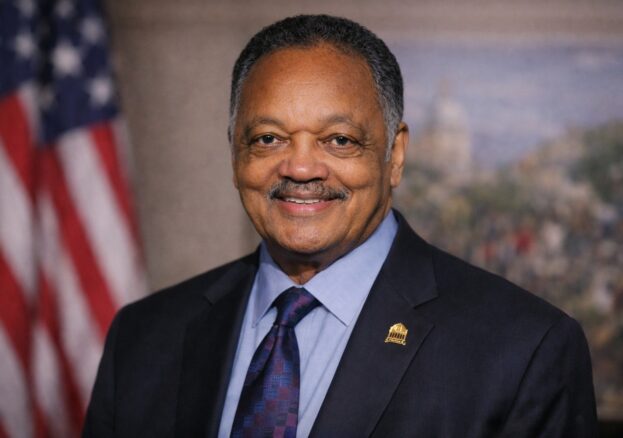
Reverend Jesse Louis Jackson Sr., one of the most prominent figures of the American civil rights movement and a two-time candidate for the US presidency, has died at the age of 84.
Jackson died peacefully on Tuesday morning surrounded by his family, according to a statement released by the Rainbow PUSH Coalition.
“It is with profound sadness that we announce the passing of Civil Rights leader and founder of the Rainbow PUSH Coalition, the Honorable Reverend Jesse Louis Jackson, Sr,” the family said.
“He died peacefully on Tuesday morning, surrounded by his family.”
No official cause of death has yet been confirmed.
Jackson had been diagnosed with Parkinson’s disease in 2017 and was hospitalised last November after doctors confirmed he had a degenerative neurological condition known as progressive supranuclear palsy.
A Life Shaped by the Civil Rights Movement
Born on 8 October 1941 in Greenville, South Carolina, Jackson grew up under the system of racial segregation that defined life in the American South during the Jim Crow era.
He became politically active while still a student, attending the University of Illinois before transferring to North Carolina A&T State University, one of the United States’ historically Black colleges. It was during this period of sit-ins and student protests that he became involved in the civil rights movement.
By the mid-1960s, Jackson had joined Dr Martin Luther King Jr’s Southern Christian Leadership Conference (SCLC). He rose quickly within the organisation and was present in Memphis, Tennessee, in April 1968 when King was assassinated.
King’s death marked a turning point in the movement, and Jackson would go on to become one of the most visible leaders of the generation that followed.
Building Institutions for Political Change
In 1971, Jackson founded Operation PUSH (People United to Save Humanity), an organisation focused on economic empowerment, voter registration and corporate accountability.
A decade later, he established the National Rainbow Coalition, bringing together African Americans, Latinos, labour unions, farmers and other marginalised groups under a broad political alliance. The two organisations later merged to form the Rainbow PUSH Coalition.
Through these initiatives, Jackson sought to translate the moral demands of the civil rights era into sustained political and economic influence. Voter registration drives and campaigns for minority representation became central to his work.
The Jackson family said his “unwavering commitment to justice, equality, and human rights helped shape a global movement for freedom and dignity”.
They described him as a “tireless change agent” who mobilised millions of Americans to register to vote, leaving “an indelible mark on history”.
Historic Presidential Campaigns
Jackson twice sought the Democratic Party’s nomination for President of the United States, in 1984 and 1988.
At the time of his first campaign, a Black candidate mounting a serious national bid was widely regarded as unlikely to succeed. Jackson nevertheless won several primary contests and secured millions of votes.
By 1988, his campaign had gained greater momentum. He won multiple states and finished second in the overall delegate count.
Although he did not secure the nomination, his campaigns expanded minority representation within the Democratic Party and demonstrated the viability of multiracial political coalitions at a national level.
Many political historians have credited Jackson’s campaigns with reshaping internal party rules and broadening participation, particularly among Black and working-class voters.
International Advocacy and Later Years
Beyond domestic politics, Jackson was active internationally. Over the decades, he undertook diplomatic missions, advocated for the release of hostages and spoke out against apartheid in South Africa.
His role as an unofficial envoy sometimes drew criticism, but it reflected his belief that civil rights were inseparable from global human rights concerns.
In 2017, Jackson publicly announced that he had been diagnosed with Parkinson’s disease, describing it as a “physical challenge”. Despite health difficulties, he continued to appear at public events and remained engaged in civil rights advocacy.
His father, Noah Louis Robinson, also had Parkinson’s disease and died in 1997.
In November last year, Jackson was hospitalised for observation after doctors confirmed he had progressive supranuclear palsy, a rare degenerative neurological condition.
Family Tribute
In their statement, the Jackson family emphasised his lifelong commitment to justice.
“Our father was a servant leader – not only to our family, but to the oppressed, the voiceless, and the overlooked around the world,” they said.
“We shared him with the world, and in return, the world became part of our extended family.”
They called on supporters to honour his memory by continuing the fight for the values he championed.
“His unwavering belief in justice, equality, and love uplifted millions, and we ask you to honour his memory by continuing the fight for the values he lived by.”
Jackson is survived by his wife, Jacqueline; their children Santita, Jesse Jr., Jonathan, Yusef and Jacqueline; daughter Ashley Jackson; and grandchildren.
Public observances will be held in Chicago. Final arrangements for celebration of life services will be released by the Rainbow PUSH Coalition.
A Defining Figure of a Generation
Jesse Jackson’s political career spanned more than six decades, linking the era of Martin Luther King Jr to contemporary debates about voting rights, representation and economic justice.
He remained one of the most recognisable voices of the American civil rights movement long after its legislative victories of the 1960s.
For many, his life symbolised the evolution of the struggle for equality — from protest marches to ballot boxes, from segregation battles to presidential primaries.
With his passing, the United States loses one of the last major figures directly connected to the leadership circle of Dr King and the defining campaigns of the modern civil rights era.