
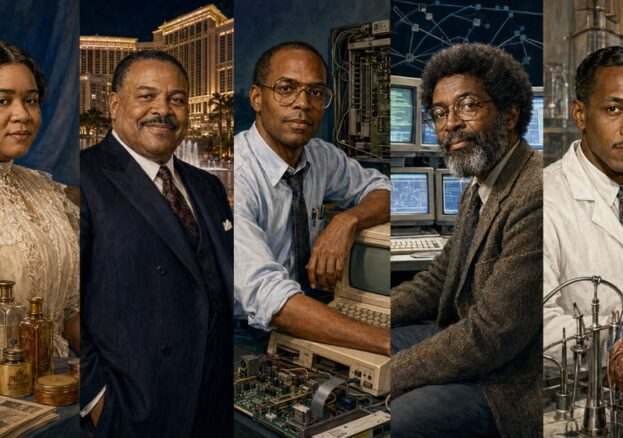
Some people achieve remarkable success within an industry. Others change the way that industry works.
Across business, technology, medicine, beauty and entertainment, African Americans have repeatedly developed ideas, systems and techniques that went far beyond personal achievement. Their work created new opportunities, challenged established barriers and, in some cases, helped establish standards that remain influential today.
Their stories are also reminders that innovation is rarely just about having a good idea. It requires expertise, persistence and the ability to keep moving forward when recognition and opportunity are not equally available.
Beauty & Business: Madam C. J. Walker
Born Sarah Breedlove in Louisiana in 1867, Madam C. J. Walker became one of the most important entrepreneurs of the early twentieth century.
Walker was born to formerly enslaved parents and was orphaned while still a child. After working for years as a laundress, she began experiencing problems with her scalp and hair loss. At a time when the mainstream beauty industry largely ignored the specific needs of Black women, Walker recognised both a personal problem and a significant business opportunity.
She developed and marketed a range of hair and scalp-care products specifically for African American women. Walker did not invent the hot comb, as is sometimes claimed, but she helped build a much wider system of Black hair care that combined products, grooming techniques, education and entrepreneurship.
Her greatest innovation may have been the business organisation that grew around her products.
Walker trained thousands of women as sales agents, giving them the knowledge and tools to sell directly within their communities. Her representatives were not simply selling beauty products. For many, the work provided a route towards financial independence at a time when employment opportunities for Black women were severely restricted.
She also encouraged her agents to become active in their communities, supporting charitable causes and campaigns for racial equality.
By the time of her death in 1919, Walker had built a national company and accumulated considerable wealth. She is widely recognised as America’s first self-made female millionaire.
Her legacy extends well beyond cosmetics. She demonstrated that Black consumers represented a powerful market and that Black women could build, manage and expand businesses on a national scale.
Gaming & Ownership: Don Barden Breaks a Las Vegas Barrier
Don Barden built his career by entering industries where African American ownership at the highest levels was rare.
Born in Detroit in 1943, Barden worked across real estate, cable television and broadcasting before moving into the gaming industry. His career was characterised by a willingness to pursue opportunities in sectors that historically had very few Black owners.
In the 1990s, Barden expanded into casino gaming through developments in Indiana. His most significant breakthrough came in 2002 when his company acquired Fitzgeralds Casino & Hotel in downtown Las Vegas.
The acquisition made Barden the first African American to wholly own a casino in Las Vegas.
That distinction mattered in a city whose history had long reflected the contradictions of American race relations. Black entertainers had helped make Las Vegas an international entertainment destination, yet African Americans were frequently excluded from ownership and, during earlier decades, from many of the city’s leading hotels and casinos.
Barden’s achievement therefore represented more than another business acquisition. It placed a Black entrepreneur at the ownership level of one of America’s most visible entertainment industries.
The gaming industry Barden entered has changed considerably since then. Technology has moved an increasing part of the sector online, with regulated operators allowing customers to access a casino digitally alongside the traditional land-based model.
But whether gaming takes place in a physical resort or through digital platforms, ownership remains a significant measure of economic influence. Barden’s career demonstrated the importance of moving beyond participation in an industry towards having a stake in the businesses and institutions that shape it.
He died in 2011, leaving behind a career that stretched across broadcasting, property and gaming, as well as a significant place in African American business history.
Technology & Computing: Mark Dean and the Architecture of the Personal Computer
Every time someone connects a device to a computer, part of the story leads back to engineers who helped establish the architecture of modern personal computing.
Among them is Dr Mark Dean.
Born in Tennessee in 1957, Dean joined IBM in 1980 and became a key member of the team involved in developing the IBM personal computer.
Dean holds three of the nine patents associated with the original IBM PC. One of his most important contributions was his work on the computer’s bus architecture — the system that enabled different components and peripheral devices to communicate with the machine.
This helped make it possible for computers to connect with equipment such as printers, disk drives and monitors while allowing other manufacturers to develop compatible hardware.
That principle of expandability became fundamental to the development of the personal computer industry.
Dean later led the team responsible for developing IBM’s first colour PC monitor and continued working on increasingly powerful computer technologies. In 1996, he became the first African American to be named an IBM Fellow, the company’s highest technical distinction.
His career illustrates something easily overlooked in the history of technology: many of the systems that eventually become ordinary parts of everyday life originate in highly specialised engineering work carried out years earlier.
Collaborative Computing: Dr Clarence “Skip” Ellis
While Mark Dean helped shape the physical architecture of computing, Dr Clarence “Skip” Ellis helped develop ideas that would influence how people use computers together.
Born in Chicago in 1943, Ellis developed an early fascination with computers and went on to become the first African American to earn a PhD in computer science.
During his career, he worked at some of the most important computing research institutions in the United States, including Xerox PARC.
Ellis became a pioneer in an area now known as computer-supported cooperative work — the study and development of systems that allow groups of people to collaborate through computers.
He contributed to research surrounding OfficeTalk, an early experimental office system that explored how multiple people could create, edit and share information electronically.
Today, collaborative technology is so common that it is easy to forget how revolutionary the concept once was. Shared documents, cloud-based workspaces and platforms that allow colleagues in different locations to work on the same material in real time are now central to modern working life.
Ellis’s research helped establish some of the concepts upon which this collaborative world was built.
His achievement was particularly significant given how few Black researchers had access to elite computer-science institutions during the early decades of the industry.
Medicine: Vivien Thomas and the Birth of Modern Heart Surgery
Few medical careers demonstrate the difference between official title and practical expertise as powerfully as that of Vivien Thomas.
Born in Louisiana in 1910 and raised in Tennessee, Thomas originally hoped to study medicine. The economic consequences of the Great Depression, however, made medical school financially impossible.
Instead, in 1930 he began working as a laboratory assistant to surgeon Alfred Blalock at Vanderbilt University.
Thomas quickly proved to be an exceptionally skilled surgical researcher.
When Blalock later moved to Johns Hopkins Hospital, Thomas went with him. There, Thomas played a crucial role in developing an operation for children suffering from a serious congenital heart condition that caused dangerously low levels of oxygen in the blood.
The condition became widely known as “blue baby syndrome” because affected children could develop a bluish appearance to their skin.
Working in the laboratory, Thomas developed and repeatedly tested the surgical technique that would eventually be used on human patients. He also designed and adapted instruments necessary for the procedure.
In 1944, when Blalock performed the groundbreaking operation on a young patient named Eileen Saxon, Thomas stood behind him in the operating theatre, guiding him through a procedure that Thomas himself had spent years developing experimentally.
The operation became a landmark in the history of cardiac surgery.
Yet Thomas performed this extraordinary work in an era of segregation and discrimination. Despite carrying out research and surgical work of enormous complexity, he was initially classified and paid as a laboratory worker rather than being recognised at a level that reflected his expertise.
His contribution eventually received greater acknowledgement. Johns Hopkins appointed him to its medical school faculty, and in 1976 the university awarded him an honorary Doctor of Laws degree.
Thomas’s influence can still be seen in cardiovascular surgery and surgical training. His story is not simply about an overlooked individual finally receiving recognition. It is about the expertise that helped create an entirely new era of heart surgery.
Innovation Changes More Than One Life
Madam C. J. Walker, Don Barden, Mark Dean, Clarence Ellis and Vivien Thomas worked in very different fields.
What connects them is the scale of their influence.
Walker did not simply sell hair products; she built a national network of Black female entrepreneurs.
Barden did not simply enter the gaming business; he broke a significant barrier in casino ownership.
Dean helped create technologies that enabled the personal computer to become expandable and useful far beyond its original configuration.
Ellis explored forms of digital collaboration decades before shared online working became part of everyday life.
Thomas developed surgical methods that helped transform the treatment of children with congenital heart disease.
Black history contains countless examples of people succeeding despite barriers. But these stories reveal something more: African Americans have not simply participated in the development of modern industries. They have repeatedly helped build, redefine and transform them.
Further Reading
- Smithsonian National Museum of African American History and Culture — Madam C. J. Walker
- IBM — The history and work of Dr Mark Dean
- Johns Hopkins University — Vivien Thomas and the development of cardiac surgery
- University of Illinois Urbana-Champaign — Clarence Ellis
- Black History Month UK — Remembering Don Barden: The First African American to Own a Las Vegas Casino