
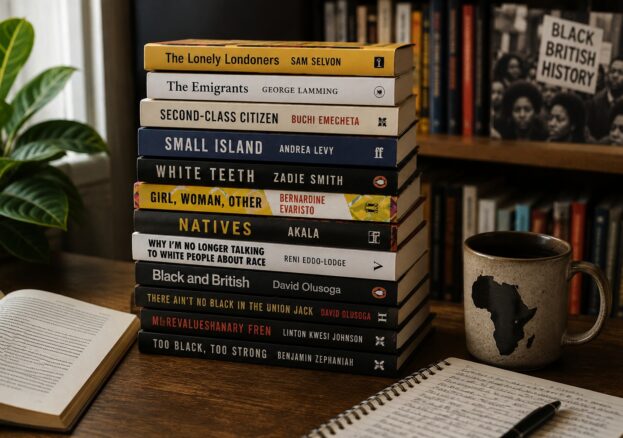
Britain likes to think of itself as a nation of tolerance, fairness and quiet decency. It remembers the Second World War with pride, celebrates abolition as proof of moral leadership, and speaks comfortably about multiculturalism as though racial progress were inevitable. Yet Black British literature has consistently exposed the gap between the stories Britain tells about itself and the realities experienced by Black communities across generations.
These books matter because they refuse silence.
They document the emotional cost of migration, the violence of racism, the loneliness of exclusion, and the contradictions at the heart of British identity. They reveal how empire shaped modern Britain long after the Union Jack stopped flying over colonial territories. They force readers to confront the fact that Black history is not separate from British history, but central to it.
For decades, many of these writers existed at the margins of British literary culture. Black authors were often treated as outsiders, their work labelled “political” or “niche” rather than recognised as essential contributions to understanding Britain itself. Yet it was precisely because these writers spoke from the margins that they saw the country more clearly than many of its celebrated establishment voices.
Long before conversations about diversity entered publishing houses and university panels, Black British writers were documenting the realities of empire and its aftermath.
Sam Selvon’s The Lonely Londoners remains one of the defining novels of post-war Britain. Published in 1956, it follows Caribbean migrants attempting to survive in London while navigating racism, poverty and isolation. Selvon captured the exhaustion and humour of migrant life with remarkable honesty, but what made the novel revolutionary was its language. By writing in Caribbean dialect rather than standard literary English, Selvon challenged assumptions about whose voices belonged within British literature.
George Lamming explored similar themes in The Emigrants, examining the psychological dislocation experienced by Caribbean migrants arriving in what they had been taught to see as the “Mother Country”. Colonial education had encouraged generations to admire Britain, yet many migrants discovered that admiration was not returned. Lamming understood that empire did not simply occupy land — it shaped identity, self-worth and belonging.
Few writers exposed the realities of Black womanhood in Britain more powerfully than Buchi Emecheta. Her novel Second-Class Citizen remains one of the most important books ever written about migration and survival in modern Britain. Emecheta wrote with extraordinary clarity about race, poverty, sexism and loneliness, showing how Black women were expected to carry impossible burdens while remaining invisible within public life.
These books challenged the idea that Britain was naturally welcoming or inclusive. They documented the everyday humiliations that shaped Black life: landlords refusing tenants, schools lowering expectations, employers shutting doors, police treating Black communities with suspicion. Yet they also revealed resilience, humour, friendship and community.
Andrea Levy’s Small Island later brought many of these histories into mainstream public consciousness. Through the lives of Jamaican migrants arriving in post-war Britain, Levy exposed the emotional contradictions of Windrush Britain. Caribbean families arrived believing they were citizens of the empire, only to encounter hostility from the very country they had helped rebuild after the war.
What made Levy’s writing so effective was its humanity. She avoided simplistic moral lessons and instead showed how ordinary people become shaped by larger political systems. Her work forced Britain to confront histories it had too often reduced to nostalgia.
Poetry also became a vital form of resistance.
Linton Kwesi Johnson transformed British poetry through dub verse rooted in Jamaican patois and reggae rhythms. His work documented police brutality, racism and political struggle during the 1970s and 1980s with a force that mainstream institutions found difficult to ignore. Johnson’s poetry did not seek approval from the establishment. It spoke directly from Black working-class experience, exposing the violence beneath Britain’s claims of civility.
Benjamin Zephaniah later brought poetry into classrooms, youth centres and public life in ways few writers had managed before. Funny, accessible and politically sharp, Zephaniah connected with generations of young readers who rarely saw themselves reflected in traditional literary education. He understood that literature belonged to ordinary people, not simply academic institutions.
By the turn of the twenty-first century, Black British literature increasingly reflected the complexity of multicultural Britain itself.
Zadie Smith’s White Teeth captured the chaos, tension and hybridity of modern London through interconnected Jamaican, Bangladeshi and English families. The novel rejected simplistic ideas about identity and belonging, showing Britain as a place shaped by migration, empire and constant reinvention.
Bernardine Evaristo’s Girl, Woman, Other later expanded that vision further, centring Black British women whose lives had often remained invisible within mainstream literary culture. Through interconnected stories spanning generations, Evaristo demonstrated that Black Britain was never a single experience or identity.
At the same time, political writers began confronting Britain more directly about race, empire and inequality.
Akala’s Natives became one of the defining books of modern Britain because it connected personal experience to wider political history. Writing about education, policing, class and empire, Akala challenged the idea that racism existed only in isolated incidents rather than within the structures of British society itself.
Reni Eddo-Lodge’s Why I’m No Longer Talking to White People About Race sparked national debate because it addressed conversations Britain had long tried to avoid. The book forced many readers to confront how deeply race shaped British institutions and public life.
David Olusoga’s Black and British similarly dismantled the myth that Black history began with Windrush. Through careful historical research, Olusoga demonstrated that Black presence in Britain stretches back centuries and is inseparable from the story of empire itself.
Together, these books reveal something uncomfortable but necessary: Britain cannot fully understand itself without confronting the realities of colonialism, migration and race.
That is why Black British literature matters so deeply.
These writers did not simply add diversity to Britain’s bookshelves. They challenged the nation’s memory. They questioned its myths. They forced Britain to confront the gap between what it claimed to be and what many people actually experienced.
Even now, many of these conversations remain unfinished. Schools still teach narrow literary canons. Publishing remains unequal. Black writers continue to fight for visibility within institutions that often celebrate diversity symbolically while resisting deeper structural change.
Yet the existence of these books itself represents a form of resistance.
They preserve histories Britain attempted to forget. They document voices that institutions tried to marginalise. They insist that Black experiences are not footnotes to British history, but part of the national story itself.
These books matter not only because they tell Black stories.
They matter because they tell the truth about Britain.