
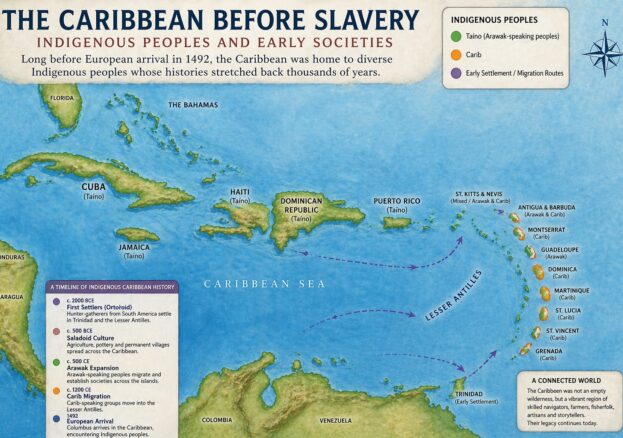
In October 1492, as European ships approached Caribbean shores, they were not entering an empty world, but one already shaped by centuries of migration, settlement and cultural exchange. Long before colonisation and the transatlantic slave trade, the Caribbean was home to diverse Indigenous societies whose histories stretched back thousands of years.
Understanding who lived in the Caribbean before slavery means tracing a long story of movement — from the first settlers to the complex societies encountered by Europeans.
A Timeline of Indigenous Caribbean History
- 2000 BCE — First Settlers (Ortoiroid)
Migrated from South America (Orinoco region). Lived as hunter-gatherers and settled in Trinidad and the Lesser Antilles. - 500 BCE — Saladoid Culture
Brought agriculture and pottery. Established permanent villages and spread across much of the Caribbean. - 500 CE — Arawak Expansion
Arawak-speaking peoples spread widely, developing structured societies and forming the foundation of later Caribbean cultures. - 1200 CE — Carib Migration
Carib-speaking groups moved into the Lesser Antilles, creating new cultural and political dynamics. - 1492 — European Arrival
Christopher Columbus reaches the Caribbean, encountering Taíno and other Indigenous peoples.
Mapping the Indigenous Caribbean
The Caribbean before slavery can be broadly understood across regions.
The Greater Antilles — including Haiti, the Dominican Republic, Cuba, Jamaica and Puerto Rico — were largely home to the Taíno, who were part of the wider Arawak world.
The Lesser Antilles — including Dominica, St Vincent and Grenada — were associated with Carib communities.
The southern Caribbean, including Trinidad and the nearby mainland coast of South America, reflects early migration routes and continued Indigenous presence.
This was not a fixed map, but a connected world shaped by movement, trade and interaction.
The First Peoples of the Caribbean
The earliest inhabitants, known as the Ortoiroid, arrived around 2000 BCE. They lived by fishing, hunting and gathering, moving between coastal sites and islands.
Their presence marked the beginning of human life in the Caribbean and laid the foundations for later societies.
The Rise of Agricultural Societies
From around 500 BCE, the arrival of Saladoid peoples transformed Caribbean life. They introduced farming, particularly cassava cultivation, and established more permanent settlements.
Their pottery and village structures reflect a more complex and organised society that spread across the islands.
The Arawak World and the Taíno
From around 500 CE onwards, Arawak-speaking peoples spread across the Caribbean. They developed structured societies based on agriculture, trade and leadership.
The most well-known of these groups were the Taíno, who lived across the Greater Antilles. By the late 15th century, they had become the dominant Indigenous population in the region.
The Caribs and the Eastern Caribbean
From around 1200 CE, Carib-speaking groups moved into the Lesser Antilles. Their arrival added new layers to the Caribbean’s cultural and political landscape.
While often portrayed in European accounts as aggressive, modern scholarship suggests a more complex picture involving both conflict and exchange.
What Changed After European Arrival?
The arrival of Europeans in 1492 marked a turning point.
Spanish colonisation introduced forced labour, violence and disease. Indigenous populations declined rapidly in the decades that followed.
At the same time, the transatlantic slave trade began, bringing millions of Africans to the Caribbean and transforming the region.
Indigenous Legacy in the Caribbean Today
Despite the impact of colonisation, Indigenous peoples did not disappear.
Their legacy continues through language, place names, cultural traditions and ancestry. Communities such as the Kalinago of Dominica and the Garifuna maintain direct links to this history.
Why This History Matters
The Caribbean did not begin with slavery.
It was already a region shaped by Indigenous knowledge, migration and culture. Recognising this history is essential to understanding the Caribbean as it exists today.