
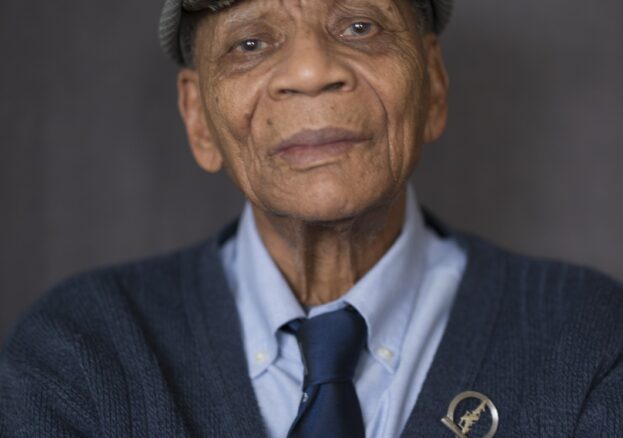
Born and raised in Little London, Jamaica, and a descendant of a Scottish military doctor who settled there, Ralph joined the RAF in 1944, hoping to become an Air Gunner. His journey to serve took him from Jamaica to the USA. There, while awaiting transport to England at a camp in Virginia, he had a unique experience.
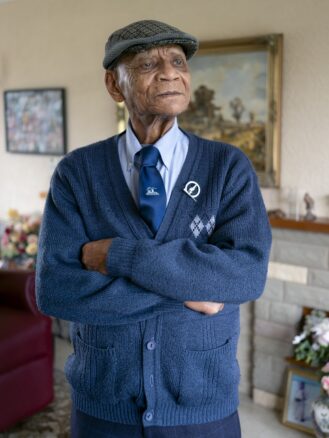 Ralph and his fellow Jamaican recruits were billeted in the white section of the segregated American military camps. “We were in the white American side,” he recalled. “This was a very rare thing because the Black camp was out of bounds to us… We saw very little of black American soldiers”. Despite this, Ralph remembers the American troops’ treatment of them positively. “They took us in as what we were, we were fellow soldiers and that was it. We enjoyed ourselves and it was alright”. From America, he continued his journey across the Atlantic to England in a vast convoy.
He recalls the rigorous 13-week training in Filey, Yorkshire. “They trained us from being young civilian, young men, into soldiers who could look after themselves and kill somebody”. He remembered a particularly tough part of the training called the ‘Burma Road’, where they had to cross a river with all their equipment. “That was the hardest thing that we had to do… If you can’t learn to do that, you’re a liability to your friends”.
When the time came for his posting, his aspiration to be a Gunner faced a hurdle. An officer told him, “What we need is motor drivers”. Ralph was assigned as a driver and soon understood the reasoning. “Because we spoke English, we can write English, most of us are highly qualified in the language. So putting us in that position, meant less training time”. The quality of his work was noticed and he was made the driver for a senior officer in the renowned 617 Squadron (the Dambusters). Ralph recalls, “He was the man who says ‘This aircraft isn’t ready to go on operation. It will be ready when I say it is ready’”. Ralph found himself at the heart of vital operations.
Life in the squadron was marked by a strong sense of camaraderie. When aircraft did not return, “the camp mourns because we are all in it”.
Ralph was always looking to improve himself. “During my downtime, I took on a course in accountancy.” He also had the chance to play cricket, a sport in which he was a very talented fast bowler.
Ralph clearly remembers VE Day while serving with 617 Squadron at Woodhall Spa: “It was quite a day!”. With the war in Europe concluded, plans were underway for the Squadron to relocate to the Far East for the invasion of Japan. Ralph was training to be an Air Gunner, when news broke of Japan’s surrender.
After being demobbed, Ralph received an RAF scholarship to train in Business Studies and returned to Jamaica. There, he worked to improve his community, including building a rice mill. He then began training as a manager for Tate and Lyle. Despite his boss’s efforts to keep him in Jamaica, a promise made in England called him back. “He did everything in his power to keep me there, but I had a pull in England, which was greater than them, and that was the girl who I married. Because I promised her that I would…”. He returned to the UK to marry his fiancée, making a new and successful life in England.
Ralph reflects on his service, “What I learned in the RAF has stood me in good stead all through my life”. He learned many things, including a key skill: “The one thing I learned… to listen. You have to listen”. He concludes, “I was ready to play my part, I volunteered. I don’t regret it; I don’t regret one minute of it. It changed my life”.
Ralph passed away in May 2026 at the age of 102.