
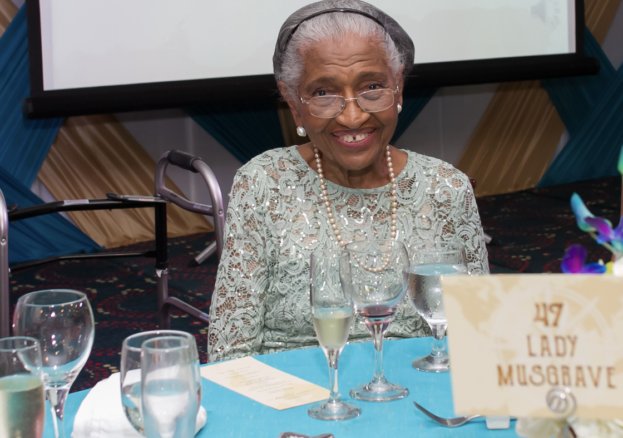
Born in Spanish Town, Jamaica, in 1917 Ena Joyce St Clare Collymore was a pioneer from the beginning of her working life. At age 20, she brazenly responded to an advertisement for a ‘Male Clerk‘ by applying for a job as an administrative clerk in a magistrate’s court in Spanish Town. No women worked there – they were not permitted to sit on juries until 1945.
Ena recalled people dropping by out of curiosity to see “this young miss who applied for the job of male clerk”. She would return as Resident Magistrate 22 years later, the first Jamaican woman to hold judicial office.
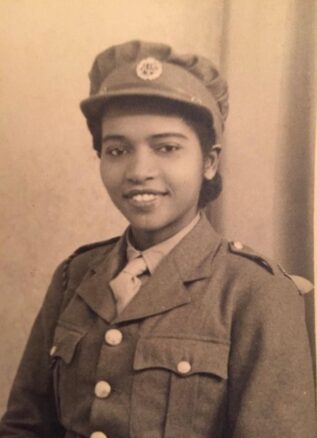
In 1943, Ena was one of the first women to leave the Caribbean to volunteer in WWII. They sailed to England, surviving a torpedo attack on the way. On arrival, Ena joined the Auxiliary Territorial Service (ATS), the women’s branch of the British Army, and she was sent with other female recruits to a training base in Surrey, where they lived in freezing accommodation and were trained in military drill. She was assigned the role of stenographer, but this didn’t suit her adventurous spirit.
“There was an overall enthusiasm to be part of the War effort, I wanted to do my part… I wanted more responsibility and more action… I didn’t come here to do what I was doing at home.”
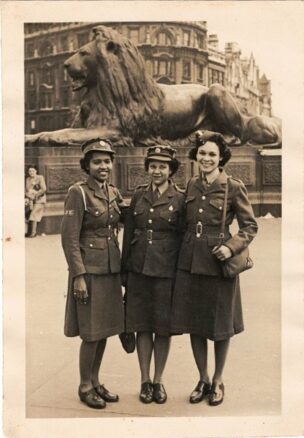 Eventually the War Office heeded her requests for more challenging work and sent her to an evaluation unit where Ena opted to join the Anti-Aircraft Corps and became a radar operator, plotting the movements of Allied and enemy aircraft. She was the first Black woman to serve as a radar operator in the British Army, at first in Oswestry and she was later posted to Belgium.
Around 600 Caribbean women volunteered to join the ATS in the war. Following her demob in 1946, Ena took a secretarial job in the War Office while studying for a law degree and would go on to achieve a series of firsts in the field of law.
She was the first Black woman to train at Gray’s Inn to become a barrister and was called to the bar in 1948. On her return to Jamaica, she was appointed Clerk of Courts for St. James Parish – the first woman to hold that post. In 1953 she was the first woman to be appointed as Assistant Crown Solicitor. Then in 1959, Ena became Jamaica’s first woman to hold judicial office when she was appointed a Resident Magistrate.
In 1951 Ena had married and went on to have three children. Maternity leave was not for her. When she became the first woman to sit on the bench in 1959, the Gleaner, Jamaica’s leading newspaper, marvelled that she “combines the two demanding worlds of homemaking and career”. Her son would travel with her in his bassinet to courts around the island and later her children would sit at her feet and listen as she passed judgment.
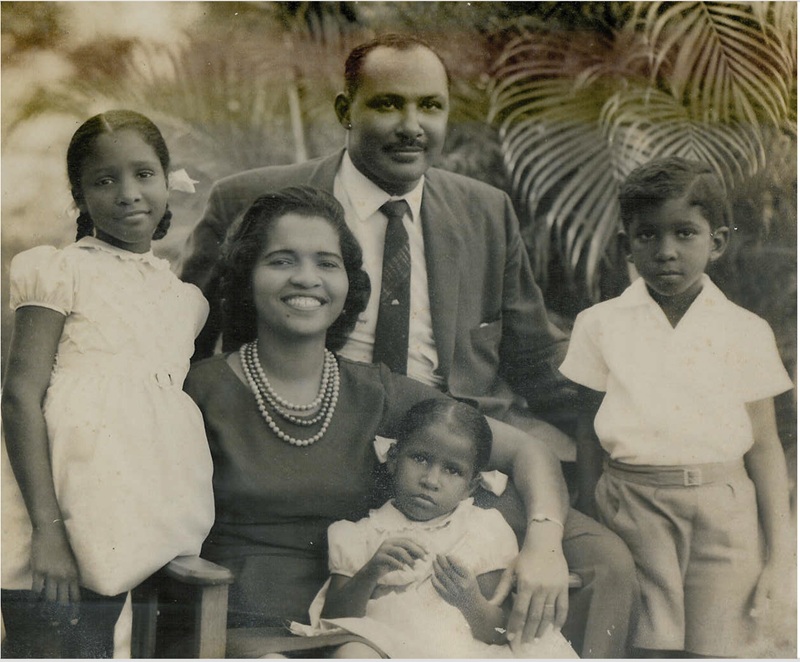
When juvenile courts were introduced on the island in 1964, Ena served as its chair. Having studied the psychology of juvenile delinquents, she believed in youth rehabilitation and helped to shape Jamaica’s child justice framework. Her judicial role extended beyond Jamaica to the wider Caribbean working in the Cayman Islands, the Turks and Caicos Islands, Montserrat and Anguilla.
Throughout this time, she was also very active in the Girl Guides and served for 10 years as Chief Commissioner for Jamaica, for which she was appointed an MBE. She was also president of the Caribbean area council for Soroptimist International, a global women’s volunteering organisation, working to improve the status of women and children in the Caribbean. She was instrumental in forming clubs in the Turks and Caicos Islands, Anguilla and St Vincent and the Grenadines.
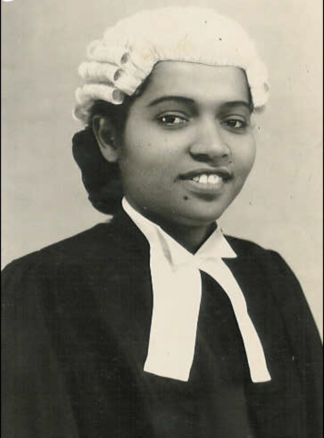
Ena’s legacy in law, advocacy and community involvement has continued with all her children being involved in community work, and through three generations of lawyers. Her daughter is a Kings Counsel, two granddaughters are lawyers (in Jamaica and Barbados), her grandson a lawyer in Florida and a granddaughter who is a social worker and licensed therapist. Her first granddaughter, Amanda Riley-Jordan, from the family’s third generation of lawyers, said that community spirit was a huge theme of Ena’s life, a lesson in “selflessness” that Ena had passed down. “You cannot have a full life if you are only living for yourself,” she said.
Ena Collymore-Woodstock’s remarkable life was defined by determination, strength and a pioneering attitude, enabling her to succeed while serving in the British Army and in the legal profession. She consistently opened doors for others to follow. She was the oldest female veteran of the British Army at the time of her passing in December 2025. Her 108 years spanned periods of profound social change, and through her many achievements she not only witnessed history but helped to shape it.