
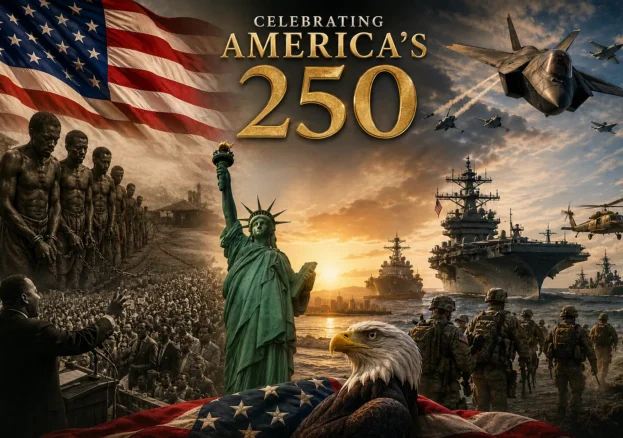
As America approaches its 250th anniversary, the first word that comes to mind is contradiction. I feel pride and pain, gratitude and disappointment, shame and possibility. I am the child of a single Black mother, a military veteran, a business owner, a taxpayer, a community servant, a voter, and I’m blessed.

I am grateful for the First Amendment and for the freedom to speak openly and honestly. At the same time, I am troubled by the nation’s continued struggle with violence, including the civilian access to military-style weapons that contributes to the tragedy of mass shootings. These realities make it impossible for me to view America’s milestone with simple celebration or condemnation.
When the Declaration of Independence was signed in 1776, millions of Africans were enslaved. The nation’s founding ideals of liberty and equality existed alongside an economy and political system deeply tied to slavery. This contradiction has shaped the American story from the beginning.
At the 1787 Constitutional Convention, slavery was preserved through political compromise. For Southern states, the protection of slavery was a condition for joining the new nation.
The Three-Fifths Clause counted three-fifths of the enslaved population for taxation and representation in the House of Representatives. This gave slaveholding states disproportionate political power, which they used to protect and expand their interests until and after the Civil War.
The 1800 and 1900s the Civil War ended slavery, but it did not end the struggle for full citizenship. Reconstruction briefly opened the door to Black political participation, education, and public leadership. Yet that progress was violently resisted and eventually undermined by Jim Crow laws, racial terror, voter suppression, and economic exclusion. These realities sustain a system that denied Black people their humanity while building white generational wealth. We never that 40 acres and a mule.
The Civil Rights Act of 1964 was a landmark federal law that prohibited discrimination in public accommodations, employment, education, and federally funded programs. When I reflect on this period in American history, the term “stand up and fight” come to mind. Black Americans finally had national leaders and local organizers who forced the country to confront its own hypocrisy. Dr. Martin Luther King Jr., Medgar Evers, Malcolm X, Fannie Lou Hamer, and countless unnamed men and women helped move the struggle from private suffering into public demand.
Yet even after new laws were passed, many Southern states resisted change, racial violence continued, and true equality remained unfinished. Desegregation opened doors that had long been locked, but it also brought painful tradeoffs for Black communities. Minority-owned businesses, schools, and institutions that had served as centers of independence and pride struggled or disappeared as larger white-owned corporations gained access to the Black consumers.
The 1970s and the Age of Blaxploitation marked a complicated moment in Black American life and culture. The Blaxploitation films of the early to mid-1970s featured Black actors, urban settings, funk and soul music, and stories aimed largely at Black audiences.
On one hand, these films gave Black viewers images of confidence, style, independence, and power at a time when Hollywood had often ignored or minimized Black life. For many people, the era seemed to say, “We are finally visible. We can move beyond the ghettos, buy homes, work federal and corporate jobs, build wealth, and become part of the middle class.” This turned out to be a diabolical deception.
At the same time, Blaxploitation was controversial because it often packaged Black struggle for profit. Films such as Super Fly, Shaft, Cotton Comes to Harlem, and The Mack created memorable Black characters, but they also frequently centered pimps, drug dealers, hustlers, violence, and crime.
This created a dangerous double message: Black people were finally being seen on screen, but too often through images that could teach young people to admire survival through exploitation and crime instead of power through ownership, education, family, and community leadership.
The 1980s, 1990s, and 2000s: The War on Drugs became one of the most destructive policies to hit Black community. The War on Drugs refers to the government’s long campaign of aggressive policing, harsh sentencing, and increased incarceration for drug-related offenses. Although drug use existed across racial and economic lines, enforcement fell heavily on Black and Brown neighborhoods. Mandatory minimum sentences, the harsh punishment of crack cocaine compared with powder cocaine, and the growth of the prison industrial complex helped turn addiction and poverty into criminal justice issues instead of public health issues.
The result was generational damage: fathers, sons, mothers, and daughters removed from families; communities destabilized; voting rights and job opportunities lost; and millions of people marked by criminal records long after their sentences ended. During the age of mass incarceration, the lifetime likelihood of imprisonment for Black men reached one in three, showing how deep this policy era shaped Black life in America. And please believe when I tell you the effects are still felt today.
With all this said America remains a country that inspires people around the world. our first world nation provides us with access to clean us clean water ,24/7 electricity, plenty of restaurants and grocery stores, paved roads , transportation, education and first-class health care.
Many Black Americans recognize the immense progress that has been made, refusing to ignore the cost of that progress. We can worship freely, vote, serve, lead, build businesses, create art, challenge injustice, and help shape the future of this nation. That progress did not come easily; it was won through sacrifice, courage, protest, faith, and persistence.
As I reflect on America at 250, I do not see a perfect nation. I see it wrestling with its promises. I see a country capable of both cruelty and greatness, exclusion and opportunity, hypocrisy and hope. My patriotism is not blind. It is rooted in memory, responsibility, and the belief that love of country includes the courage to tell the truth about it.
Our nation’s story is unfinished. Its next chapter depends on whether we are willing to confront the past honestly, protect the rights we claim to value, and extend the promise of freedom to every person. That is where my pride, pain, and possibility meet.