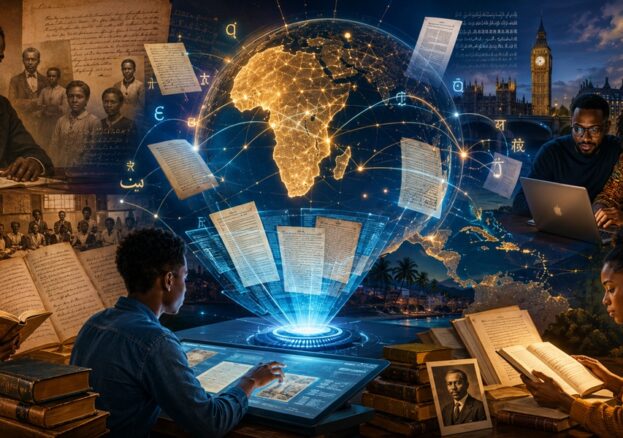
Knowledge has never been evenly distributed, and one of the oldest barriers to sharing it has been language. For Black history in particular, vital records, scholarship, and stories are scattered across many languages: French, Portuguese, Spanish, Arabic, Swahili, Creole, and countless others spoken across Africa, the Caribbean, and the wider diaspora.
A great deal of important history sits locked away from those who cannot read the language it was written in. Today, a new generation of AI translation tools is beginning to dismantle that barrier, opening up global knowledge in ways that carry real significance for understanding our shared past.
The Hidden Cost of the Language Barrier
When we think about access to history, we often picture archives, libraries, and the cost of education. Language is the barrier we tend to overlook, yet it is one of the most significant. A researcher in Britain exploring the history of the transatlantic slave trade, for example, will quickly encounter crucial documents in French, Portuguese, Spanish, and Dutch, the languages of the colonial powers who kept those records.
For students, community historians, and curious individuals without the resources of a university behind them, this has long been a formidable obstacle. Whole bodies of scholarship and primary source material remained effectively out of reach. The result is a version of history that can feel incomplete, told disproportionately through the sources that happened to be available in one’s own language. Breaking down that barrier is about far more than convenience; it is about who gets to access and shape our collective understanding of the past.
Telling Fuller, More Honest Stories
Black history is global by its very nature. The African diaspora spans continents and centuries, and its stories are recorded in dozens of languages. The history of Haiti, the first nation born of a successful slave revolt, lives substantially in French and Haitian Creole. The histories of Angola, Mozambique, and Brazil are written in Portuguese. Records of East African history and the Indian Ocean trade exist in Arabic and Swahili.
When these sources can be translated and read widely, the history we tell becomes richer and more honest. We move beyond a single national or linguistic perspective towards something closer to the full, interconnected picture. Translation tools that make these documents accessible help ensure that the contributions, experiences, and perspectives of people across the entire diaspora can be heard, studied, and woven into the broader narrative rather than left siloed by language.
How AI Translation Tools Are Helping
The practical reality of translating documents has changed dramatically. Where once translating a lengthy historical document meant either learning the language or paying for professional translation, accessible tools now handle much of the work in moments. This matters enormously for individuals and community organisations working with limited budgets.
Many of these tools are built into software people already use. With Adobe Acrobat, for instance, you can translate a document by opening a PDF, choosing the translate option, and letting it detect the source language automatically before converting the text into your chosen language through Adobe Express. You can translate an entire document or just selected passages, adjust whether the tone reads formally or informally, preview the result, and then download or share it, all without maintaining separate versions of the file. It is worth knowing that very complex, scanned, or secured documents may not always translate cleanly, so some older archival material will still need a careful human eye. Even so, for making a readable French or Portuguese historical text accessible to an English-speaking reader, tools like this remove a barrier that once stopped many people in their tracks.
Preserving and Sharing Heritage
Translation is not only about reading the past; it is about preserving and sharing heritage for the future. Community archives, family histories, oral traditions that have been transcribed, and local records all form an irreplaceable part of Black history. Making these materials accessible across languages helps ensure they are not lost and can be appreciated by a global audience.
According to UNESCO, documentary heritage holds immense value for humanity, and widening access to it, including across language barriers, is essential to preserving collective memory and promoting mutual understanding between cultures. Translation tools contribute directly to this goal. A community organisation digitising and translating its historical records is doing important preservation work, allowing descendants and scholars anywhere in the world to connect with that heritage in their own language.
A Tool, Not a Replacement
For all their promise, it is important to approach these tools with realistic expectations and appropriate care. Automated translation, however impressive, is not flawless. Nuance, historical context, idiom, and culturally specific meaning can be lost or distorted by software that does not truly understand the material. For sensitive or scholarly work, human expertise remains essential.
The best approach treats AI translation as a powerful first step rather than the final word. It can open a door, giving someone access to a document they could never have read otherwise, and from there, human translators, historians, and community knowledge-holders can refine and contextualise the meaning. Used thoughtfully, the technology democratises initial access without displacing the deep, careful work that good history requires.
Knowledge for Everyone
The broadening of access to global knowledge is one of the quiet but profound shifts of our time. For Black history, with its inherently international and multilingual character, this is especially meaningful. Documents and stories that were once accessible only to a privileged few who happened to read the right languages are gradually becoming available to all.
This matters because history belongs to everyone, and a fuller understanding of the past makes for a richer, more empathetic present. As translation tools continue to improve and reach more people, they help bring us closer to a world where the colour of a story’s original language no longer determines who gets to hear it. That is a future genuinely worth building, one translated document at a time.