
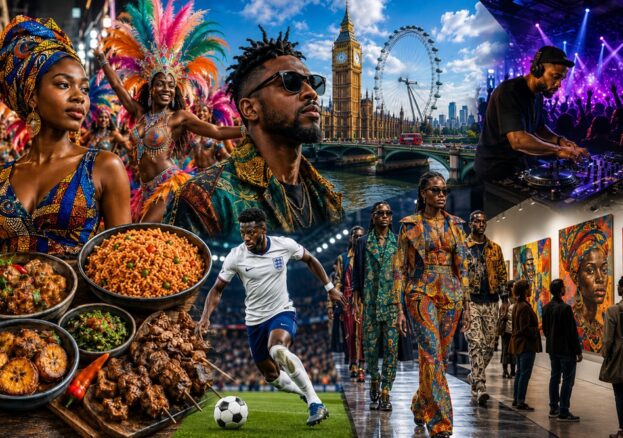
The influence of African culture can be seen across Britain’s entertainment landscape — in the music filling arenas and clubs, the food appearing on high streets, the designers shaping fashion, and the artists, writers and digital creators reaching increasingly global audiences.
These connections are not new, but they have become far more visible. Afrobeats has moved into the British mainstream, African cuisines have found wider audiences, and British-African artists and entrepreneurs are influencing everything from nightlife and fashion to publishing and digital culture.
Britain’s leisure culture has always been shaped by cultural exchange. Today, African and African-diaspora influences form an increasingly significant part of that story.
A Long History of African Presence in Britain
African presence in Britain reaches much further back than is sometimes assumed. Evidence of people of African origin can be found in Roman Britain, while Black individuals also appear in records from Tudor, Georgian and Victorian Britain.
The nature and scale of that presence changed considerably over the centuries. Britain’s involvement in the transatlantic slave trade and colonial rule created further connections with Africa and the Caribbean, while migration, education, military service, trade and employment brought people from across the African continent to Britain.
The period following the Second World War brought another major transformation. Britain experienced increased migration from Commonwealth countries as workers were recruited into sectors including transport, manufacturing and the newly established NHS.
Much of the better-known story of this period concerns Caribbean migration and the Windrush generation, whose cultural influence on modern Britain has been profound. African migration followed its own patterns, increasing substantially during the second half of the twentieth century.
By the 2001 Census, 378,933 London residents identified as Black or Black British: African.
Two decades later, African heritage is visible throughout British public and cultural life.
From Afrobeats to British Pop Culture
Perhaps nowhere has that influence become more obvious than music.
Afrobeats has developed from a collection of sounds associated particularly with West Africa into an international phenomenon. Nigerian and Ghanaian artists who might once have reached predominantly African and diaspora audiences now regularly appear on UK charts, festival line-ups and some of Britain’s biggest stages.
Artists including Burna Boy, Wizkid and Rema have performed to huge British audiences, while the UK now has an Official Afrobeats Chart reflecting the genre’s commercial importance.
British musicians have created their own hybrids.
J Hus helped bring Afroswing — combining elements of Afrobeats, rap, grime, dancehall and R&B — to a mainstream British audience. Fuse ODG played an important role in popularising Ghanaian-influenced Afrobeats and Azonto in Britain.
The result is not simply African music being imported into Britain. It is an ongoing exchange in which artists raised in London, Lagos, Accra and elsewhere borrow, reinterpret and combine sounds.
A similar process can be heard in the increasing popularity of South African amapiano, which has moved rapidly from Johannesburg and Pretoria into British clubs, festivals and playlists.
Carnival and the Wider African Diaspora
Britain’s Black cultural life cannot be understood without also recognising the distinctive contribution of the Caribbean.
Notting Hill Carnival is perhaps the clearest example.
Its roots lie primarily in Britain’s post-war Caribbean community, particularly Trinidadian carnival traditions. Claudia Jones organised an indoor Caribbean Carnival in London in 1959 following a period of severe racial tension, while Rhaune Laslett helped bring carnival celebrations onto the streets of Notting Hill during the 1960s.
Steel pan, calypso, soca, reggae and sound-system culture became fundamental parts of the celebration.
Today, however, Carnival also demonstrates how African, Caribbean and wider Black British cultures continually interact.
Alongside its established Caribbean traditions, contemporary sounds including Afrobeats and amapiano increasingly form part of the wider musical landscape surrounding Carnival and Black British nightlife.
The same exchange can be found across London.
From Peckham and Brixton to Dalston and beyond, clubs and promoters regularly build nights around Afrobeats, amapiano and other African-influenced sounds, attracting audiences extending far beyond African diaspora communities.
Music that might once have been described as specialist has become part of ordinary British nightlife.
African Food on Britain’s High Streets
Food tells a similar story.
For generations, African restaurants and food businesses served communities that knew dishes such as jollof rice, suya, egusi soup and plantain well.
What has changed is their visibility.
African cuisines are increasingly being discovered by diners outside those communities, while African restaurants, supper clubs, street-food traders and food entrepreneurs are reaching new audiences.
London remains at the centre of much of this activity, with particularly strong West African culinary communities, but African food culture is increasingly visible in cities across Britain.
Social media has accelerated that process.
A restaurant no longer needs to rely entirely on passing trade or traditional reviews. A single food video can introduce hundreds of thousands of people to a dish they may never previously have encountered.
Recipes, cooking personalities and restaurant recommendations now travel internationally within hours.
That has helped turn food into another important form of cultural exchange.
Fashion, Art and African Creativity
African influence in Britain extends far beyond music and food.
Fashion provides one of the clearest examples.
Designers with African heritage increasingly combine influences from several places at once: traditional fabrics and techniques, contemporary African streetwear, British tailoring, sportswear and London youth culture.
Designers such as Foday Dumbuya of Labrum London have shown how African heritage and British identity can exist within the same creative language.
That approach challenges the idea that African fashion needs to occupy a separate category from British fashion.
The same thing is happening within contemporary art.
African and diaspora artists have become increasingly visible in major British galleries, museums and institutions, while events such as the 1-54 Contemporary African Art Fair have established a permanent presence within London’s cultural calendar.
British-African and diaspora writers have also transformed publishing.
Their work covers history, identity, migration, family, politics, romance, fantasy and almost every other literary genre. African heritage is not confined to one section of British cultural life; it is part of the wider creative landscape.
Sport and a Culture That Crosses Borders
Sport provides another powerful connection between Britain and Africa.
Football in particular operates across national boundaries.
British supporters follow Premier League clubs whose squads include players with family connections to countries across Africa, while Premier League football attracts enormous audiences throughout the continent.
The relationship works in both directions.
Players move between African academies and European clubs. Supporters in Lagos, Accra, Nairobi or Johannesburg follow the same teams as supporters in London, Manchester and Liverpool. Football conversations take place simultaneously across television, radio, YouTube, podcasts and social media.
That exchange means British leisure culture increasingly exists beyond Britain’s geographical borders.
A Digital Entertainment Culture Without Borders
Digital entertainment has accelerated many of these connections.
British audiences can now discover a Nigerian artist, watch highlights involving an African footballer, find a Ghanaian restaurant, follow a South African fashion designer and stream a film from another continent without leaving the same device.
The same mobile-first behaviour can be seen across many African markets, where smartphones have become important gateways to music, sport, video, gaming and social media.
Consumers increasingly move between different forms of digital leisure rather than remaining within one type of entertainment.
Someone watching football may move to YouTube, Spotify or TikTok before researching another form of online entertainment. Comparison services such as Casino.com UK form part of that much broader digital marketplace, allowing adult consumers to research and compare online gaming platforms.
The more significant cultural change, however, is the disappearance of many of the old barriers to distribution.
African creators no longer necessarily need a British broadcaster, record label or publisher to introduce their work to British audiences. TikTok, YouTube, Spotify, Instagram and other platforms can carry a song, fashion trend, comedy sketch or cultural conversation directly from one country to another.
That has changed who gets to influence British popular culture.
Part of Modern British Culture
The importance of African influence on British leisure is not that it has somehow replaced older traditions.
It is that it has become part of them.
Modern British culture has been created through layers of migration, exchange and reinvention. African communities sit alongside Caribbean, South Asian, European, Middle Eastern and many other communities within that continuing story.
But the African contribution is becoming increasingly difficult to overlook.
It can be heard in the music filling British arenas and clubs. It can be tasted in restaurants and home kitchens. It appears across fashion, visual art and literature. It can be seen on football pitches and across the digital platforms through which millions now experience entertainment.
And the exchange continues to evolve.
The next influential sound, designer, chef, filmmaker or online creator may emerge from London, Lagos, Accra, Johannesburg or somewhere entirely unexpected.
What matters is that audiences no longer experience those places as separate cultural worlds.
African culture is firmly embedded within modern British leisure — not as a passing trend, but as part of the country’s continually evolving cultural landscape.