
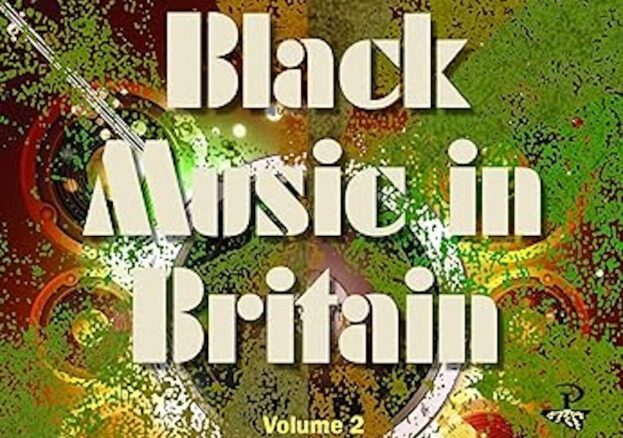
British Black Music Month 2026 Recommended Book: ‘Black Music In Britain Vol. 2: Children Of The Ghetto’ (Kevin Le Gendre; Peepal Tree)
By Kwaku BBM
If you have any interest in British Black music and its history, Kevin Le Gendre’s latest book is an absolute must-read.
Following up his debut, the respected jazz broadcaster, journalist, and Echoes deputy editor has delivered a highly impressive and authoritative tour de force that explores both well-known and largely uncharted territories of British Black music.
Nothing I can say can fully do justice to how excellent and desirable this book is. If you’re someone who reads about music, you should simply buy it, or at least borrow it immediately! Volume 2 covers the late 1960s to the mid-1980s – a golden period I lived through and cherish deeply. Although I consider my knowledge of the era fairly solid, Le Gendre’s meticulously researched book repeatedly exposed major gaps in my knowledge. My copy is now filled with pen marks on almost every other page, noting artists, albums, and stories that demand further exploration.
Le Gendre excels at providing socio-political, pan-African, and migratory contexts where needed, whilst making insightful musical and historical connections that only a deeply knowledgeable researcher could draw. He describes the late 1960s to early-1980s as one filled with “countless songs that have thought-provoking political content as well as stylistic ingenuity that is sometimes aimed at the dance-floor and sometimes requires deep listening in solitude”. His passion for musical mavericks shines through, giving figures like Thin Lizzy’s Phil Lynott a meaningful place in the Black music narrative. By the way, I recently had reason to plough through Friends/Frendz, an influential British underground counterculture and music magazine, where an early-1970 all-African rock band called Noir was given props. Although not mentioned in this book, I thought I’d do so here, as a service to anoraks.
The book also highlights the remarkable genre fluidity of the early 1970s, influenced by the fading psychedelic era. This gave rise to groundbreaking acts such as Osibisa, the Santana-ish rock influenced Batti Mamzelle, who incorporated Trinidadian steel pans, and the free-form jazz explorations of Demon Fuzz.
Whilst the book naturally covers better-known ‘transatlantic soul’ acts like Heatwave, Hot Chocolate, and The Real Thing, its real strength lies in shining a light on lesser-known or unsung artists. I know of drummer Barry Ford from his progressive reggae band Merger, which isn’t mentioned here. However, discovering acts like Clancy, a jazz-rock/blues-rock band featuring drummer Ford, was a highlight. Despite releasing two albums on major label Warner, they never found a wide audience at the time. Thanks to platforms like YouTube, their music can now be properly appreciated as part of Britain’s rich and diverse black musical tapestry. Ditto soulsters Joe E Young & The Toniks, whom I had never heard of, was naturally a pleasant exposure to one of many unsung musical characters mentioned in this book.
This is just a dip into the book. Chapter titles like The Property Of The Negro Race, Funkin’ For Jamaica, and Young Americans Who Are Black… And British should hopefully give a sense of the impressive breadth of this book. The Selected Discography, although only three pages long, is wonderfully diverse and eclectic, and serves as both a trip down memory lane and a treasure map for new discoveries. Le Gendre takes a broad, inclusive view of British black music, encompassing not only music made in Britain but also tracks with strong social, cultural, political, or commercial connections to Britain. This explains the presence of artists like Max Romeo, The Upsetters, Assagai, Jabula, and Hugh Masekela alongside homegrown jazz-funk, R&B, folk and reggae, acts.
Just as this British Black Music Month has a strong focus on reggae, so too, although surprisingly for me to discover, reggae does make a strong showing in the discography. Barring Courtney Pine, The Jazz Defektors, and perhaps CCS, I notice jazz doesn’t have a look in. No doubt, Le Grendre, who’s a jazz buff, will see to it that jazz is well represented when Vol. 3 brings the story from the 1990s into the 21st century – hint, hint, it took some six years for Le Gendre to get this follow up published. Let’s hope at a time when major libraries and museums have shown interest in British black music, book publishers will be quick off the mark in publishing books like Vol. 3, which I know will be another excellent documentation of our domestic black music history.
If you’re a serious black music fan or someone genuinely interested in musical history, I whole-heartedly implore you to get this book, especially during British Black Music Month, or else during African History Season. I can’t wait to see how Le Gendre covers the turn of the 21st century in Volume 3!
Click here for more details or to buy a copy.
For details of British Black Music Month (June 1 – July 31): BBM.eventbrite.com