
I am not a novelist. I am an IT executive with more than thirty years in the industry, someone who has spent his career locating the flaw before it becomes the failure. That sentence does not usually open an author’s biography, and it was never supposed to open mine.
But there is a story I could not put down, and eventually the only way to put it down was to write it.
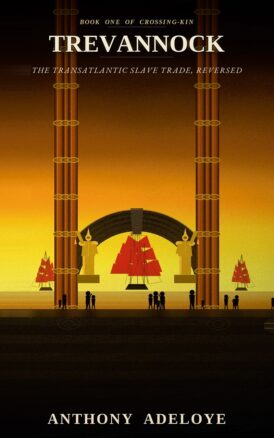
Trevannock is an alternate history. In 1782, the slave ships still sail, as they have for a hundred and sixty years, but the empire that owns them is African, and the cargo is white. Elias Hollowell, a Cornish fisherman, is seized at his own harbour, stripped of his name, and carried across the Black Water in chains. What waits for him is not vengeance but administration: the same cold machinery that has always turned people into property, now pointed at Britain. Lives become entries in a ledger with no column for a name.
People sometimes ask why I chose alternate history, as if the genre were a costume rather than a tool. The answer is that I did not choose it so much as recognise it. The premise arrived already formed: the same trade, the same mechanism, the same coldly bureaucratic reduction of people to cargo, but with the identities of the people inside it reversed. I did not write it to shock. I wrote it so the mechanism itself becomes impossible to look away from, precisely because the faces inside it have been changed.
And here is the thing I have come to understand clearly: this book was only ever going to be written by a Black person.
Not because no one else could have imagined the premise. But the specific weight of it is not available to everyone equally. One of the first and most deliberate acts of the Transatlantic Slave Trade was to take away the names of the people it consumed. Captains and slave traders renamed the enslaved on the crossing, replacing Yoruba names, Akan names, Igbo names, with European ones chosen by strangers. It was not a bureaucratic convenience. It was an act of erasure: the first step in converting a person into property was to make them answer to someone else’s word for them. To destroy the name was to begin the destruction of the self.
I carry that knowledge not as a historical fact I learned but as something closer to instinct. It is in the geography of a diaspora, in the particular way a Nigerian-British man learns to understand the distance between the name he was given and the names that were taken. The Transatlantic Slave Trade did not only move bodies across an ocean. It moved people out of their own identities and left the identities behind.
That is why the central act of resistance in Trevannock is the keeping of names. Against the machinery of enslavement, the people in this book hold the names of their dead: every parish, every village, every life the record tried to erase. They pass those names hand to hand, so that no one crosses unremembered. This is not a device I invented. It is a direct answer to what the Transatlantic Slave Trade actually did. The book’s moral centre is the refusal of that erasure, written by someone for whom the erasure was never merely historical.
I did not write Trevannock from research alone. I wrote it from that inheritance.
There is something else this premise does, something I did not fully understand until the book was written. The Transatlantic Slave Trade has always been easier to absorb as history than as experience. Numbers, dates and Acts of Parliament can be held at a distance. What the inverted premise does is close that distance. A white reader who enters this book encounters the machinery from the inside of it. The anger that Black people carry, the disappointment, the deep and rational distrust of systems and of people who benefit from those systems: these are not mysteries when you have spent nearly five hundred pages on the wrong side of the ledger. They become the only reasonable response to what you have just felt.
I hope that feeling, even in imagination, counts for something. Empathy built on having been somewhere, rather than on good intentions, is more durable. And it is the kind that might, over time, bring people closer together.
The theme of Black History Month this year is Honouring Our Communities. Honouring is more demanding than it is sometimes treated. It is not only remembrance. It is insisting on the full weight of what our communities have carried and what they have produced. It is refusing the version of history that keeps our ancestors at the margins of their own story.
Writing this book was part of that work for me. I am an IT executive and a businessman. I published Trevannock myself, through my own imprint, Trevannock Press. I did not wait for the industry to decide whether this story deserved a platform. The story existed before I found a way to tell it, and it will exist after any platform that carries it.
That is what I mean when I say this book is about honouring a community by refusing to let it be forgotten. It is not a sentiment. It is a method.
Trevannock by Anthony Adeloye is available in paperback at £14.99, hardcover at £24.99, and ebook at £4.99. It is Book One of the Crossing-Kin series. All editions are available at trevannock.adeloye.com and Amazon UK, and orderable through any bookshop or library via Ingram.