
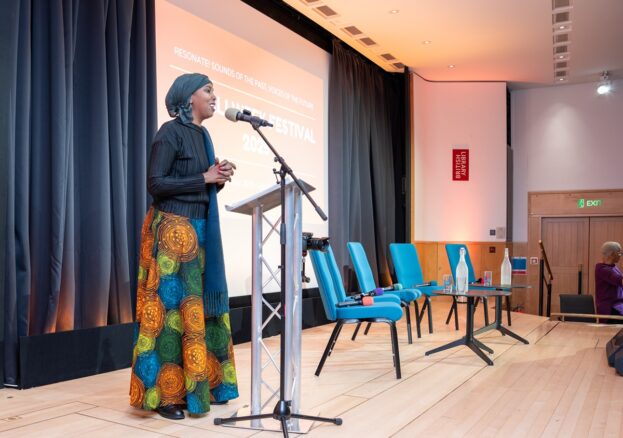
Ayan Mahamoud MBE founded Kayd Somali Arts and Culture in Tower Hamlets in 2009. Since then, she has built a platform that preserves Somali heritage, nurtures new talent and brings the community’s creativity to audiences across Britain and beyond.
She was awarded an MBE in 2015 for services to promoting cultural understanding between the UK and the Somali region, and served as head of the Somaliland Mission to the UK from 2016. But the contribution that most deserves recognition is the one she has made here in Britain, in our community halls and national theatres.
As a Somali refugee herself, she created the conditions for Somali culture to take its rightful place in British life. She built something that belonged to the community it was made for. For more than sixteen years, she has never stopped pushing to make that community more visible.
When Ayan started Kayd, London was already home to tens of thousands of Somalis. This included refugees from the civil war and a community with roots in Britain stretching back to the late nineteenth century.
Yet despite this history, Somali music, poetry, oral traditions and stories had little space in mainstream British arts institutions. A community shaped by war and displacement needed places where its heritage could be recognised and shared. Kayd was Ayan’s answer.
The word Kayd means preservation in Somali. It is a fitting name for what she set out to do: preserve, celebrate and bring into public life a culture that much of Britain had rarely encountered.
For a generation of young people who grew up here, often caught between two worlds and rarely seeing themselves reflected in British cultural life, Ayan has created something precious: a home.
Through Kayd, there is a place where their language is spoken with pride, where their grandparents’ music is treated as the treasure it is, and where their stories are told on their own terms.
Many British Somalis describe Somali Week as the one time of year they feel fully seen in this country. For communities shaped by displacement, the question of belonging runs deep. Ayan has spent years answering it with tangible action.
She has treated Somali music, poetry and oral tradition with the same seriousness and ambition as any classical heritage. She has brought elders and established artists onto the same stages as emerging performers, refusing to let the living memory of Somali culture be lost between generations.
She has also digitally archived more than a decade of festival material, preserving performances by iconic artists, some of whom are no longer with us. Family events give Somali children opportunities to engage with their heritage in their own language, while writers’ rooms help the next generation develop their craft.
The breadth and care of this work reflect an understanding that culture carries memory, identity and a sense of belonging.
Nowhere is this clearer than in what she has made possible for young British-Somali artists. Side eYe Productions, a theatre collective founded by young British-Somali women who felt shut out of mainstream theatre, found in Kayd the support they needed.
Their play Dugsi Dayz, written by Sabrina Ali, debuted at Rich Mix as part of Somali Week. Ayan backed it, gave it a platform and helped take it on a national tour. It went on to win the BBC Writersroom Popcorn Award and the Untapped Award at the Edinburgh Fringe, before a run at the Royal Court Theatre.
Producer Hannah Abdule described that support plainly: “Having Kayd behind us has literally been the reason why we achieve anything that we do. They’ve almost been like our very own Arts Council.”
Side eYe is one example among many. Ayan has also given a platform to filmmaker Warda Mohamed, singer-songwriter Aar Maanta and documentary filmmaker Kasim Wise. She has supported debut playwrights, first-time directors and actors who had never stepped onto a professional stage.
At the heart of her work is a powerful conviction: Somali culture is part of British culture.
The artists she has nurtured are performing at the Royal Court. The stories she helped bring to audiences are winning national awards. Through her life’s work, Ayan has helped paint a fuller picture of a community too often defined by its hardships, giving its creativity, talent and cultural heritage the recognition they deserve.