
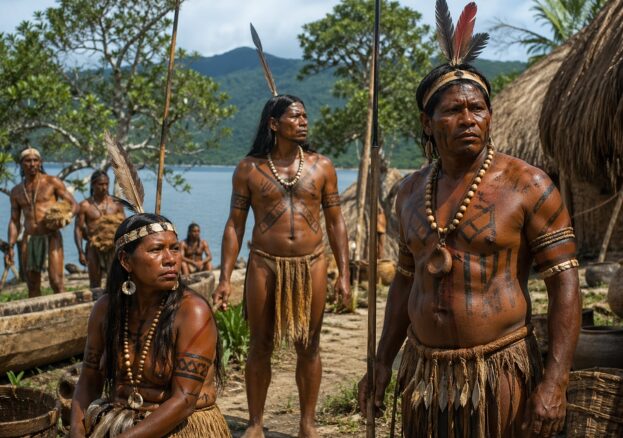
In October 1492, as European ships approached Caribbean shores, they were not entering an empty world, but one already shaped by centuries of migration, settlement and cultural exchange. Among the peoples who formed part of this world were the Caribs — a group whose history has often been overshadowed by myth, yet remains central to understanding the Indigenous Caribbean.
Long portrayed in colonial accounts as fierce and warlike, the Caribs have frequently been reduced to stereotype. In reality, their history is more complex — shaped by movement, encounter, resistance and survival.
Origins and Migration
The Caribs originated in northern South America, particularly in the region of the Guianas and the lower Orinoco basin. From around 1200 CE onwards, Carib-speaking groups began moving gradually northwards into the Caribbean, settling across parts of the Lesser Antilles.
This was not a sudden invasion, but part of a longer pattern of migration that had shaped the Caribbean for centuries. Earlier cultures had already established communities across the islands, and the arrival of Carib groups contributed to an evolving and interconnected region.
By the time Europeans arrived in the late 15th century, Carib communities were established across islands such as Dominica, St Vincent and Grenada, as well as along nearby mainland coasts.
A Connected Caribbean World
The Caribbean before European arrival was not defined by a single people, but by a network of societies linked through movement, exchange and adaptation. Arawak-speaking communities, including the Taíno of the Greater Antilles, had already developed complex societies across the region.
Interactions between these groups were varied. While there is evidence of conflict, particularly in later European accounts, modern scholarship suggests a more nuanced picture — one that includes exchange, coexistence and cultural overlap.
The Caribbean, in this sense, was already a dynamic and interconnected world long before European expansion.
Society and Way of Life
Carib communities were highly adaptable, drawing on both mainland and island traditions. Their way of life was closely tied to the natural environment, combining agriculture, fishing and seafaring.
Cassava formed a staple of their diet, while their expertise in canoe-building and navigation allowed them to travel between islands and maintain connections across the region. Social organisation tended to be less centralised than that of the Taíno, with communities structured around kinship and local leadership rather than large, hierarchical chiefdoms.
Spiritual beliefs, oral traditions and environmental knowledge played a central role in maintaining cultural continuity.
European Contact and Misrepresentation
When Europeans encountered the Caribbean in 1492, they distinguished between the Taíno of the larger islands and the Caribs of the eastern Caribbean. Early Spanish accounts frequently portrayed the Caribs as hostile, in contrast to the more “peaceful” image assigned to the Taíno.
These distinctions were not neutral. From the early 16th century, such portrayals were used to justify harsher treatment, enslavement and displacement. The association of the term “Carib” with “cannibal” in European narratives reflects this process of misrepresentation, rather than clear or reliable evidence.
These narratives have had a lasting impact, shaping perceptions of the Caribs for centuries.
Resistance and Survival
Carib communities maintained resistance to European expansion for longer than many other Indigenous groups in the Caribbean. Throughout the 17th and 18th centuries, islands such as Dominica and St Vincent remained centres of Indigenous resistance.
In St Vincent, Carib descendants — later known as the Garifuna — resisted British colonial forces until 1797, when many were forcibly deported to Central America. Despite this, Garifuna communities survived and continue to maintain a distinct cultural identity today.
Legacy and Identity Today
The descendants of the Caribs are most clearly represented today by the Kalinago people of Dominica, who maintain a recognised Indigenous territory established in 1903.
Across the Caribbean and mainland South America, Carib ancestry also persists through mixed heritage populations, cultural traditions and language. Their influence can be seen not only in living communities, but in the cultural and historical foundations of the region itself.
Reframing the Carib Story
To understand who the Caribs were is to move beyond the narratives imposed by colonial history. They were not simply warriors or adversaries, but part of a wider Indigenous world that shaped the Caribbean long before European arrival.
Their history reflects movement, encounter and resilience — a reminder that the Caribbean’s past is deeper and more complex than the moment of colonisation alone.
For Black History Month, recognising the Caribs is part of acknowledging the full history of the region — one that includes the voices, cultures and experiences of its first peoples.
References
- Hulme, P. (1986) Colonial Encounters: Europe and the Native Caribbean, 1492–1797. London: Methuen.
- Rouse, I. (1992) The Taínos: Rise and Decline of the People Who Greeted Columbus. New Haven: Yale University Press.
- Allaire, L. (2013) ‘The Caribs of the Lesser Antilles’, Journal of Caribbean History, 47(1), pp. 1–20.
- Encyclopaedia Britannica (n.d.) Carib. Available at: https://www.britannica.com
- National Museum of the American Indian (n.d.) Kalinago (Carib) Peoples.