
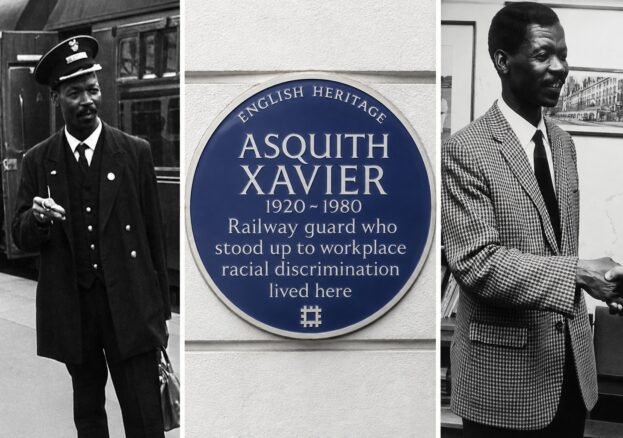
An English Heritage blue plaque has been installed at the former London home of Asquith Xavier, the pioneering railway worker whose determination to challenge racial discrimination helped bring an end to the unofficial “colour bar” operating at Euston Station.
The plaque marks 149 Ledbury Road in Notting Hill, where Xavier was living in 1966 when he challenged discriminatory employment practices that prevented him from transferring to a better-paid position at Euston.
For Black History Month, the recognition has particular resonance.
In 2020, Xavier’s granddaughter, Camealia Xavier-Chihota, wrote for blackhistorymonth.org.uk about her grandfather’s largely overlooked place in British history. In Omitted from History: Asquith Xavier, she described both her family’s pride in his achievements and her hope that his contribution would receive wider recognition.
Six years later, the English Heritage plaque represents another significant step towards that recognition.
A stand against the colour bar
Born in Dominica in 1920, Xavier came to Britain in 1958 and began working for British Railways at Marylebone Station shortly after his arrival.
He progressed through several railway jobs, including working as a porter and carriage cleaner, before becoming a train guard.
In 1966, Xavier applied to transfer to Euston Station, where the position offered better earning opportunities.
But his application was rejected.
The decision had nothing to do with his experience or ability. Local staff representatives at Euston were operating an unofficial colour bar and had refused to accept the transfer of what were described at the time as “coloured staff”.
Xavier was informed of the discriminatory policy in writing.
Rather than accept the decision, he challenged it.
Supported by his National Union of Railwaymen representative, Jim Prendergast, Xavier pursued his case as it began to attract national attention.
His challenge exposed racial discrimination that was operating within parts of Britain’s railway system at a time when protection against workplace discrimination remained limited.
The Race Relations Act 1965 had made racial discrimination unlawful in certain public places, but employment and housing were not covered by the legislation. Those areas would later be addressed by the Race Relations Act 1968.
‘Ordinary people can have an extraordinary impact’
Howard Spencer, Senior Historian at English Heritage, said Xavier’s story demonstrated how an individual seeking fairness for himself and his family could help bring about wider change.
“Asquith Xavier’s story is a powerful reminder that ordinary people can have an extraordinary impact,” he said.
“He was not seeking to become a campaigner or public figure. His fight began with a simple desire for a fair opportunity to support his family, but it became a landmark moment in Britain’s struggle against workplace discrimination.
“We hope that this plaque will help to ensure that his remarkable contribution is remembered.”
During the summer of 1966, Xavier’s Ledbury Road home became part of the story as journalists gathered outside to interview him.
He consistently maintained that he was not seeking publicity. He wanted the same opportunity to progress in his profession as his white colleagues and the ability to support his family without being disadvantaged because of his race.
His challenge succeeded.
On 15 July 1966, British Rail announced that the colour bar at Euston and St Pancras would end and that Xavier would be given the position he had sought.
On 15 August 1966, he began work at Euston, becoming the first Black railway guard to work out of the station.
His victory, however, did not mean an end to the racism he faced. Xavier received racist abuse and threats and at one stage required police protection while travelling to and from work.
A family’s fight to keep his story alive
For decades, Xavier’s contribution remained unfamiliar to much of the British public.
His family has played an important role in ensuring his story is remembered.
Writing for Black History Month in 2020, the year that would have marked Xavier’s 100th birthday, Camealia Xavier-Chihota described the pride she felt in her grandfather’s refusal to accept discrimination.
She wrote:
“His dignity, strength of character and tenacity in the face of adversity makes me feel honoured to carry the Xavier name.”
She also spoke about her determination to ensure that Xavier and other Black figures who helped shape Britain were not left outside the mainstream telling of British history.
At the time, she expressed hope that growing local recognition of her grandfather would eventually lead to wider national acknowledgement.
That recognition has continued to grow.
Xavier has been commemorated at Euston and Chatham stations, and a train has been named in his honour. The English Heritage plaque now places his story permanently on the London home from which he challenged one of the discriminatory barriers confronting Black workers in post-war Britain.
From overlooked history to national recognition
Xavier’s story is important not simply because he became the first Black guard to work from Euston.
It demonstrates how racial discrimination was embedded in ordinary working life and how individuals could challenge systems that were widely accepted or left unexamined.
He did not begin his campaign as a politician or professional activist. He was a railwayman who believed he should be judged on his ability to do his job rather than the colour of his skin.
That simple principle became a significant test of Britain’s approach to workplace equality.
Xavier died in 1980, aged 59, but the recognition of his contribution has steadily increased.
For his family, the plaque carries particular meaning.
When Camealia Xavier-Chihota wrote for Black History Month in 2020, she described an “ordinary man who achieved extraordinary things by standing up against systemic racism” and expressed the hope that his bravery would inspire others to stand up for what they believed was right.
The blue plaque at Ledbury Road ensures that people passing the house where Xavier lived during that defining year will now encounter his name and his place in British history.
It is also a reminder that some of the country’s most significant advances towards equality began with people who simply refused to accept that discrimination was the natural order of things.
Founded in 1866, the English Heritage London Blue Plaques scheme commemorates significant figures from the past at buildings closely associated with their lives and work.