
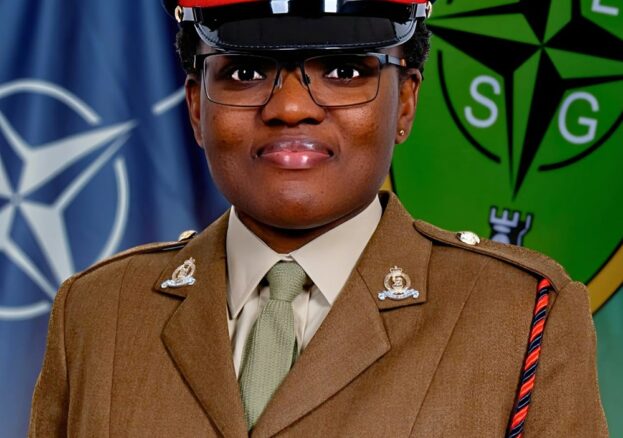
Sergeant Afua Amponsa was nominated for Honouring Black Britain 2026 in recognition of her service, leadership and commitment to creating opportunities for others. From demanding infantry exercises in Kenya to an award-winning NATO appointment, she has built a career defined by courage and resilience. She speaks to Black History Month about her unexpected journey into the British Army, the importance of representation and helping the next generation believe that they belong.
What first inspired you to join the British Army, and what do you remember most clearly about the beginning of your military career?
The honest answer is… I never planned to join
the Army. I’d actually been out of university for about five years. I
studied Politics, Philosophy and Economics (PPE) because I wanted to go
into politics, government, policy, and diplomacy; that
was the direction I saw for myself.
But after university, things didn’t quite go
according to plan. I applied for graduate jobs and kept getting rejected. I was
working different jobs to pay my bills, and I really wanted proper work
experience. I didn’t want to take on another student loan to do a Master’s when
what I really needed was an opportunity to work.
And I remember one day I was actually on my way to
the library to print CVs for another application when I saw a billboard that
said, **”Army: Be the Best.” **It wasn’t some
lifelong dream. I didn’t see it and think, this is what I’m meant to do. But it
caught my attention.
I went home, looked into it, and thought, *”Why
not?” What have I got to lose? *I applied to become an
officer first because that was where I saw myself. And I failed AOSB.
So that could easily have been the end of the
story. Instead, I was advised to try the soldier route. I did, and I came
out in the top third of my cohort’s selection. And then, very suddenly, I went from trying to get a
graduate job to packing up my little one-bedroom flat and going to basic
training with one suitcase.
I think that’s
probably the clearest memory I have of the beginning of my military career,
just how completely unexpected it was. I didn’t join because I’d always
wanted to be a soldier. I joined because I was trying to find a door that would open. And the funny thing is,
that door ended up taking me somewhere I never imagined.
You have taken part in demanding military exercises and operated in environments where few Black women had gone before. What did those experiences teach you about yourself?
They taught me not to limit myself based on
what I think I’m capable of. Because if you’d told me when I
joined that I’d be doing some of the things I’ve done in the
Army, I probably wouldn’t have believed you.
I’ve been in environments where there weren’t many
women, and even fewer Black women. I was the only woman on the first SpecINF
cadre. I’ve been on demanding exercises, I’ve operated in an
infantry role (as part of my attachment to B Company in 1 Scots), and I’ve
found myself in rooms and environments where I knew I was different.
And, yes, sometimes you are very conscious of it.
But I believe the biggest lesson for me has been
that **you don’t always need to see someone who looks like you before you
decide you belong somewhere. **Sometimes you have to be the
first. And being the first can be uncomfortable because there isn’t always
a blueprint. You don’t have someone you can look at and say, that’s
exactly how she did it.
So you figure it out. I’ve also learned that
resilience isn’t something you have. You build it. Through experiences,
failures, rejections and being out of your comfort zone.
There have been difficult points in my career.
There’ve been moments I’ve questioned myself. Even during basic training, there
was a point where I genuinely considered quitting. I remember calling my mum,
and she talked me through it, prayed for me and reminded me why I’d started.
So, I stayed.
And I think experiences like that change you. They
teach you that a difficult moment doesn’t necessarily mean you’re on the wrong
path. Sometimes it just means you’re in the middle of becoming someone you
haven’t met yet.
During Exercise Haraka Spear in Kenya, you operated in an infantry role. What were the greatest challenges, and how did you overcome them?
Haraka Spear was one of the biggest learning
experiences of my career because I was learning on the job. I was a
relatively new Private, in my mid-20s, and my trade was HR. So being an
inexperienced HR Private is very different from being an inexperienced infantry
Private. I was attached to B Company, and these guys were physically fit, experienced and used to
being in the field. They were often the first ones out the door, and suddenly I
was expected to operate alongside them.
And this was also my first time in Kenya. So
there was a lot to take in — the heat,
the environment, trying to understand what it actually meant to be in the infantry, and
learning quickly without becoming a burden on the team. And then, of
course, I was the only female. There were over 60 blokes, and I was spending
more than six weeks in the field with them. You don’t have the comforts you’re
used to. You’re not getting regular showers. You’re not getting enough sleep.
You’re tired, you’re dirty, you’re uncomfortable, and you’re still expected to
get up and do it all again the next day.
But interestingly, I don’t remember sitting there
thinking, *I’m the only female. *I
was much more focused on thinking, *I’m here
now. This is the opportunity I’ve been given. What am I
going to make of it? *So I threw myself into it.
I listened. I watched very closely. I asked
questions. I paid attention to how the more experienced soldiers did things. If
I didn’t understand something, I learned it quickly. And I made a conscious
effort to blend in — not by losing who I was, but by understanding that I was
joining a team that already had its own rhythm and culture. I didn’t want
special treatment. I wanted to be useful.
One of the biggest challenges for me was **not wanting
to be the person the team had to carry. **And over time, I
believe the guys saw that. They could see that I was new. They understood
I wasn’t an expert, as I was only an HR. But they could also see that I was
willing to learn, willing to work and willing to put myself through the same
discomfort as everyone else. And I think that’s how I earned their
respect.
Looking back, Haraka Spear has become one of the
defining experiences of my career. It was my first time in Kenya, my first real
experience of being immersed in that kind of infantry environment, and it
really shaped how I saw myself as a soldier. And it was also part of why 1 SCOTS
became my first and, to this day, my favourite Battalion.
I was taken in by the guys because of how I
carried myself. They knew I was different. They knew I was inexperienced. But I
didn’t make that my identity. I just thought, *I’m here. Give me the
opportunity, and let’s see what I can do. *And that’s probably
the biggest lesson I took from Kenya: sometimes you don’t overcome a challenge by trying
to prove that you belong. You overcome it by getting stuck in, learning,
contributing and letting your actions speak for you.
How did your NATO appointment in the Netherlands broaden your understanding of leadership and international cooperation?
My NATO posting in Brunssum really changed my
understanding of what international cooperation actually looks like.
Before that, most of my experience had been within
the British Army. You have your unit, your chain of command, your way of doing
things, and although you work with other people, you’re still operating within
one national organisation.
At NATO, you’re part of something much
bigger. You’re working alongside
people from different countries, each bringing their own military experience,
national procedures, cultures and ways of thinking. And yet, despite all of
those differences, everyone has to work towards a common objective.
That was probably the biggest lesson for me — **international
cooperation isn’t about everyone doing things the same way. It’s about being able to work effectively
when they don’t. **You have to understand where other people
are coming from. You have to communicate clearly, build relationships and
sometimes find a compromise between different ways of doing things.
And I believe that’s where it really changed my
understanding of leadership. You can’t lead effectively in an
international environment by assuming that your way is automatically the right
way. You have to listen first, understand the bigger picture and then work out
how your contribution fits into it.
It also gave me a much better appreciation of the
role that the UK plays within a wider alliance. You’re not operating in
isolation. The decisions and work you do can have an impact beyond your own
organisation and country.
That experience has stayed with me, particularly
now that I work across different spaces myself. Through Triple A Foundation,
for example, we’re working with people and partners across different countries
in Africa. And I’ve realised that the same principle applies: you can’t go into
another country or community assuming that you know what is best because you’ve
done something a certain way somewhere else.
You have to listen,
understand the local context, respect what people already bring to the table
and then work together. So NATO gave me a much broader understanding of
both leadership and cooperation.
It taught me that you don’t have to agree on everything, or even work
in exactly the same way, to achieve something together. What matters is finding
the common purpose and understanding how each person or organisation
contributes to it.
You received the Military Member of the Year award in 2022 and the Adjutant General’s Corps Colonel Commandant’s Recommendation in 2025. What did these recognitions mean to you?
Honestly, both recognitions were quite surreal for
me, because neither was something I was expecting.
The NATO one especially. I didn’t even know
the award existed. I was told I’d received it, and at first I didn’t fully
appreciate what that meant. And then I’m standing on a podium at NATO
Headquarters in SHAPE, being presented with the award by **SACEUR — the
Supreme Allied Commander Europe, **the highest-ranking
military officer in NATO’s military command structure.
And that, for me, was a wow
moment. Because you don’t just meet SACEUR. You certainly don’t expect to
find yourself standing on a stage receiving an award from SACEUR. And then
hearing my citation read out was incredibly humbling, because everything they were describing was work I was doing at the
time simply because I wanted to do my job well.
JLSG was a newly formed headquarters, and my role
was newly formed. I was building the role as I went. I wasn’t thinking about
recognition. I wasn’t thinking that somebody was watching. I was just
trying to contribute. But standing there, hearing those words, and then
looking around and realising that I was the junior-ranked person among the
awardees, the only woman, and the only person of colour…
It was one of those moments where you think, how did I get
here?
And then later, seeing my picture displayed in the
hallway at SHAPE — that’s
something I’ll probably never take for granted. It taught me something
that has stayed with me: **always do your best, because you never know who’s
watching, and you never know who is mentioning your name in rooms you don’t
even know exist. **And that’s particularly meaningful when I
think about where I started.
I didn’t grow up planning an Army career. I wasn’t
someone who had always dreamed of becoming a soldier. I was trying to find a
job. So, going from that to standing at NATO Headquarters, receiving an
award from SACEUR, was incredibly humbling. And I also know I didn’t get
there on my own. There were people God
placed in my path who supported me, challenged me, opened doors for me and
believed in me at different points in my career.
Then came the Colonel Commandant’s
Commendation in 2025, another surreal moment. The citation
had originally been written for a Brigade-level award, and when that didn’t go
through, it was put forward for the Colonel Commandant’s award instead. So
again, when I heard the citation being read, I had that same feeling: I’m just
doing what I can.
But what made that recognition particularly
special was dedicating it to my Triple A Foundation team. Because by that
point, the work I was doing outside the Army had become such an important part
of my life. Triple A wasn’t something I was building alone. There was a team
behind it — people who believed in the vision, gave their time, showed up and
helped turn ideas into something tangible.
So although my name was on that recognition, I
knew it represented more than me. And that’s what both awards have
ultimately taught me.
You don’t always know the impact of what you’re
doing while you’re doing it. You don’t know who’s watching. You don’t know
whose life you’ve influenced. And sometimes, you don’t even know your name is
being mentioned until you’re standing somewhere you never imagined you’d be.
So yes, I’m incredibly proud of both
recognitions. But more than anything, I’m grateful. Grateful for the
opportunities. Grateful for the people God has placed along my journey. And
grateful that a decision I made years ago, when I was trying to find a job, has
taken me to places I could never have imagined.
And sometimes, honestly, I still look at those
moments and think… Who would have thought?
In your current Army recruitment role, how are you helping to build trust and show young people from underrepresented communities that there is a place for them in the Army?
One of the biggest things I bring to my current
recruitment role is representation. Because I know what it’s like
to look at something and not necessarily see someone who looks like you in that
space. And I believe sometimes representation isn’t about having someone
standing there telling you, you can do this.
Sometimes it’s simply seeing someone who looks
like you doing it, and thinking, ***maybe I can too. ***That’s
something I try to bring into recruitment.
I’m very open with young people about my own
journey because mine isn’t the typical Army story. I didn’t grow up
wanting to be a soldier. I actually wanted to go into politics and government.
I applied to become an officer and failed AOSB. And I tell them that.
Because sometimes young people see someone in
uniform and assume that they’ve had this
perfect, straightforward journey into the Army. I haven’t. I know
what rejection feels like. I know what it feels like to try something and not
get it right the first time.
And then I tell them what happened
afterwards. I took another route into the Army, and that decision
completely changed the direction of my life. So when I’m speaking to young people, particularly those
from communities that may not traditionally see the Armed Forces as a place for
them, I’m not there to give them a sales pitch.
I’m there to say, ***this is what the Army can offer
you, these are the opportunities, these are the challenges, and this is my
experience. ***And then I let them make an informed
decision. But I also want them to understand something that I think is
really important: occupy the space.
If you walk into a room and you’re the only Black
person, the only woman, or the first person from your background to be there,
don’t immediately assume that you don’t belong. Sometimes you’re the first
because someone has to be. And being the first can feel uncomfortable.
I’ve experienced that myself. I’ve been in environments where I was the only
woman and the only person of colour. But I’ve learned not to treat
that as a reason to make myself smaller.
If anything, I’ve come to see it as an
opportunity. Because when you occupy that space, you change the picture
for the person coming behind
you. They don’t have to imagine whether someone like them belongs
there. They can look at you and see that someone like them is already
there.
And that’s what representation means to me.
It’s not about saying, ***look at me, I’ve made it. ***It’s
about saying, ***there is space here, and you
belong in it too. ***And that’s particularly
important in the Armed Forces, because
if young people never see themselves represented, they may never even consider
it as an option. So if I can
be the person who makes someone stop and think, actually, maybe the Army is for someone like me,
then I’ve done something worthwhile.
And perhaps the most important part is that when
those young people eventually get through the door, I want them to understand
that they don’t have to become somebody else to belong either. **You can
occupy the space, be yourself, and still succeed. **
If you’re the first, **be the first and be
the best. Take up the space. Do the job well. **And then turn
around and make sure the person coming behind you knows the door is open!
Have you ever felt pressure to compromise part of your identity to progress, and how have you remained true to yourself?
Yes, I think there have definitely been moments where I’ve felt that
pressure. For me, it’s come from
being a woman in a very male-dominated profession, but also from being Black.
Sometimes you can feel like you’re being judged through one lens or the other —
are
you doing too much as a woman? Are you being overlooked because you’re the only
person of colour?
And I’ll be honest, that’s something I have struggled with, and still
struggle with. There are days when you feel overlooked, and you start
questioning yourself or wondering whether you need to do more to be
seen. But I’ve had to learn not to let those moments change how I show up.
There’s a difference between developing yourself and losing yourself. I’m
always willing to learn, improve and take feedback. But I don’t believe
progressing means becoming somebody else. I’ve learned to focus on what I
can control: doing my job well, treating people properly, carrying myself with
confidence and giving my best. I think about Haraka Spear quite a lot in
that respect. I was the only woman among more than 60 men, and I was
inexperienced in an environment where I was learning very quickly.
I could have spent the whole time thinking
about being different. Instead, I thought, *I’m here. What am I going to make of this opportunity? *So
I listened, I watched, I asked questions, and I got stuck in. I didn’t
have to become one of the men to earn their respect. I just had to be a good
soldier, a good teammate and someone they could rely on. And that’s how
I’ve approached a lot of my career.
There will always be moments when you feel like you’re being overlooked. You
can’t control how everyone sees you. What you can control is the quality
of your work and how you respond. So
on those days, I remind myself of what makes me unique, get the work done as
best I can, and keep moving. I don’t think staying true to yourself
means refusing to change. It means knowing which parts of yourself you should
never have to change just to be accepted.
For me, that’s been an important lesson — **I can continue to grow without
losing myself in the process. **I’m Ghanaian. I’m British.
I’m a Black woman. I’m a soldier. I’m a leader. I’m a founder. I’m a daughter.
I’m someone who cares deeply about community. I don’t want to have to put
any of those things in a box. And actually, I think the older I’ve become,
the more I’ve realised that my difference isn’t something I need to apologise
for.
What inspired you to establish the Triple A Foundation, and what difference do you hope it will make for young people across Africa?
For me, it really comes down to opportunity
and access. I think a lot about how different life can
look when you have access to the right opportunity. My own journey is a
good example of that. I was five years out of university, struggling to get a
graduate job, getting rejection after rejection, and then I happened to see a
billboard that led me to the Army. One opportunity changed the direction
of my life.
And I think that made me very conscious of the fact that there are so many young people with
ability, ambition and potential, but they don’t
have access to the things that can
help them move forward. Sometimes it’s not that a child doesn’t want to be
in school. They might not have the uniform, the stationery or the basic things
they need. Sometimes a girl is missing school because she
doesn’t have access to menstrual products. Sometimes a young
person can learn a digital skill but has never had access to a
computer. And sometimes, it’s simply that nobody has given them the
opportunity to see what they’re capable of.
That’s really where Triple A Foundation came
from. It grew from seeing those gaps and asking, *what can we
actually do about them? *We’ve worked across education, ICT,
and menstrual health, and in supporting children at risk of becoming
street-connected. The projects might look different, but the underlying purpose
is the same: **remove some of the barriers and create access to opportunity. **And
I don’t want our work to be about simply giving things to people.
If we’re supporting a child to stay in school, I
want to think about what that access to education could mean five, ten or
fifteen years from now. If we’re giving a young person access to
technology, I want them to gain a skill that can open another door. If
we’re supporting a girl with menstrual health, I want her to be able to remain in the classroom and not have her education
interrupted by something that shouldn’t have to stop her.
For me, that’s the bigger picture. Because
you can have all the potential in the world, but **potential
without access can remain just that — potential. **I want Triple A Foundation to help bridge that gap. We
can’t change everything overnight, and we don’t have all the answers. But
if we can create one opportunity for one young person, and that opportunity
leads to another, and another, then we’ve started something.
And perhaps one day that young person will look
back and realise that something that seemed small at the time — a school bag, a
computer, a scholarship, a sanitary product, someone believing in them — was
actually the access point to something much bigger.
That’s the difference I hope Triple A Foundation can make. Not just
giving young people something, but giving them access to what could come next.
As we celebrate Black History Month under the theme Honouring Our Communities, what advice would you give to a young Black woman considering a career in the Armed Forces?
I’d say, first of all, **look beyond
your gender and your colour. **They’re part of who you are,
but they don’t have to define the limits of what you can do. Don’t look at
a room and think, *there’s nobody who looks like
me, so maybe this isn’t for me. *Look at it and
think, maybe I’m meant to be here.
So, make the application. Take the
opportunity. Put yourself forward. Take up the space — because you
belong there. And ***don’t be afraid of being the first. Do it afraid,
but do it anyway. ***I’ve been the only woman in a room. I’ve been the only person of colour. Many times I’ve
been both. And yes, there are moments when that can make you question
yourself. But if you spend all your time **waiting for the room to look
like you before you enter it, you might never walk through the door. **Sometimes
you have to be the person who changes what the room looks like.
And I’d also say don’t be discouraged by
rejection. I failed AOSB. If I’d allowed that rejection to define me, I wouldn’t
be where I am today. The route I eventually took wasn’t the route I’d
planned, but it gave me opportunities I couldn’t have imagined when I
started. So make the application even if you don’t think you’re the
obvious candidate. Apply even if you don’t meet every single thing you
think they are looking for.
**And if someone gives you an opportunity, make
something of it. **Do the work. Learn. Ask questions. Find people who
will support you. But don’t feel that you have to become somebody else to
succeed. And then, when you get there, remember that your journey isn’t
just about you. Because one day, there might be another young Black woman
standing where you once stood, looking at you and wondering whether she
belongs. **Be the representation you would have wanted to see. **Let
her see you occupying that space and think, ***if she can do it, maybe I can too. ***And
then help her through the door.
That’s what Honouring Our Communities means to
me. We honour the people who came before us, but we also have a
responsibility to make the path a little easier for the people coming behind us. So don’t wait
for permission.
Make the application. Take the space. Do the work. And when you get
there, leave the door open for someone else.