
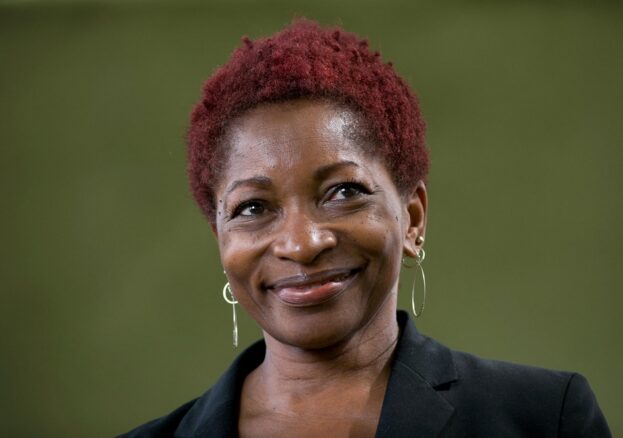
Bonnie Greer was someone you listened to. Not because she demanded attention, but because she brought something worth hearing: a connection others had missed, a piece of history that changed the argument, a perspective that made a familiar subject feel less settled.
Her death following a brief illness leaves a considerable absence in British cultural life. To television audiences, she was a recognisable and thoughtful presence. To readers and theatre-goers, she was a writer whose interests stretched far beyond the subjects on which broadcasters most often invited her to speak.
Born in Chicago in 1948, the eldest of seven children, Greer grew up on the city’s South Side. She studied theatre with David Mamet in Chicago and Elia Kazan in New York. Those cities provided the early settings for a creative life that would eventually take her across the Atlantic.
She moved to Britain in 1986 and became a British citizen in 1997. By then, she was developing a career that would make her an important participant in the country’s artistic and intellectual life.
Her American upbringing remained part of her work. Living in Britain gave her another vantage point, allowing her to consider the histories and contradictions of both countries. She could speak about belonging without making it sound simple, and about culture without treating it as something fixed.
The writer behind the familiar face
Television made Greer widely known, but her writing deserves equal attention.
Her play Munda Negra received the Verity Bargate Award. Her novels included Hanging by Her Teeth and Entropy, while her work for radio brought dramatic storytelling to another audience.
In Obama Music, she drew together music, personal memory and the history of Chicago. Her biography Langston Hughes: The Value of Contradiction explored the celebrated writer associated with the Harlem Renaissance. Her memoir, A Parallel Life, offered a further account of the experiences that had shaped her.
The range was substantial. Fiction, biography, memoir and drama each offered her a different way to examine a life or pursue an idea.
In Marilyn and Ella, she explored the relationship between Marilyn Monroe and Ella Fitzgerald. The work brought together subjects that recur across her career: artistic achievement, racial prejudice, women’s lives and the possibilities of solidarity. It was also theatre, built around people and performance rather than an abstract argument.
That distinction matters when remembering her. Greer did not simply comment on the work of others. She knew the demands of making something herself.
Knowledge, wit and conviction
On Newsnight Review, Greer brought a writer’s understanding to discussions of books, film and theatre. Her contributions combined close attention to the work with a sense of the wider world from which it had emerged.
She was equally memorable in political debate. Her appearance on Question Time alongside British National Party leader Nick Griffin in 2009 placed her in an exceptionally charged broadcast. She challenged racist ideas with composure and historical knowledge.
It remains a defining television moment, although it should not be allowed to stand for her entire public life. Greer’s interests were too extensive, and her contribution too varied, to be contained in one encounter.
She could discuss a performance, a political argument or a historical question with the same seriousness. There was authority in her knowledge, but also wit and an individual way of seeing things. She did not sound interchangeable with anyone else.
A life beyond the page
Greer also took on responsibilities within some of Britain’s most prominent cultural institutions. She served as a trustee and later deputy chair of the British Museum, and held board positions at the Royal Opera House and the London Film School.
From 2013 to 2018, she was Chancellor of Kingston University. In its tribute, the university remembered her commitment to free expression, education and equality, as well as her contribution to its own community.
She was appointed OBE for services to the arts in 2010 and elected a Fellow of the Royal Society of Literature in 2022.
These appointments and honours record the public recognition of her work. Her husband, David Hutchins, spoke of something more personal when announcing her death: her humour, generosity and ability to bring people together.
His tribute offered a glimpse of the person beyond the broadcasts and public appearances — a loved partner and companion, whose loss is felt privately as well as publicly.
There is much to return to in Bonnie Greer’s work: plays to encounter, books to read and arguments to reconsider. The familiar television face was only one part of a life spent writing, thinking and participating.
She leaves behind the example of an independent mind, and work that deserves to keep finding readers and audiences.
She is survived by her husband, David Hutchins.
Bonnie Greer OBE, 1948–2026.