
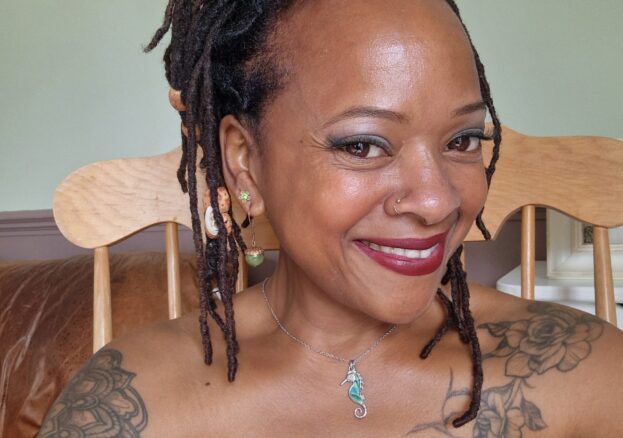
I would like to honour Dr Cheryl Diane Parkinson for her sustained daily leadership, professional excellence, cultural contribution and community commitment.
Cheryl completed her undergraduate degree in English Literature in 1998. She then studied for an MA in Colonial and Postcolonial Literature in English with Professor David Dabydeen at the University of Warwick in 2001 and became a secondary school teacher in 2004.
As a teacher, she was shocked when another adult commented that she should have a sign above her door reading: “Beware: Educated, Strong Black Woman.” This negatively intended comment stayed with her and later became a catalyst for her PhD studies.
It was also as a teacher that she became involved with the Black Teachers’ Association. She wrote about her experience at a conference where she sought legal advice concerning a classroom display at a parents’ evening entitled “The Good Side of Slavery”.
She began her PhD in 2011. As the only Black student, she noticed how few Black women she encountered within teaching or academia were educated to doctoral level. This was something she felt she could help change.
Her PhD thesis, Exploring the Fictional Origin of Stereotypes of the Angry Black Woman and the Strong Black Woman, examined negative stereotypes towards Black women in Britain. Her research contributed to the exploration of the treatment of Black women, expanding knowledge and making a cultural contribution..
As a teacher, Cheryl demonstrates sustained daily leadership. She has delivered lunchtime lectures around Black History Month in schools in London, Coventry, Cambridge and Peterborough. She has also written a module on slavery and the slave trade, approaching the subject with sensitivity towards the experiences of enslaved people and their descendants.
She is part of a school anti-racism club that validates students’ experiences of racism both in and out of school. She also helped develop an anti-racism policy within her school that is now operational.
Through Stories for Change with the United Kingdom Literacy Association, she is involved in using stories to help change how topics are taught. This includes how teachers address racist language in texts, with protecting and educating students at the heart of the work. The aim is for this continuing professional development to reach schools nationally.
Cheryl has written a scheme of work around Shakespeare’s The Tempest, focusing on Britain, empire and the role of Caliban. She has also used poetry to support learning, including Rudyard Kipling’s The White Man’s Burden.
Her wider community contribution includes guest lecturing at Atlantic Technological University in Ireland on the hidden descendants of African slavery, exploring narratives of identity and belonging.
At Goldsmiths, University of London, she has lectured on decolonising the curriculum, examining the National Curriculum and changes needed to make it more inclusive. She has also delivered workshops on identity and belonging in schools in London, Cornwall, Coventry and Buckinghamshire.
Her book Last Girl In was longlisted for the Branford Boase Award and the Little Rebels Award in 2024. In 2025, she won the UKLA Brenda Eastwood Award for Diversity and Inclusion, recognising the impact of her work.
She also received a GLL Literary Award in 2026, with further workshops planned at Boston Library and two schools in Spalding, Lincolnshire.
Last Girl In explores identity and belonging through Kerry Ann, who travels backwards in time, is taught cricket by her teenage grandfather and experiences the London race riots of 1958.
Her forthcoming book, Grendlesham, is due for publication in 2027. A modern-day Beowulf story, it places a Black protagonist within a retelling of a foundational Old English epic. Published by Dinosaur Books, a Black-owned business, it continues Cheryl’s commitment to weaving Black British history into fiction that entertains and educates.
Further school and community workshops are planned for 2027, continuing her work with young people across different settings.
Cheryl demonstrates sustained daily leadership through her work in schools, the wider community and nationally. Through fiction and nonfiction, teaching, workshops and lecturing, she engages people with questions of history, identity and representation.
I believe her impact is significant. Her commitment to challenging prejudice and changing understanding through education makes her deeply deserving of recognition through Honouring Black Britain 2026.