
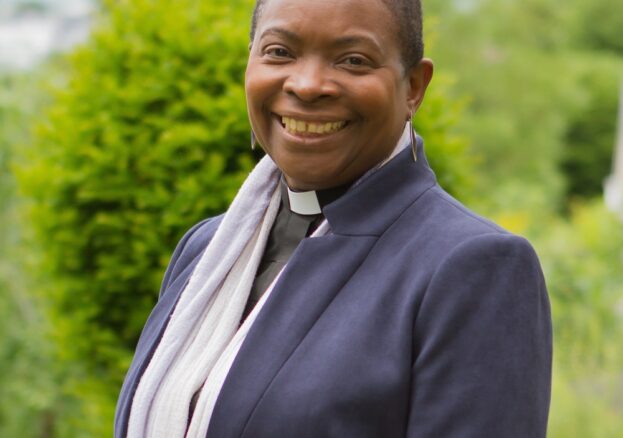
For Bishop Rose Hudson-Wilkin, community is not an abstract idea. It is about how people treat one another when life is difficult, how they respond to injustice and whether they are prepared to stand alongside those who are most vulnerable.
Her life and ministry have been rooted in that belief.
Born and raised in Jamaica, Bishop Rose came to Britain carrying a strong sense of faith, family and responsibility. She is a child of the Windrush generation, inspired by the resilience of relatives who travelled to Britain and made it their home despite the many challenges they faced.
“I am Black, African Caribbean—born in Jamaica, clearly of African heritage,” she has said.
Her Jamaican heritage has remained central to the way she understands her calling. It has also informed her commitment to speaking openly about racism, inequality and the importance of building communities in which people are valued.
Bishop Rose first felt called to ministry at around the age of 14. At the time, however, women were not permitted to become priests in the Church of England. The call did not disappear. She waited, trained with the Church Army and was commissioned as an evangelist in 1982.
She was ordained deacon in 1991. In 1994, the year the Church of England first ordained women as priests, she was ordained priest.
That journey required patience, perseverance and faith in her own vocation.
Her ministry began in the Diocese of Lichfield before she went on to serve for 16 and a half years as a priest in Hackney, east London. There, she worked in communities shaped by diversity, poverty, migration, faith and rapid social change.
Her experience in Hackney reinforced a conviction that faith must be lived beyond the walls of a church. It must be present in the everyday concerns of people’s lives: the need for dignity, safety, justice and the confidence to believe that they matter.
In 2007, Bishop Rose was appointed as a Chaplain to Her Majesty Queen Elizabeth II. Three years later, she became the 79th Chaplain to the Speaker of the House of Commons—and the first woman to hold the role.
Her work at Westminster included leading prayers when the House of Commons sat and offering pastoral care to Members of Parliament and staff across the Palace of Westminster.
It was a highly visible role, yet Bishop Rose has never separated public responsibility from personal compassion. Her ministry has consistently been driven by what she describes as compassion for “the lost, the least and the last”.
In 2019, she made history when she became the first Black woman to be appointed a bishop in the Church of England. As Bishop of Dover and Bishop in Canterbury, she has oversight of the Diocese of Canterbury on behalf of the Archbishop of Canterbury, serving communities across Kent, from towns and villages to coastal areas and rural communities.
The significance of her appointment was clear. But Bishop Rose has always understood that being the first brings both opportunity and responsibility.
She has spoken honestly about the racism she has encountered during her ministry. As a parish priest, she was at times prevented from taking funerals because of the colour of her skin. She has also spoken of assumptions that, because she is Black, she might not be intelligent enough or good enough for senior leadership.
Her response has not been to remain silent.
“I deal with it by being the best that I can be,” she has said, “knowing that I cannot be mediocre—always knowing that whatever I do impacts on those yet to come.”
Those words express a truth understood by many people who have been the first or only person from their community in a professional or public role. Success can be personal, but it also creates space for others. Visibility can challenge assumptions and widen people’s understanding of who belongs in leadership.
For Bishop Rose, faith provides both the strength to endure prejudice and the obligation to challenge it.
Her faith is informed by scripture, tradition and reason, with Black theology playing an important role in her journey. Yet her message is always practical. The Church, she believes, must be a place of welcome, honesty and action—not simply words.
This conviction has led her to speak about the treatment of refugees and asylum seekers, racial justice and the need for institutions to confront their own failures. Her focus remains on human dignity and on the responsibility people have towards one another.
In a recent reflection on community, Bishop Rose drew on the African philosophy of Ubuntu: “I am because you are.”
It is a simple phrase, but one that captures the spirit of Honouring Our Communities. None of us succeeds entirely alone. We are shaped by family, neighbours, teachers, friends, colleagues, faith communities and the people who encourage us when life becomes difficult.
Bishop Rose believes that flourishing communities are built when people recognise this interdependence. They are strengthened not by pretending that differences do not exist, but by choosing to meet one another with respect, generosity and compassion.
Her ministry has shown that leadership can be both principled and warm. It can challenge injustice while still inviting conversation. It can honour tradition while making space for people who have too often been excluded from it.
The Rt Revd Rose Hudson-Wilkin is being honoured because she has used her faith, voice and position to serve others with courage. From her early calling in Jamaica to her historic role within the Church of England, she has remained guided by the belief that every person is worthy of dignity and hope.
Her life reminds us that community is not simply where we live. It is how we choose to care for one another, stand up for one another and ensure that no one is left behind.