
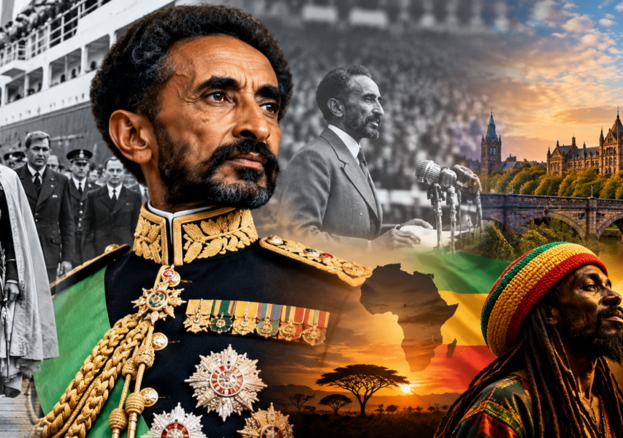
A special Black History Month event in Glasgow will revisit Emperor Haile Selassie’s historic visit to Scotland 90 years ago, bringing together African, Scottish and Caribbean history while giving the public a rare opportunity to see artefacts connected with the Ethiopian leader.
HIM Haile Selassie and Scotland takes place at Kelvin Hall on Friday 16 and Saturday 17 October 2026 as part of Black History Month Scotland.
The two-day programme will explore Haile Selassie’s visit to Glasgow and Wemyss Bay in June 1936, which came at one of the most dramatic moments in modern Ethiopian history.
Through talks, historical artefacts, poetry, music and discussion, the event will look at the connections between Ethiopia and Scotland and consider why Haile Selassie’s story continues to resonate across generations and communities.
Visitors will also have a rare opportunity to see objects connected with Haile Selassie that were donated to Glasgow Museums by Lord Inverclyde.
Ethiopia’s resistance to invasion
Haile Selassie became Emperor of Ethiopia in 1930, leading one of the few African countries that had successfully maintained its independence during the era of European colonial expansion.
That independence came under direct threat in October 1935 when Fascist Italy, under Benito Mussolini, invaded Ethiopia.
The conflict became a defining international crisis of the 1930s. Ethiopia appealed to the League of Nations for support, but the international response failed to prevent the occupation.
Italian forces eventually entered Addis Ababa in May 1936, forcing Haile Selassie and members of the imperial family into exile.
His struggle became much more than a conflict between two countries. For many people across Africa and the African Diaspora, Ethiopia came to symbolise resistance to colonialism, racism and European domination.
At a time when much of the African continent was controlled by European empires, Ethiopia’s defence of its sovereignty attracted worldwide attention.
Haile Selassie comes to Britain
After leaving Ethiopia, Haile Selassie travelled to Europe and continued to campaign for international action against the Italian occupation.
In June 1936, he addressed the League of Nations in Geneva, warning the international community about the consequences of allowing aggression to go unchallenged.
His famous intervention became one of the defining moments of his political life and helped establish him internationally as a symbol of Ethiopian resistance.
Haile Selassie subsequently spent several years in exile in Britain before returning to Ethiopia in 1941.
His visit to Scotland in 1936 forms a fascinating and often less widely known part of that story.
The Glasgow event will revisit his connections with Glasgow and Wemyss Bay and explore how those encounters became part of a much wider relationship between Scotland, Ethiopia and the African Diaspora.
A rare opportunity to explore the Glasgow connection
The Black History Month programme at Kelvin Hall will give audiences the opportunity to learn more about this period through historical material that is rarely brought together in this way.
Artefacts associated with Haile Selassie and donated to Glasgow Museums by Lord Inverclyde will help tell the story of his time in Scotland and provide a direct link to events that took place 90 years ago.
The programme will not simply look back at an isolated historical visit. It will examine the wider questions surrounding empire, colonialism, African resistance and the international connections that shaped Black history in Britain.
These histories are particularly important because they challenge the idea that Black British history began only with post-war migration.
Connections between Britain, Africa and the Caribbean stretch back centuries and can be found in cities and communities throughout the country, including Glasgow.
From Ethiopia to the Caribbean
Haile Selassie’s influence also extends far beyond Ethiopian history.
He holds a particularly important place within the Rastafari movement, which developed in Jamaica during the 1930s and drew inspiration from Ethiopia, African identity and resistance to colonial oppression.
His coronation in 1930 had a profound impact among people of African descent in the Caribbean and beyond, helping to strengthen Ethiopia’s symbolic significance within the global African Diaspora.
Over subsequent decades, Rastafari culture developed into an influential international movement, shaping music, art, spirituality and ideas about African identity.
Those connections have also become an important part of Black British cultural history, particularly through Caribbean communities that settled in Britain after the Second World War.
The Glasgow programme reflects that international story by bringing together Ethiopian history, Scottish connections and Caribbean cultural expression.
Poetry, music and community
Friday evening’s programme will feature Jamaican dub poet Yasus Afari, whose work combines poetry, performance, Rastafari philosophy and social commentary.
He will be joined by Samuel Struth from Rastafari Scotland, while music will be provided by Messenger Sound System.
The combination of history, poetry and music reflects the way Black history is carried not only through books and archives, but also through oral traditions, performance and community memory.
The event is presented by the Scottish Museum of Empire, Slavery, Colonialism and Migration in partnership with Glasgow Museums.
Its focus fits strongly with the purpose of Black History Month: bringing overlooked histories into public view, making connections between generations and encouraging people to understand how the past continues to shape the present.
Why this history still matters
Ninety years after Haile Selassie’s visit to Scotland, the story remains relevant because it connects local history with a much larger global struggle.
It is a story about the defence of African independence, the failures of international institutions, resistance to colonial aggression and the development of political and cultural movements across the African Diaspora.
For audiences in Glasgow, it is also an opportunity to discover that important moments in African history have direct connections with places much closer to home.
By bringing together historical objects, scholarship, music, poetry and community voices, the programme offers a distinctive way of exploring those connections during Black History Month 2026.
Event details
HIM Haile Selassie and Scotland
Dates: Friday 16 and Saturday 17 October 2026
Friday 16 October: 6pm–8pm
Saturday 17 October: 10am–12pm
Venue: Kelvin Hall, 1445 Argyle Street, Glasgow G3 8AW
Admission: Free. Registration is required.
All ages are welcome. Under-18s should attend with a parent or legal guardian.
Tickets / registration:
Book your free place