
In October 1492, when European ships crossed the Atlantic, they entered a world already shaped by movement, exchange and long histories of human connection. Britain, often imagined as distant and separate, had never been isolated from these wider currents. Long before the arrival of the Windrush Generation, and long before Britain’s involvement in the transatlantic slave trade, people of African descent were already part of the story of these islands.
Their presence does not begin at a single moment. It appears instead in fragments — in archaeological remains, in court records, in paintings and pay rolls — each offering a glimpse into lives that were once lived, but not always fully recorded. Taken together, these fragments reveal a history that is both older and more complex than is often assumed.
Roman Britain and the Earliest Evidence
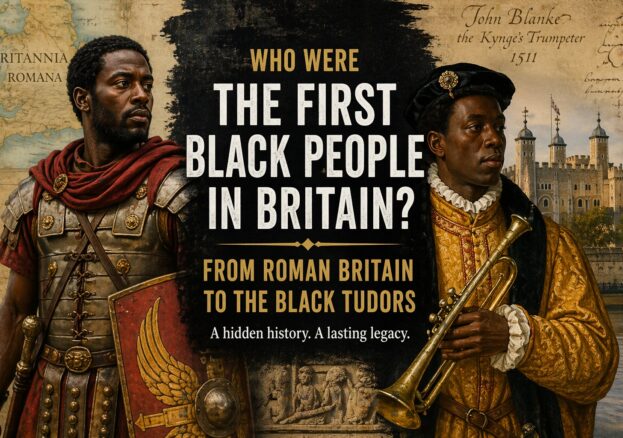
The earliest evidence of Black presence in Britain emerges during the Roman occupation. When the Roman Empire extended into Britain in 43 CE, it incorporated the islands into a vast imperial system that stretched across Europe, North Africa and parts of the Middle East. Within this system, movement was not exceptional — it was fundamental. Soldiers were recruited from across the empire, administrators were posted to distant provinces, and merchants followed trade routes that connected cities thousands of miles apart.
North Africa, in particular, played a significant role within the Roman world. Provinces such as Egypt and parts of modern-day Libya, Tunisia and Algeria were deeply integrated into imperial life. It is within this context that individuals of African origin came to Britain — not as outsiders to the empire, but as participants within it.
Archaeological discoveries offer glimpses into these lives. The burial of the so-called Ivory Bangle Lady in York, dating to the 4th century, remains one of the most compelling examples. Analysis suggests she may have had North African ancestry. Her grave goods — including jewellery, glassware and an ivory bracelet — indicate wealth and status. This was not a marginal figure, but someone embedded within the social fabric of Roman Britain.
Other finds, including skeletal remains from sites such as London and Southwark, have also suggested the presence of individuals with diverse ancestral backgrounds. While the evidence remains limited, it points towards a Britain that was far more connected and diverse than later historical narratives have often suggested.
Silences in the Record: Early Medieval Britain
With the collapse of Roman rule in the early 5th century, the historical record becomes quieter. This silence has sometimes been interpreted as absence, but it is more accurately understood as a limitation of sources.
Early medieval Britain produced fewer written records, particularly for ordinary people. What survives tends to reflect the concerns of elites — kings, clergy and landowners — rather than the full diversity of society. The absence of clear references to Black individuals during this period does not necessarily mean they were not present, but rather that their lives were not recorded in ways that have endured.
At the same time, Britain did not exist in isolation. Trade routes linking the British Isles to continental Europe and the Mediterranean continued, and with them, the movement of goods, ideas and people. While the evidence is fragmentary, it is reasonable to understand this period as one of reduced visibility, rather than complete disappearance.
Black Lives in Tudor England
By the 16th century, the historical record becomes more detailed, and Black individuals begin to appear more clearly within it. Tudor England was a society increasingly connected to the wider world through trade, diplomacy and exploration. These connections brought people from different parts of Europe, Africa and beyond into contact with English society.
One of the most well-known figures from this period is John Blanke, a Black trumpeter in the court of Henry VIII. He appears in the Westminster Tournament Roll of 1511, participating in royal celebrations marking the birth of a prince. More than a visual presence, Blanke was a paid member of the royal household. Records show that he successfully petitioned the king for a wage increase — evidence not only of his existence, but of his agency within the system.
Beyond the royal court, Black men and women lived in port cities such as London, Bristol and Plymouth. Parish records, household accounts and legal documents reveal their presence in a variety of roles — as servants, sailors, craftsmen and labourers. Some were free, others were not, and their experiences varied widely.
What emerges from these records is not a single narrative, but a series of individual lives, each shaped by the opportunities and constraints of early modern England.
Expansion, Empire and the Atlantic World
From the 17th century onwards, Britain’s role in the Atlantic world expanded rapidly. Trade routes linked West Africa, the Caribbean and the Americas to British ports, creating new patterns of movement and exchange.
This expansion brought increasing numbers of African people into contact with Britain. Some were brought as part of elite households, others arrived as sailors or servants, and some lived as free individuals within growing urban communities. London, in particular, became home to a small but visible Black population.
At the same time, Britain’s involvement in the transatlantic slave trade introduced a system of exploitation that would shape the lives of millions. While much of this history unfolded overseas, its effects were felt within Britain itself, where questions of freedom, identity and belonging were actively contested.
Voices of Resistance and Reform
It is within this context that figures such as Olaudah Equiano become central to the story. Born in West Africa and enslaved as a child, Equiano eventually purchased his freedom and became a leading voice in the abolitionist movement.
His autobiography, published in 1789, offered a powerful account of enslavement and its consequences. Widely read across Britain, it helped to humanise the experiences of enslaved people and contributed to the growing campaign to end the slave trade.
Equiano was not alone. Black writers, campaigners and community members played a significant role in shaping public debate during the late 18th and early 19th centuries.
Abolition and the Growth of Communities
The abolition of the slave trade in 1807, followed by the abolition of slavery in the British Empire in 1833, marked important legal milestones. Yet these changes did not mark a beginning, but a continuation.
Black communities continued to exist and develop, particularly in port cities such as Liverpool, Cardiff and London. These communities were shaped by migration, maritime work and family life, maintaining connections across the Atlantic world.
Their presence, though often overlooked, formed part of the social fabric of Britain throughout the 19th century and beyond.
Rethinking “First”
To ask who the first Black people in Britain were is to confront the limits of the historical record. There is no single moment of arrival, no definitive starting point. Instead, what emerges is a pattern — a history of presence that is intermittent in its visibility, but continuous in its reality.
This history challenges familiar narratives. It shows that Britain has long been connected to wider global movements, and that its past is more diverse than it is often imagined.
Recognising this is not about adding new stories to history, but about seeing existing ones more clearly. It is about understanding Britain not as an isolated island, but as part of a wider world shaped by movement, encounter and exchange over many centuries.