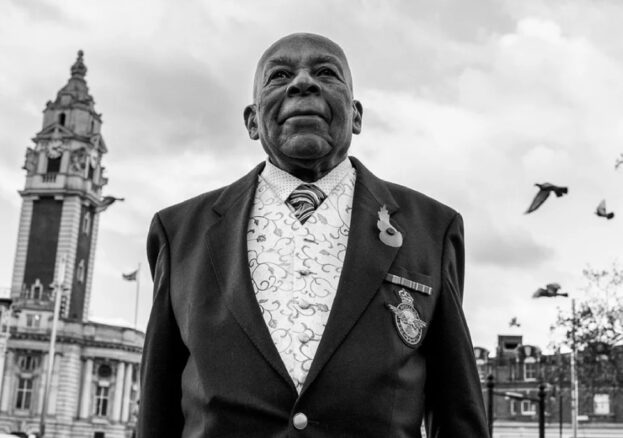
Born in Jamaica in 1925, Gilbert, his brother and sister lost their father when he was three. A bright pupil who stayed on a year longer at school, leaving at 16, Gilbert used his interest in mechanical and electrical things to charge up old batteries, make good other old electrical products and reuse light bulbs.
He quickly gained employment at Henderson bookstore, but his passion remained mechanics, and he only stayed a week. His next job, which lasted just over a year, was not in mechanics but selling men’s suits, shirts, shoes and other clothing.
In 1943 news came that volunteers were wanted by the RAF. To be accepted, candidates had to pass entry tests. Gilbert lied about his age, passed the tests and on 17th March 1944, along with the other successful volunteers, enlisted and was sent to Kingston Palisadoes RAF camp. After being kitted out and receiving some basic training, they were sent on a troop-carrying ship to Britain via the United States.
Gilbert would explain his reason for joining years later, “I volunteered like so many millions of others from Britain, the Commonwealth and elsewhere out of a sense of duty, to fight for king and country, to play my part like all the veterans here today in ensuring we left the world a better place for everyone”.
The journey to Britain was marked by torpedo attacks on their convoy by German U-Boats which hit a number of the ships. Gilbert finally docked at Liverpool on 3rd June 1944.
He would be stationed in camps around the country, initially in Filey in Yorkshire and then in Cambridge and elsewhere. While at the camps Gilbert would undergo physical training, combat training and attend classes to study radio and radar mechanics and engineering. They were also taught to identify both Allied and Axis planes and ships.
While at Cambridge studying radar equipment servicing, Gilbert and his class heard a heavy, droning noise. Gilbert recalled: “We all rushed outside to see what was happening. It was hundreds and hundreds of aircraft of all kinds; you could hardly see the sky. Our tutor, Chiefy Brown, said: ‘It’s started boys!’ and everyone started cheering and waving them on. That was when we first knew D-Day was underway.”
Gilbert would use his keen interest in electrics and mechanics to good use. He went on to train in, what was at the time, cutting-edge technologies to be a radio and radar mechanic repairing the wireless thermionic equipment in Spitfires, Hurricanes and Lancaster bombers.
After the war Gilbert was finally demobbed on 9th July 1948 and settled in the UK and used his new-found knowledge to become a radio and TV engineer. Music was a big part of his life, having learnt how to play the piano in the RAF and he continued to play right up until the end of his life. He worked tirelessly into his 90s ensuring that the service and sacrifice of all who came from the Caribbean and beyond is remembered. Gilbert participated in the annual pilgrimage to Ypres organised by the British West India Regiments Heritage Trust (BWIRHT) and in 2021 he spoke at the 77th anniversary of D-Day which also marked the opening of the British Normandy Memorial. In 2025, the BBC used his voice in the New Year’s Eve fireworks display saying the words “I feel very proud that I did something for peace.”
Gilbert died on 23rd May 2026, at the aged of 100. Speaking of his passing, Paul Chambers, Chair of BWIRHT, said, “He served his country with honour during wartime and dedicated his later years to ensuring the memory of Black Caribbean servicemen would never be forgotten… His was a remarkable life of service, resilience and dignity. Gilbert will remain forever part of our story.”