
Despite this enthusiasm, the War Office was reluctant to allow Black soldiers to fight against white European forces and even considered repatriating them. Intervention by King George V led to the establishment of the British West Indies Regiment (BWIR) on 26th October 1915.
Robert joined the 7th Battalion in 1917. His three-year-old sister Sarah later recalled him kissing her goodbye before leaving - she would never see him again.
Facing Inequality and Hardship
From the outset, BWIR soldiers faced discrimination. They were largely restricted to labouring roles including digging trenches, carrying ammunition and serving as stretcher bearers. They were not permitted to become officers or use weapons in combat. Camps were often segregated, and although some battalions later saw active service in Palestine, opportunities for recognition were rare. Even so, Caribbean soldiers were denied pay increases granted to other troops.
Training for the regiment began at Seaford in Sussex in late 1915. The cold climate and poor accommodation proved devastating for men accustomed to Caribbean conditions. Nineteen soldiers died from pneumonia and mumps.
Conditions were just as harsh at sea. One battalion aboard the SS Verdala encountered freezing temperatures after being diverted to avoid German ships. Without proper winter clothing and lacking warm food due to frozen pipes, many soldiers suffered severe frostbite. By the time help arrived, it was too late for many: two men died, and over 100 suffered frostbite, some requiring amputations. Numerous others were so weakened they had to be repatriated without ever seeing the front line.
Service and Sacrifice
In June 1917, Robert’s battalion was deployed to Belgium in preparation for the Third Battle of Ypres, known as Passchendaele. Canadian troops played a key role in the campaign, and a nearby dressing station became known as Canada Farm. On 12th September 1917, the area came under heavy bombardment. Robert was wounded and died the same day. He was buried at Canada Farm War Cemetery alongside four other BWIR soldiers killed in the same attack.
His parents received compensation of £3 and 4 pence (equivalent to about £180 today) for their son’s death.
A Family Legacy
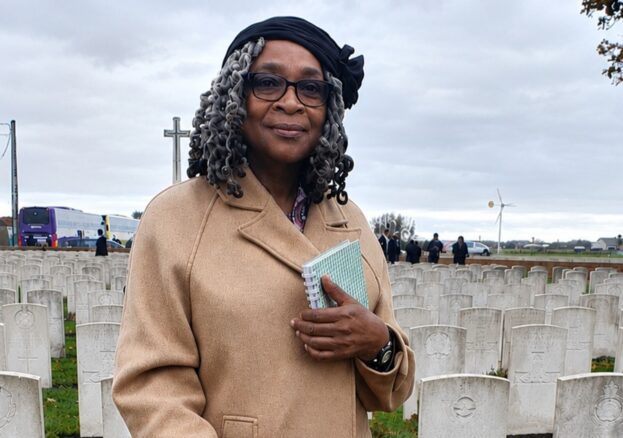
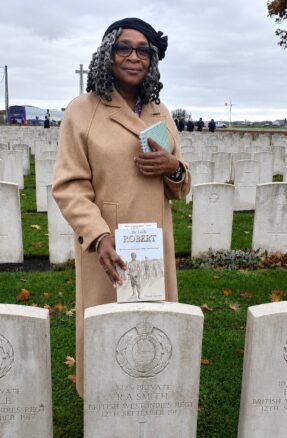
Robert’s story survived through his sister Sarah, who later became part of the Windrush Generation. She passed his memory on to her daughter, Beulah Coombs. For years, the family believed Robert had no known grave until Beulah’s daughter, Zennia, discovered its location and shared a photograph with Sarah shortly before her death.
Beulah later learned Robert had been awarded the British War Medal and Victory Medal: items she remembered playing with as a child. She visited his grave with family members, leaving a photograph of Sarah there.
In 2017, Beulah attended the unveiling of the African and Caribbean War Memorial in London. She later published a book about Robert in 2022 and revisited his grave in 2025. His legacy continues through descendants, including a great-great-nephew serving in the British Army.
Robert Adolphus Smith is no longer forgotten; his story represents both the service and struggles of Caribbean soldiers in the First World War and continues to inspire new generations to recognise their place in British history.