Long before the arrival of European ships on Caribbean shores, the islands were home to complex, organised and deeply rooted societies. Among them were the Taíno — the largest Indigenous group in the region at the close of the 15th century, and a people whose presence shaped the Caribbean long before colonisation redefined it.
Their story is often reduced to a brief prelude to empire — a civilisation encountered, described, and then erased. But the history of the Taíno is not simply one of disappearance. It is a history of settlement, adaptation, resistance and survival, embedded in the cultural fabric of the Caribbean to this day.
Origins and Migration
The Taíno were part of the wider Arawakan-speaking world, with ancestral roots in the northern regions of South America. Over generations, these communities moved gradually into the Caribbean, navigating rivers and coastlines before settling across the island chains.
By the time of European contact in 1492, Taíno communities were firmly established across Hispaniola (modern Haiti and the Dominican Republic), Cuba, Jamaica, Puerto Rico and the Bahamas. Across these islands, they developed distinct identities shaped by geography, yet bound by shared language, cultural practices and social organisation.
Historians generally identify three main Taíno groupings: the Classic Taíno, centred in Hispaniola and Puerto Rico; the Western Taíno, in Cuba, Jamaica and the Bahamas; and the Eastern Taíno, in the northern Lesser Antilles. Beyond these, related groups extended into Florida, where communities such as the Tequesta and Calusa emerged, demonstrating the broader reach of Arawakan migration.
A Structured and Connected Society
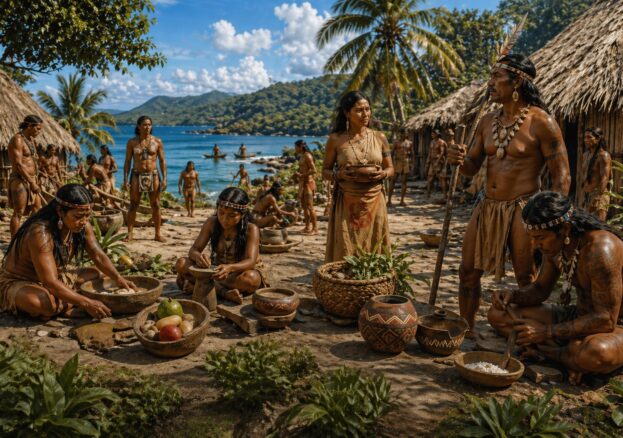
Taíno society was not loosely organised, as early European accounts sometimes implied, but structured and politically defined. Each region was divided into chiefdoms, governed by a cacique — a hereditary leader responsible for maintaining order, overseeing resources and guiding the community. Beneath them existed a social hierarchy that included nobles, skilled workers and agricultural labourers.
Their economy was rooted in agriculture, particularly the cultivation of cassava, alongside fishing and coastal navigation using dugout canoes. Craft production, including pottery, tools and ceremonial objects, also played an important role. Settlements ranged from small villages to larger population centres, some of which supported several thousand inhabitants. In Cuba alone, there were dozens of such chiefdoms, many of which later became Spanish colonial settlements, retaining their Taíno names.
Spiritual life was equally central. The Taíno believed in a world shaped by zemís — ancestral and spiritual beings tied to natural forces. Ritual, oral tradition and ceremony reinforced a worldview in which land, community and ancestry were inseparable.
Conflict and Movement in the Pre-Colonial Caribbean
The Caribbean before European arrival was shaped by movement, exchange and conflict. The Taíno had a complex and often tense relationship with the Caribs, who occupied parts of the Lesser Antilles. Evidence suggests that Carib raids influenced Taíno settlement patterns, pushing some communities further north and east.
These encounters were not only violent but also transformative. Language, culture and people moved between groups, creating a dynamic and interconnected region — far from the passive landscape often imagined in colonial narratives.
1492: Encounter and Misunderstanding
When Christopher Columbus arrived in the Caribbean in October 1492, he encountered the Taíno in the Bahamas. He described them as generous, physically strong and peaceful, noting their willingness to trade and their openness to strangers.
Yet these early observations were framed by misunderstanding. Columbus referred to them as “Indians”, a misidentification that would be imposed across the Americas. He renamed places, claimed land, and initiated a process that would rapidly transform the region. Within a few years, the relationship between Europeans and the Taíno shifted from contact to control.
Colonisation, Violence and Collapse
The Spanish presence brought devastating consequences. Through the encomienda system, Taíno communities were forced into labour, required to provide tribute, and subjected to colonial authority. The system, presented as protection, functioned as exploitation.
Violence, coercion and displacement became widespread. Alongside this came disease. With no immunity to European illnesses, Taíno populations were highly vulnerable. The smallpox epidemic of 1518–1519 is believed to have killed the vast majority of those who had survived the initial years of conquest.
Within a generation, populations collapsed dramatically. By the mid-16th century, official records indicated that only a small number of Taíno remained in Hispaniola.
Resistance and Leadership
Despite these conditions, the Taíno resisted. In Puerto Rico, Agüeybaná II led a rebellion in 1511, bringing together multiple chiefdoms against Spanish forces. In Cuba, Hatuey, who had fled from Hispaniola, became a symbol of resistance before his execution in 1512.
In Hispaniola, Enriquillo led a sustained rebellion in the 1520s, successfully challenging Spanish control and forcing negotiations. These acts of resistance demonstrate that the Taíno actively opposed colonisation and sought to defend their communities.
Cultural Survival and Continuity
The idea that the Taíno became extinct has been increasingly challenged. While population decline was severe, the people themselves did not disappear entirely. Intermarriage between Taíno, African and European populations led to the formation of new communities in which elements of Taíno heritage survived.
Language provides one of the clearest examples. Words such as canoe, hammock and barbecue all derive from Taíno. Place names, including Ayiti (Haiti), also reflect this enduring presence. Agricultural knowledge and cultural practices have similarly persisted.
In the 19th and 20th centuries, renewed interest in Indigenous identity led to movements reclaiming Taíno heritage, particularly in Puerto Rico and the Dominican Republic, as well as among diaspora communities in the United States. Today, many individuals identify as Taíno, asserting continuity rather than disappearance.
Reframing the Taíno Story
To understand the Taíno fully is to move beyond narratives of extinction. Their history did not end with European arrival. It continued through adaptation, survival and cultural transmission.
For Black History Month, recognising the Taíno is part of understanding the deeper histories of the Caribbean — histories that existed before colonisation and continued alongside the transatlantic world that followed. It reminds us that the Caribbean was not created by empire, but transformed by it, and that its Indigenous foundations remain essential to its identity.
References
- Altman, I. (2008) The War for Mexico’s West: Indians and Spaniards in New Galicia, 1524–1550. Albuquerque: University of New Mexico Press.
- Deagan, K. and Cruxent, J.M. (2002) Columbus’s Outpost among the Taínos: Spain and America at La Isabela, 1493–1498. New Haven: Yale University Press.
- Keegan, W.F. and Carlson, L.A. (2008) Talking Taíno: Caribbean Natural History from a Native Perspective. Tuscaloosa: University of Alabama Press.
- Rouse, I. (1992) The Taínos: Rise and Decline of the People Who Greeted Columbus. New Haven: Yale University Press.
- Sued Badillo, J. (2003) Autochthonous Societies of the Greater Antilles. Gainesville: University Press of Florida.
- Wilson, S.M. (2007) The Archaeology of the Caribbean. Cambridge: Cambridge University Press.
- Curet, L.A. (2014) ‘The Taíno: Phenomena, Concepts, and Terms’, Journal of Caribbean Archaeology, 14, pp. 1–20.
- National Museum of the American Indian (Smithsonian Institution) (n.d.) Taíno. Available at: https://americanindian.si.edu (Accessed: 21 April 2026).
- Encyclopaedia Britannica (n.d.) Taíno. Available at: https://www.britannica.com (Accessed: 21 April 2026).