
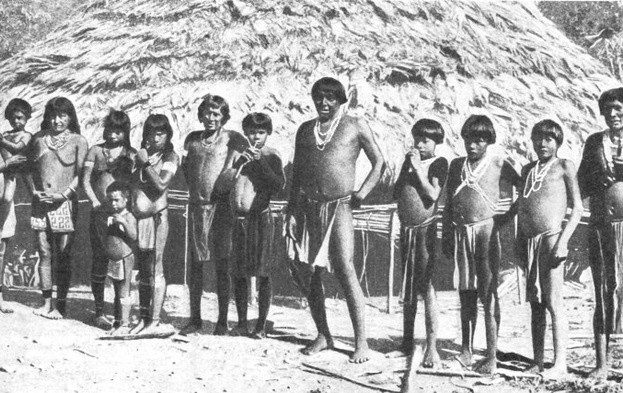
Long before European ships entered Caribbean waters, the islands were already part of a wider Indigenous world shaped by movement, language and settlement. Among the most influential of these peoples were the Arawak — a broad network of communities whose journeys from South America into the Caribbean helped to shape the societies that followed.
Their history does not begin with colonisation, nor does it end with it. Instead, the story of the Arawak is one of migration, adaptation and continuity, stretching across both land and sea.
Origins and Migration
The origins of the Arawak can be traced to the Orinoco River basin in northern South America, in what is now Venezuela and Guyana. From here, over generations, communities travelled northwards, following river systems and coastlines before moving out into the Caribbean. This was not a single migration, but a gradual process, marked by settlement, movement and exchange.
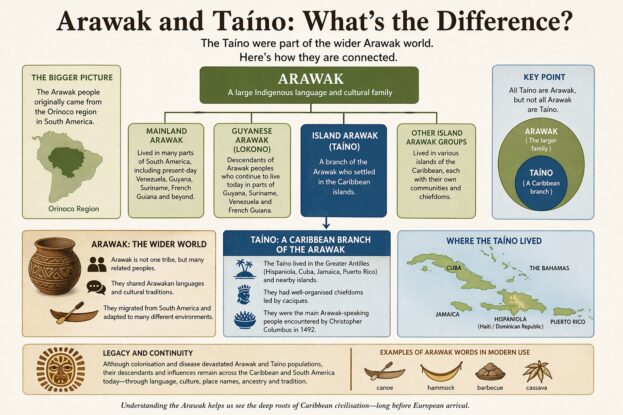 By the late 15th century, Arawakan-speaking peoples were established across much of the Caribbean, as well as along the mainland coasts of South America. They were not a single tribe, but a wider linguistic and cultural family, connected through shared language and traditions rather than political unity.
A Connected Caribbean World
In the Caribbean, the most familiar expression of this wider Arawak world was the Taíno. Living across Hispaniola, Cuba, Jamaica and Puerto Rico, the Taíno were part of this broader tradition — often described by historians as the “Island Arawak”.
Their societies, encountered by Columbus in 1492, were not isolated developments, but the continuation of centuries of migration and settlement shaped by Arawakan peoples. The Caribbean, in this sense, was already a connected and evolving region long before European arrival.
Society and Way of Life
Life within Arawak communities was organised, skilled and closely tied to the natural world. Agriculture formed the foundation of daily life, with cassava providing a reliable and widely cultivated staple. Fishing and coastal travel connected communities across islands, while craftwork — from pottery to tools — reflected both practical needs and cultural expression.
Leadership structures, often centred on figures known as caciques, provided stability and governance, while spiritual life was rooted in beliefs that connected people to ancestors, the environment and unseen forces. Oral tradition and ritual played an important role in maintaining this connection.
Encounter and Disruption
The Caribbean before European arrival was not isolated, but shaped by movement and encounter. Arawak-speaking peoples interacted with other groups, most notably the Caribs of the Lesser Antilles. These relationships influenced settlement patterns and contributed to a dynamic regional history.
The arrival of Europeans in 1492 marked a turning point. When Columbus first encountered Arawak-speaking communities, he described them as open and generous, willing to trade and engage. Yet these early observations quickly gave way to exploitation.
Spanish colonisation introduced forced labour, violence and displacement, fundamentally altering life across the Caribbean. Disease proved the most devastating force. With no prior exposure to European illnesses, Indigenous populations were highly vulnerable, and within a few decades, communities were reduced dramatically.
Survival and Legacy
For many years, historical accounts suggested that the Arawak had disappeared entirely. Today, this interpretation is widely challenged. While population decline was severe, the people themselves did not simply vanish.
Across mainland South America, communities such as the Lokono continue to maintain connections to Arawak identity, language and tradition. Across the Caribbean, Arawak heritage survives through culture, ancestry and language.
Words that have entered global use — such as canoe, hammock and barbecue — trace their origins to Arawakan languages. Place names, agricultural practices and cultural traditions also reflect this enduring influence.
Understanding the Arawak helps to reframe the history of the Caribbean itself. It shifts the starting point away from colonisation and towards the societies that existed long before it — societies that shaped the region and continue to inform its identity today.
For Black History Month, recognising the Arawak is part of understanding the deeper histories of the Caribbean — histories rooted in movement, knowledge and culture that long predate European arrival, and which remain present in many forms today.
References
- Rouse, I. (1992) The Taínos: Rise and Decline of the People Who Greeted Columbus. New Haven: Yale University Press.
- Hill, J.D. and Santos-Granero, F. (2002) Comparative Arawakan Histories. Urbana: University of Illinois Press.
- Keegan, W.F. and Carlson, L.A. (2008) Talking Taíno: Caribbean Natural History from a Native Perspective. Tuscaloosa: University of Alabama Press.
- Encyclopaedia Britannica (n.d.) Arawak. Available at: https://www.britannica.com