
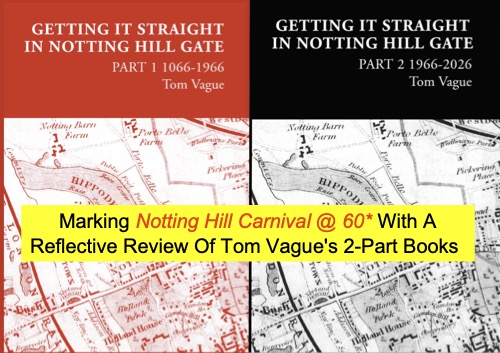
Getting It Straight In Notting Hill Gate Pt 1 1066-1966/Pt 2 1966-2026 (Tom Vague; PortobelloRadio)
By Kwaku BBM
To mark British Black Music Month (BBMM) 2026, African History Season 2026, and the 60th anniversary of Notting Hill Carnival, this reflective review places the event within the broader historical context of the area – both before and since its founding in 1966.
These are two books that can be bought separately, or together with a small discount. They are by Tom Vague, a psychogeographer who can probably be described as Mr Notting Hill History. Whilst his work, whether through books, pamphlets, blogs, talks, or walks generally covers North Kensington and its immediate environs, from Ladbroke Grove, Portobello, Notting Hill Gate, Holland Park to Kensington, his eclectic coverage takes in the music, fashion, politics, culture, counter-culture, community activism, adventure playgrounds, and housing activism connected with one of London’s most richly diverse and exciting areas of local history.
However, my introduction to Tom was through his writings on Notting Hill Carnival history, which includes the handy ’50 Years Of Carnival 1959–2009′ booklet. So naturally, I started by reading Part 2, which begins with 1966 – the year Tom states that Notting Hill surpassed Chelsea as “the grooviest part of London,” with several Swinging London film scenes, songs, and iconic photographs shot in Notting Hill. It was also the year that the London Free School (LFS) was set up, the organisation behind the first Notting Hill Carnival in 1966.
This being the 60th year, hopefully everyone will now accept that Notting Hill Carnival started in 1966 and was organised by Rhaune Laslett. It’s good that the book introduces several referenced facts, which mean that if you are so disposed, you can follow the stories beyond the book. However, useful as primary sources are, they can without further interrogation introduce or perpetuate myths. Such as Russ Henderson‘s often-used quote about how he and his steel band spontaneously went outside the confines and, voila, his gig became a carnival procession instead of just a children’s party. The truth is that there was a procession route mapped out in advance of Henderson’s arrival. Although the LFS imploded soon after that first Carnival 60 years ago, its story and its transition into areas such as raves, early Pink Floyd gigs, and the International Times underground newspaper deserve wider recognition. Among its members was Michael X (Michael de Freitas, Michael Abdul Malik), who brought Muhammad Ali to visit the children at the playgroup run by Carnival organiser Rhaune Laslett in her Tavistock Crescent home.
It wasn’t just celebrities such as actress Vanessa Redgrave and members of the Rolling Stones and the Beatles who breezed through Notting Hill for fashion on Portobello Road, soul food, or excitement in the 1960s. Even the likes of soul man Otis Redding, actor/singer Sammy Davis Jr, Jimi Hendrix, and Nina Simone made the journey to this happening part of west London. The books are info-packed with a wide range of facts, big or minutiae, with connections to Notting Hill. However, the drawback is that there is no index, so potentially some gems will be hidden within the pages of this well-researched book.
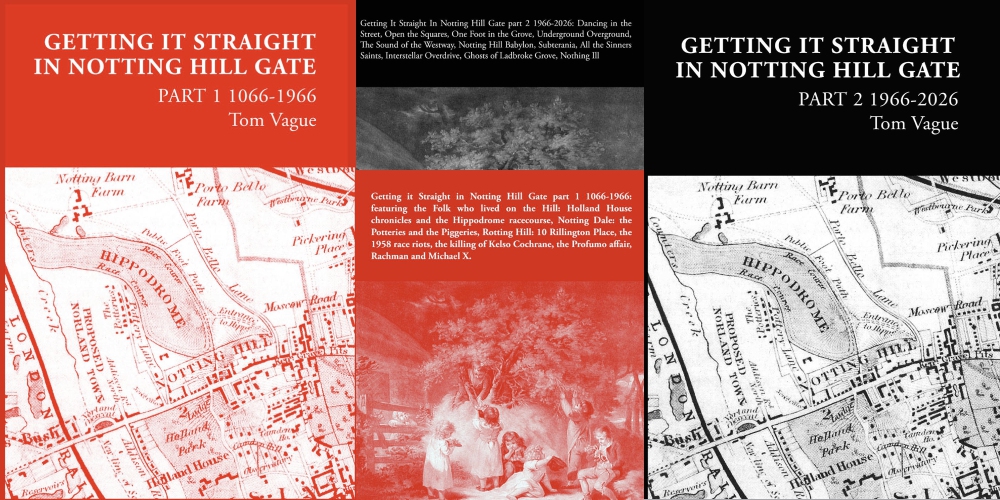
This is a book that touches to varying depths subjects such as Frank Critchlow‘s Mangrove restaurant and community hub; support and advice groups such as Laslett’s Neighbourhood Services and Caroline Coon‘s Release; Richard Branson‘s Virgin music empire; actor and singer Ram John Holder; alternative cinema houses such as the Electric; record shops including branches of Trojan’s Musicland/Musik City record stores; Leslie Palmer and Wilf Walker, who respectively introduced sound systems and live stages into Carnival; the ups and downs of the Carnival over the decades and the diverse acts who performed live, including Soul II Soul, Last Poets, Burning Spear, Arrow, Osibisa, Omar, and Courtney Pine; Lepke, founder of Dread Broadcasting Corp, which was started in Neasden before moving to Ladbroke Grove; the Rough Trade company which broke punk, indie rock, and other then-alternative music genres including roots reggae; influential fashion and record stalls, such as Rock On; underground newspapers and magazines like Friends and Oz, the latter being the subject of a cause célèbre obscenity trial; the Mangrove Nine and Angry Brigade trials; the Clash, Aswad, Pink Fairies, Pink Floyd, Hawkwind, and Lemmy who went on to gain mainstream success as part of Motörhead, and fusion rock band Quintessence (whose song provide the books’ titles), who didn’t quite break out as fellow Island acts such as Traffic; music industry bods such as artist manager Pete Jenner and record producer and Elektra UK executive Joe Boyd; the Westway arches, Acklam Hall, Metro Club, to the short-lived Zig Zag club, which catered for differing tastes from pop, rock, and hardcore to reggae; tower blocks from Trellick Tower to Grenfell Tower; the ever-gentrifying changing landscape of the 1990s where Trustafarians meet Rastafarians; hip cafes and bars; Subterania becomes the hip, showcasing club – thanks for the memories; the All Saints frontline inspired an eponymous hip female quartet who flopped when first signed to ZTT, which operated out of the old Island Basing Street studio/office complex, but went on to big things from the late 1990s into the 2000s.
In 2002, the longest-serving Carnival executive Claire Holder was ousted and moves to take the event outside North Kensington resurface. Adele plays the Tabernacle in support of her sophomore album ’21’. In 2015, supposedly marking Carnival’s 50th, Leslie Palmer, the organiser who cemented today’s Carnival format, and his Carnival Pioneers paid tribute to the women carnival organisers Claudia Jones, Rhaune Laslett, and Merle Major on Portobello Green. That year was a washout Carnival, which was attended by soon-to-be Labour Party leader Jeremy Corbyn. A year later, David Cameron was photographed relaxing and drinking coffee at the Lisboa Patisserie in Notting Hill with former Chancellor George Osborne, soon after resigning as Prime Minister following the EU referendum.
On June 14 2017 fire consumed some six dozen people in Grenfell Tower, and developments following the tragedy are covered in subsequent years.The Portobello Pop-Up Cinema screened ‘Reggae In A Babylon’ in tribute to DBC founder Lepke Anderson and ‘Burning An Illusion’ in tribute to the film’s director Menelik Shabazz. Not surprisingly, the launch in the Tabernacle of Ishmahil Blagrove‘s excellent ‘The Frontline: A Story Of Struggle, Resistance And Black Identity In Notting Hill’ tome is noted. In 2020, the Carnival for the first time moved online from the streets. Not being around, I’ve only discovered that the online offers included the Access All Areas sessions which gave the likes of superb local musician Asheber and his Afrikan Revolution and Don-e, who had links with Notting Hill through his manager Ron Tom, an opportunity to record closed live sessions from the famous Abbey Road studio.
Sadly, as the Carnival returned two years later to the streets post-Covid-19, in recent years it has made the news as much for the music as for the stabbings each year, some fatal as in 2022. In 2023, six years on from the devastating fire, the main organisations and companies connected with the refurbishment of Grenfell Tower – the cladding panel manufacturer and sub-contractor, the main contractor, Council, tenant management organisation, the insulation boards manufacturers, and the fire engineering consultancy – just passed the blame ball among each other. Two “iconic Notting Hill restaurants” closed down and re-opened, unlike some pubs that didn’t come back. The following year, a Mexican Taco opened which occupies part of the Portobello Road property from which Mangrove Nine defendant Rhodan Gordon first ran in the late 1960s the Back-a-Yard restaurant and cultural centre, before opening the Black People’s Information Centre on the same site.
The Medieval, Tudor to the Victorian periods of Notting Hill covered in Part 1 don’t interest me, though no doubt Tom provides useful information for local history enthusiasts on who lived where and built what over the centuries. So I jump well into the first book and find out that the slum conditions much highlighted in the 1950s and 1960s have a long history in Notting Hill. No sooner have the rich developed parts of Notting Hill than pockets of slums spring up around the homes of the rich. The 20th-century history which resonates with me comes from the latter part of the century.
West Kensington, where the greatest pan-Africanist Marcus Garvey died in 1940, isn’t within the immediate environs of Notting Hill. But Kensal Green cemetery, where his body was interred for 24 years before being transported to Jamaica, is within the Notting Hill catchment area. Hence the reason why Garvey is mentioned here. Though Tom doesn’t speculate on the year, which some reckon was 1957, there’s supposed to have been a so-called Marcus Garvey Skiffle Carnival that’s said to have taken place in St Stephen’s Gardens, featuring 1950s Notting Hill established African Caribbean characters such as Hubert ‘Baron’ Baker and Leopold ‘Totobag’ Williams. Not unexpectedly, the Bassett Road community hub and abode of Garvey’s first wife Amy Ashwood Garvey gets a mention. The 1930s Notting Hill Carnival was actually the Princess Louise Hospital Carnival, a fun and fundraising event for the hospital. One of the many surprising facts I discovered was that at the outbreak of World War II, windows of German and Italian businesses were smashed in Notting Hill, and no doubt elsewhere in the UK. Then immediately after WWII, homeless East Enders marched to Campden Hill to squat in the luxury block of flats in which Maltese and Gibraltarian refugees had been housed during the war. We know what fascist leader Sir Oswald Mosley and property tycoon Peter Rachman became in the 1950s, especially with their negative engagement with Africans. However it’s interesting reading their back-stories, no matter how brief. As Rachman located to London through the Polish Resettlement Act, I’m surprised Tom, who makes fascinating connections at every opportunity, did not make the connection of that Act and the Polish people who came to London from Mexico on the Empire Windrush with the “500 West Indian men”.
I must point out however that the 1948 Nationality Act did not “lift immigration restrictions” for the Windrushers or the subsequent Caribbean migrants. Do the nativists, racists and fascists who soon set up camp in Notting Hill know that the concept of the African Briton went back to the Roman Legions who had Africans in their ranks as they marched along the route of Holland Park Avenue centuries before the “first Anglo-Saxon immigrants arrived”?
Rachman is shown not to be the only slum landlord, but he sure profited from the desperation of mostly African Caribbean tenants. Him providing financial support for Europeans to buy homes away from his noisy “coloured” tenants is part of a bigger story of housing activism and profiteering, which Tom covers including spotlighting specific addresses of properties. The 1950s throws up stories about the likes of Michael de Freitas a.k.a. Michael X, a hustler and one-time Rachman enforcer and rent collector; the “West Indian” basement shebeens and nightclubs, including one owned by the Notting Hill based tailor Clifford Fullerton, where Duke Vin was the selector.
I knew record producer Joe Meek of ‘Telstar’ fame operated his recording studio on Holloway Road in north London. Not knowing that he previously operated a recording studio from his Ladbroke Grove bedsit. And I knew a South African High Commissioner lived in Campden Hill Road in Holland Park, where a 1960 Sharpeville massacre “strong resolution” was sent by the North Kensington Labour Party. But I didn’t know that one of the Boycott/Anti-Apartheid Movement’s arch-supporters, Father Trevor Huddleston, lived in Holland Park during the time of the 1958 riots.
The 1958 Notting Hill race riots are an inescapable important local history, well covered and which thankfully is coupled with what took place in Nottingham some days before. The local post-riots community organisations, such as the Coloured People’s Progressive Association, Advancement of Coloured Peoples Association, and United Africa and Asia League, respectively led by Frances Ezzreco, Amy Ashwood Garvey, and Hubert ‘Baron’ Baker, are mentioned. So too are what came out in the aftermath, such as Claudia Jones organising the West Indian Gazette Caribbean Carnival; and the adventure playground and rent tribunal campaigns of which de Freitas and London County Councillor Donald Chesworth were involved in. Things had hardly improved when the Afriphobic murder of Kelso Cochrane took place in May 1959. The attendant activities following his death, included the formation of the Inter-Racial Friendship Co-ordinating Council, which met with the Home Secretary and handled Cochrane’s funeral. We circle back to literally where I started with Part 2. Frank Critchlow’s brother Victor, Vibert Scrubbs and Frank Bynoe took over from Claudia Jones, who died on Christmas Day 1964, by organising indoor Caribbean carnivals in venues such as Porchester Hall in nearby Bayswater. Michael X gave Malcolm X a tour of Notting Hill in 1965. Michael X would also give Sammy Davis Jr and Dick Gregory the same British ‘Black’ ghetto tour. Same with Muhammad Ali, who was famously photographed in May 1966 outside the Tavistock Crescent home of Rhaune Laslett, from where she masterminded the first Notting Hill Carnival in 1966.
Click here to buy the books or listen to Tom talking about the books on Aidan McManus‘ Flipside London Radio Show on Portobello Radio.
*British Black Music Month covers June-July; African History Season covers October and beyond.