
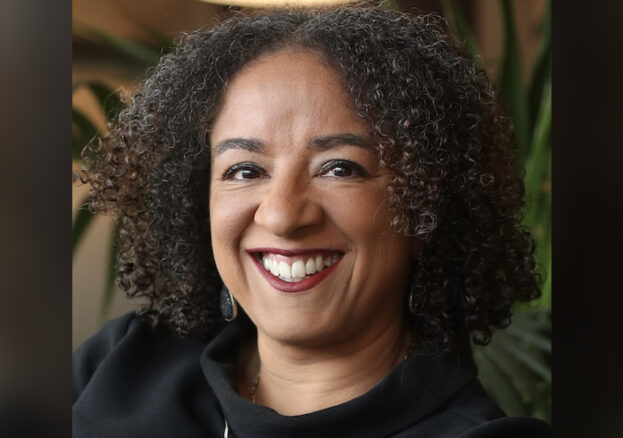
When Dr Wanda Wyporska speaks about community, she is careful not to use the word in the singular.
“Whenever people say community, I say communities,” she explains. “Togetherness is a feeling of solidarity. Community needs to be non-hierarchical in that sense. Solidarity means we are doing it together, for each other.”
It is a distinction that goes to the heart of her work. Communities are not fixed labels or neat categories into which people can easily be placed. They are shaped by heritage, family, language, memory, friendship, politics and lived experience. They can change throughout a lifetime.
For Dr Wyporska, identity has never been straightforward.
Born to a Polish mother and a father from the Windrush generation, she grew up immersed in her Polish heritage. She studied Polish history, literature and language at University College London, was President of the Polish Society and spent time living in both Warsaw and Kraków.
Yet, growing up in a town where there were only a handful of Black people, she was also aware of being visibly different.
“Community can be something that changes,” she says. “When I was younger, I felt very connected to the Polish side of my life. I grew up in a town where there was a handful of Black people. I couldn’t escape being different. But I chose the way in which I wanted to be different.”
Her Polish identity became especially important following the absence of her father, who left when she was two. It was made tangible through family customs, stories shared by her grandmother and a love of languages.
At the same time, racial injustice could not be ignored.
“I’ve always worked on racial injustice and injustice,” she says. “When you grow up as a Black person, you can’t grow up and fail to see racism. And when you experience it, you can’t ignore it.”
Her mother raised her to be politically aware, and growing up in the 1980s made that awareness unavoidable. Politics was present in everyday life, as were questions about race, equality and whose experiences were acknowledged.
Today, as Chief Executive of Black Cultural Archives in Brixton, Dr Wyporska leads one of Britain’s most important institutions for preserving the histories of people of African and Caribbean descent.
For her, Black history is not simply a subject to be remembered once a year. It is an active and necessary form of resistance.
“Black history is a political activity,” she says. “Preserving our history, to contest the established history, is something very critical. We are in charge of our own history, and therefore nobody can say that we are wrong because we have the evidence.”
That belief is central to the work of Black Cultural Archives. The organisation collects, preserves and shares the stories, records and objects that tell the wider history of Black people in Britain.
It is a place where visitors can encounter abolitionists, feminists, activists, artists, families and communities whose lives have too often been reduced, overlooked or excluded from mainstream accounts of British history.
Dr Wyporska describes it as an immense privilege to lead an organisation with such an important role.
“Black Cultural Archives has a huge role in Black British history in making sure that our stories are valued and told,” she says. “We have over 6,000 young adults coming through our doors, and we are teaching them about Black abolitionists, feminists and the active history of our people—that we weren’t just passive.”
As Chief Executive, she recognises that leadership brings responsibility as well as opportunity.
“Having that position of responsibility allows you to have the platform to bring up that injustice,” she says.
Her passion for history is also rooted in genealogy. For Dr Wyporska, tracing family histories is not only about discovering names and dates. It is an act of recognition.
“When I am looking through registers of enslaved people, just reading their names in my head is honouring and saying that you have not been forgotten. I am going to feel your presence and feel what you went through.”
This simple but powerful act reflects the spirit of Honouring Our Communities. It reminds us that people who were denied power, freedom and visibility still deserve to be named, remembered and treated with dignity.
Among her favourite items in the collection are imperial coins featuring Septimius Severus, the Roman emperor born in what is now Libya, who spent time in Britain during the second century.
For Dr Wyporska, they offer a powerful challenge to the idea that Black presence in Britain is recent.
“They show presence of being here in the second century,” she says. “It sets the tone of how Black people have been here for a long, long time.”
Dr Wyporska’s work is grounded in the conviction that history can help people understand themselves and one another more fully. It can challenge the false divisions created by labels and remind us of the connections that exist across cultures and generations.
“We have far more that we share than we don’t,” she says.
By leading Black Cultural Archives, advocating for racial justice and encouraging people to explore their own histories, Dr Wanda Wyporska is helping ensure that voices once silenced are heard and acknowledged.
Her message is clear: we do not need to become the same in order to stand together. We honour our communities by recognising their differences, preserving their stories and working collectively for a more truthful future.
As she puts it, “It is communities, not community.”