
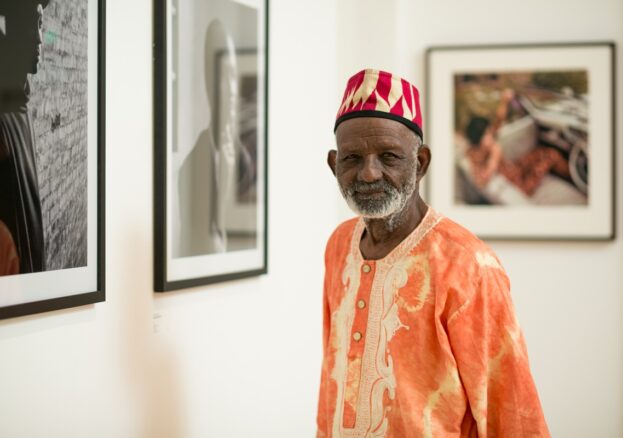
It was an absolute honour to attend James Barnor’s exhibition at the October Gallery. Witnessing such an inspirational character left me full of hope.
Barnor is the embodiment of “Honouring Our Communities”, from highlighting the foundations of our communities and our people to celebrating our contributions and hopes for the future through legacy.
As one of Ghana’s first photojournalists, Barnor contributed to the international anti-apartheid publication Drum magazine, as well as capturing the Swinging Sixties and the African diaspora in England. His aspirations transcended the two nations, leaving an impeccable legacy that is still discussed today.
“I wish there were younger people here, so that they can learn from my 97 years and build on it.”
Just sitting in the same room as Barnor and listening to him condense his life and achievements into a two-hour talk, I could feel his past, present and future honour.
Honouring Barnor Through the People He Honours
“Learning from others more than books.”
This quote from the talk stuck with me because initially I thought, “Isn’t learning from books learning from others?”
However, Barnor’s growth is about direct, natural contact rather than edited, indirect contact. Practical and active learning was still achieved, despite him not attaining the same level of academic achievement that this generation is advised it needs to succeed.
During those two hours of discussion, the majority of his gleeful talk was about the people who made him. Hearing about these interactions and the lessons he learned reinforced Barnor’s physical symbolisation of “Honouring Our Communities”. The most important part is the skeleton: the people who shape us.
Therefore, here are just a few of the names Barnor honoured in his talk.
A.Q.A. Archampong
“London is the place for you!”
As the quote above shows, Archampong played a significant role in encouraging Barnor to come to London to learn and apply his skills.
Barnor described him as a “top-class teacher and great friend”. When he needed to choose a name for his own studio, Barnor went back to Archampong for advice. As a result, the Ever Young studio was born.
Dennis Kemp
“Meeting Dennis Kemp changed my life.”
Kemp was a war veteran who trained as a medical photographer and gave Barnor his first Kodak camera.
His close association with Barnor’s photographic journey included sharing his knowledge of colour photography, which Barnor took back to Ghana. Kemp gave James Barnor a home and mentored him throughout his stay in London. This support contributed to the development of Barnor’s talent and interest in photography.
Kemp’s 1960 portrait of James Barnor hangs in the National Portrait Gallery.
These are only two names among the many discussed with great detail and affection. I could sense Barnor’s admiration and sincere gratitude for every interaction that shaped the man he is today.
Reflective Sentiments
Reflecting on his eventful journey, specifically during his travels in London, Barnor stated:
“I did more than anyone expected, and it was wonderful.”
This statement reinforces the idea that expectations are possibilities, not certainties. Therefore, we should not be held back by them because the result depends on our actions and self-belief.
Barnor’s achievements were not geographically limited, but they were temporally boundless. This can be seen through his nickname, “Lucky Jim”. He acquired this nickname because he was alive when everything was happening.
But what makes him luckier, and even more inspirational, is that he chose to capture these memories through his lens, becoming a part of everything that was occurring.
James Barnor is a 97-year-old man who may not be as active as before in terms of capturing memories with his camera, but he certainly has not stopped doing this through his talks and future aspirations.
First, Barnor wishes to exhibit photographs that he believes represent some of his best work but have not yet been showcased.
Second, Barnor wishes to teach modern photographers and young people about his story and the skills he acquired, so that the traditional ways of photography are not lost.
Third, his continued activity is most noticeable through the foundation he established in 2022 to preserve African cultural heritage and support the development of upcoming African talent.
Finally, Barnor wishes to have more people write about his experiences and perhaps document them in a book to ensure that his message is widely shared.
Therefore, I recommend keeping an eye out for biographies, articles and exhibitions documenting his life and work.
James Barnor has been shaped, supported and sustained by the people in his life. He has now taken what he has learned and is using it to ensure that he continues the cycle.
“I will never forget the people who helped and made me.”
Where to See Barnor’s Work
Barnor’s work can be seen during the remainder of the year at Africa Fashion, Musée du Quai Branly – Jacques Chirac, Paris, France, and Ibrahim Mahama: Le Temps des récoltes, Fondation Cartier pour l’art contemporain, Paris, France.
Between 2026 and 2027, his work will also be presented in Sunday Best at the Art Gallery of Ontario in Toronto, Canada.
For more information about this year’s exhibitions, please visit: James Barnor | Galerie Clémentine de la Féronnière