
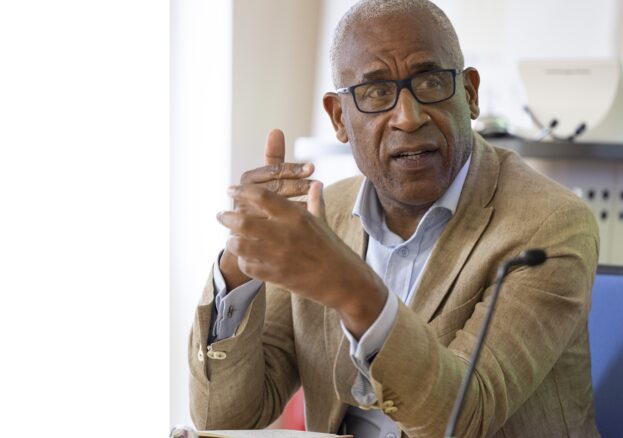
Simon Woolley, Baron Woolley of Woodford, has devoted his public life to a simple but powerful principle: Britain’s institutions should reflect and serve the full diversity of its people. As a campaigner, crossbench peer and educational leader, he has helped people from underrepresented communities recognise that their voices belong in the places where decisions are made.
His commitment to opportunity is rooted in his own life. Fostered and later adopted as a young child, he grew up on a council estate in Leicester. He left school without A-levels and later returned to education through an access course—an experience that changed the direction of his life. He studied Spanish and English Literature at Middlesex University before completing a master’s degree in Hispanic Studies at Queen Mary University of London. That journey gave him a lasting understanding of how easily talent can be overlooked when people lack encouragement, confidence or a clear route forward.
In 1996, he co-founded Operation Black Vote, becoming its first director. The organisation was created to address the political underrepresentation of Black and minority ethnic communities and to encourage greater involvement in Britain’s democratic life. Its work has included voter-registration campaigns, civic education, leadership programmes and initiatives designed to help people understand how political institutions work.
Lord Woolley’s approach has never been about telling communities what to think or which political party to support. It has been about ensuring that people recognise the power of their vote, feel able to question those in authority and have opportunities to become leaders themselves. Operation Black Vote has worked across political parties, helping to build a stronger pipeline of councillors, magistrates, school governors, public appointees and prospective parliamentary candidates.
When the organisation began, only a small number of Black and minority ethnic MPs sat in the House of Commons. Representation has grown considerably since then. That progress belongs to many campaigners and communities, but Lord Woolley and Operation Black Vote have played an important part in keeping political inclusion on the national agenda. His work has demonstrated that representation is not merely symbolic: decisions are stronger when they are informed by a wider range of experiences.
His commitment to equality also took him into national public service. He served as an Equality and Human Rights Commissioner and, from 2018 to 2020, chaired the advisory group for the Government’s Race Disparity Unit. The Unit brought together data on inequalities across areas including education, employment, health, housing and criminal justice. Lord Woolley argued that reliable evidence could make disparities harder to ignore and give communities a stronger basis on which to demand change.
In 2019, he was knighted for services to race equality and later that year was made a life peer. As Lord Woolley of Woodford, he sits as a crossbencher in the House of Lords, retaining political independence while contributing to debates about equality, democracy, education and social mobility. His elevation to the Lords placed a long-standing community campaigner inside one of Britain’s most influential institutions, but it did not separate him from the concerns that had shaped his work.
Education has become another important part of his leadership. In October 2021, Lord Woolley became Principal of Homerton College, Cambridge. His appointment brought his personal story full circle: someone who had once left school without A-levels was now leading a college at one of the world’s best-known universities. At Homerton, he has championed academic excellence alongside widening participation, inclusion and the belief that universities should actively seek talent in every community.
He has also supported programmes that prepare people from underrepresented backgrounds for senior leadership. These initiatives do more than help individuals advance. They challenge organisations to reconsider where they look for ability, whose potential they invest in and what leadership can look like. For Lord Woolley, opening a door is only the beginning; people must also be able to enter, contribute and thrive.
What makes his contribution especially valuable is the connection he draws between political power, education and community confidence. A young person who sees someone like themselves in Parliament, university leadership or public life may begin to imagine a different future. A registered voter may realise that their voice can influence local and national priorities. A mentoring opportunity may become the first step towards years of public service.
In honouring Lord Woolley of Woodford, we recognise a leader who has spent decades making British democracy more inclusive and opportunity more widely shared. His journey from a Leicester council estate to the House of Lords and the leadership of a Cambridge college is remarkable, but his wider legacy lies in the paths he has helped create for others. Through persistence, practical action and faith in overlooked talent, he has helped more people believe that public life belongs to them too.