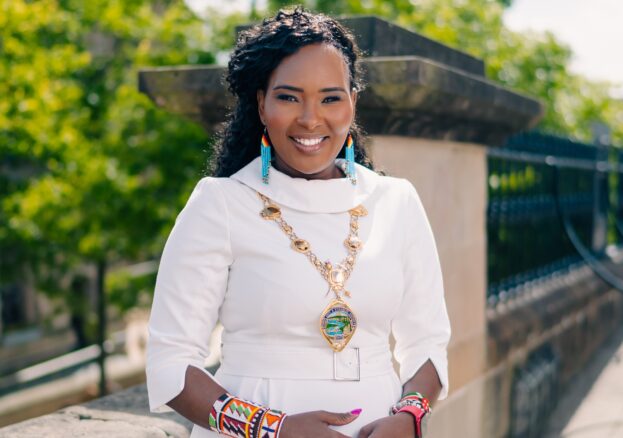
Long before Lilian Seenoi-Barr entered politics, she understood that leadership begins with taking action.
Born and raised in Kenya and proud of her Maasai heritage, Lilian began campaigning for the rights of women and girls early in her life. In 1999, she co-founded a project supporting Maasai girls at risk of early forced marriage and female genital mutilation. The work also pressed for stronger legal protection and better access to primary education for disadvantaged communities.
In 2010, Lilian arrived in Northern Ireland as a refugee and made Derry her home. Starting again in a new country gave her direct experience of the barriers migrants, refugees and asylum seekers can face—from navigating unfamiliar public services and encountering discrimination to rebuilding a life without established support networks.
Rather than allowing those experiences to limit her, Lilian used them to help others.
In 2012, she founded the North West Migrants Forum, providing advice, advocacy and practical assistance while challenging racism and negative stereotypes. Today, she serves as its Chief Executive Officer. The organisation has become an important voice for Black and minoritised communities across the region, helping people understand their rights, access services and participate in decisions affecting their lives.
Her move into elected politics brought that community experience directly into local government.
Lilian joined Derry City and Strabane District Council through co-option in June 2021 as an SDLP representative for Foyleside. In 2023, she was elected to represent the area, becoming the first Black person elected as a representative in Northern Ireland.
Then, in June 2024, she made history again when she became Mayor of Derry City and Strabane—the first Black mayor in Northern Ireland.
The significance of that moment went well beyond one individual achievement. For Black children, migrant families and minority communities, it demonstrated visibly that civic leadership was not a space closed to them.
But Lilian was determined that her mayoralty should be measured by more than the history it made.
She pledged to be a mayor for everyone: approachable, visible and committed to serving communities across the district.
During her year in office, she supported the signing of the Financial Deal for the Derry~Strabane City Deal, intended to create new economic, cultural and employment opportunities. She also represented the district internationally, promoting Derry and Strabane as a place of innovation and investment.
At the same time, community work remained central.
Her One Big Weekend, One Big Cause programme supported the BUD Club, which works with children and young people with disabilities. The initiative brought people together through culture, music and fundraising.
Lilian also established Our Guildhall, Our Place, an inclusive youth hub that gave young people a voice within one of the district’s most important civic buildings. She hosted a birthday celebration for children and young people with additional needs and organised a Christmas gathering recognising residents who had gone out of their way to help others.
These were not simply ceremonial activities. They reflected her belief that public institutions should feel open and responsive to the people they exist to serve.
Her influence has also travelled far beyond Northern Ireland. Lilian addressed the Congressional Black Caucus Annual Legislative Conference in Washington and, at Howard University’s 2025 commencement, received an honorary Doctor of Laws degree recognising her contribution to human rights, equality and public service.
Her historic rise was not without opposition. Lilian faced racist abuse and personal threats following her appointment as mayor.
She refused to allow that hostility to determine how she carried out the role. She continued meeting residents, visiting schools, supporting community organisations and representing the district.
That response matters. Representation cannot only mean opening a door; it also means ensuring intimidation does not decide who is entitled to walk through it.
Lilian Seenoi-Barr is being honoured not simply because she became Northern Ireland’s first Black mayor, but because of the work that came before and after that milestone.
Across more than two decades of campaigning and public service, her work has supported women and girls, migrants, refugees, young people, disabled children and families. She has taken experience gained through grassroots campaigning into the council chamber and used public office to widen participation rather than simply occupy a historic position.
Her journey shows that leadership can begin a long way from government buildings. It can begin with protecting a girl, helping a newly arrived family or challenging a system that is not listening.
Lilian Seenoi-Barr made history—and then used that moment to help more people believe that public life could include them too.