
Walk through Britain and much of its history can be read on its walls. Plaques and monuments reveal whose achievements a country has chosen to remember.
For generations, however, African and Caribbean people were largely absent from this public record. Their contributions could be found throughout British life, but their names and stories were rarely given a permanent place in the landscape.
Dr Jak Beula has devoted his life to changing that. As founder and chief executive of the Nubian Jak Community Trust, he has created a visible public record of people, organisations and events whose significance had too often been overlooked. His work has changed not only who Britain commemorates, but how Black British history is discovered and passed to future generations.
Jak’s career has crossed the arts, social work, education and heritage. A former performing artist and model, he became the first Black model to become the International Face of Interflora. His most enduring contribution, however, has come as an educator, cultural historian and designer of public memorials.
Education remains central to his work. Through publications, workshops, exhibitions and community projects, Jak has helped people of all ages engage with histories that have often received limited attention in schools and public institutions.
His purpose is not simply to install a plaque or unveil a monument. It is to build understanding around the person or event being commemorated and create opportunities for communities to participate in preserving their own heritage.
Established in 2006, the Nubian Jak Community Trust developed an ambitious programme of plaques, sculptures, publications and commemorative events. It is the only such organisation with a specific remit to recognise Black and minority ethnic heritage in Britain and across the wider diaspora.
The Trust has installed more than 120 blue, black, bronze and green plaques in the UK and internationally. Together, they demonstrate the extraordinary breadth of Black history.
Its plaques have commemorated historical figures and campaigners including Mary Prince, Ignatius Sancho, Frederick Douglass and Claudia Jones. They have honoured Stephen Lawrence and celebrated artists and musicians such as Bob Marley, Jimi Hendrix, Miriam Makeba, Eartha Kitt and Althea McNish.
Other plaques recognise the African National Congress, the Wailers and the history of Notting Hill Carnival. These commemorations show how Black history reaches across politics, civil rights, literature, music, art and community life.
In 2024, the Trust worked with Camden Council and Bloomsbury Central Baptist Church to unveil the UK’s first blue heritage plaque honouring Martin Luther King Jr. It marks the church where Dr King preached during his 1961 visit to London, connecting an internationally recognised civil-rights leader to a specific chapter of British history.
Each plaque connects a person to a building, neighbourhood or historic moment. It tells residents that something important happened there and invites younger generations to ask who walked those streets before them.
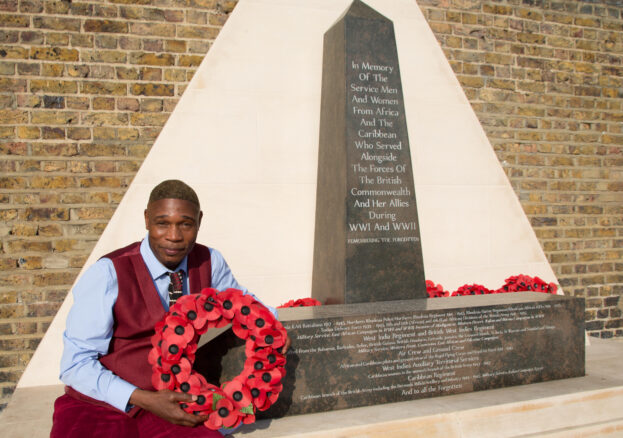
Jak’s contribution can also be seen in two major public monuments. The African and Caribbean War Memorial, designed by him and permanently unveiled in Windrush Square, Brixton, in 2017, honours the more than two million servicemen and women from Africa and the Caribbean who supported Britain and its allies during the First and Second World Wars.
For generations, their courage and sacrifice had received too little public recognition. The memorial gave their service a dignified place within Britain’s tradition of remembrance.
Jak also pioneered the annual African and Caribbean Remembrance Sunday at Windrush Square. The ceremony brings veterans, families, community representatives and younger generations together, ensuring that remembrance remains an active and shared responsibility.
He also designed the Windrush and Commonwealth NHS Nurses and Midwives Statue, unveiled at Whittington Hospital in North London in 2021.
The monument recognises the Commonwealth healthcare professionals whose skill and commitment helped build and sustain the National Health Service. The accompanying publication, Nursing a Nation, records and preserves the experiences of nurses and midwives whose contribution was not always properly acknowledged.
Public monuments influence whose service is valued, while plaques determine which lives become part of the history encountered in everyday places. Jak has not simply called for greater inclusion; he has built a new structure of public remembrance.
Working with historians, families, schools, councils and cultural organisations, he has transformed overlooked stories into permanent educational resources. His importance is measured not only by the number of plaques installed, but by the conversations they begin and the sense of belonging they create.
Dr Jak Beula is being honoured because he has changed the landscape of British memory. He has placed names on walls, memorials in public squares and knowledge in the hands of young people.
Through vision, research and determination, he has helped ensure that Black British history is recognised not as a footnote, but as an essential part of Britain’s past, present and future.