
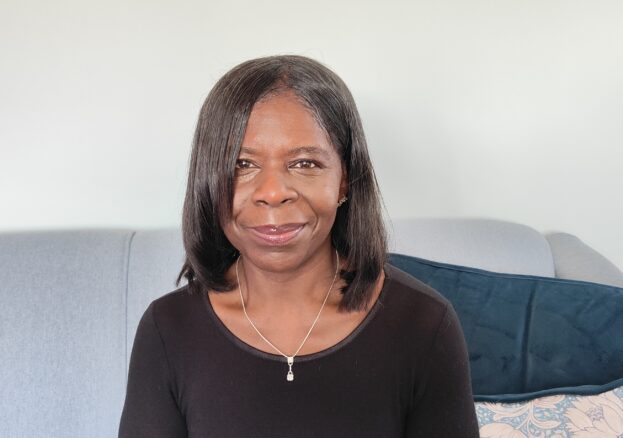
Campbell’s story has been shaped by family, identity, racism, setbacks, renewed confidence and a lasting commitment to justice. It is also a story of determination: learning when to take control of your direction and knowing when to grab the wheel.
Growing Up British-Jamaican
Campbell’s parents were part of the Windrush generation. As a British-born Jamaican, she grew up carrying both her parents’ hopes and the complexities of living between cultures.
“For our parents’ generation, we were the ones expected to achieve, not them,” she explains.
As a child, however, she did not constantly analyse her identity. Jamaican culture was simply part of everyday life.
“As children we were not aware of it. There was no dilution, we got it head on from our parents’ background. It was automatically something we grew up with; it was part of our culture.”
Campbell spent her first ten years on an Orthodox Jewish street, where hers was the only Black family. The family later moved to Tottenham, to a street where almost everyone was Jamaican.
“We moved from one side of the scale to the other, and both were equally beneficial to us.”
It was only as she grew older and encountered established institutions that she became more aware of how race shaped other people’s perceptions of her.
“The difficulties we were going to face became more and more apparent the older we got, and the more we began to embroil ourselves into the establishment.”
When Someone Else Defines Your Potential
One experience had a lasting impact. A teacher told Campbell that she was not “an A-level student”.
Today, she recognises the comment within a wider context of race and low expectations. At the time, she simply believed her teacher.
“I didn’t think that it was racism at the time. I just believed my teacher.”
This came after she had already been told to “go back to where I came from” and made to feel that she did not fully belong in Britain.
Campbell also saw Caribbean pupils struggle in an education system that often treated difficulties as evidence of limited ability rather than considering the cultural and social barriers they faced.
“We were from the Caribbean, and we weren’t doing as well as our fellow students, but that was also put down to our inability rather than the cultural barriers that we were facing.”
Her father encouraged her to reject those limitations, but as a child she trusted the authority of her teacher.
“Why question my teacher?”
It is one reason Campbell shares her story today. She wants young people to question negative assumptions about their potential rather than internalise them.
Not every teacher discouraged her. Earlier teachers had recognised qualities that could make her an excellent lawyer: intelligence, confidence and a willingness to speak up. Campbell was fascinated by law, and becoming a lawyer would have made her parents proud.
But her confidence had been damaged, and rebuilding it would take time.
Rice and Peas and Fish and Chips
Campbell’s identity and experiences later inspired her book, Rice and Peas and Fish and Chips.
The title reflects how she sees herself.
“Every Sunday we would have rice and peas, and every Friday you are having fish and chips. You can’t separate the two.”
For Campbell, Britishness and Jamaicanness are not competing identities.
“I love my fish and chips, and I love my rice and peas. And that is a culmination of who we are, who I am, what I stand for and what I love.”
She wanted the book to reflect the richness of her experience, not focus only on hardship.
“I had the best of both worlds, and the book had to be that, not just the negatives.”
That balance of acknowledging struggle without allowing it to define an entire life runs throughout Campbell’s story.
Rebuilding Confidence
Campbell returned to education and completed her degree in her early thirties. The biggest difference was confidence.
She came to understand that ability does not disappear simply because circumstances prevent it from flourishing.
“You can never stop being good at something. You just forget that you are good at it when other things stop you from focusing on it.”
For 14 years, Campbell worked as a benefits counsellor and in administration. She gradually took on more complex cases and corporate complaints, rediscovering her ability to write, analyse arguments, navigate systems and advocate for others.
Initially, she considered studying English literature because of her love of writing and ambition to become an author. But she also wanted a profession that could offer greater financial opportunities.
Law brought those interests together.
“I always enjoyed law, and law is literally reading all the time and drafting and writing. So, I got the best of two worlds in choosing to do law.”
Leaving behind security was difficult.
“The scariest part of the journey was the beginning. When you decide to jump ship, all the safe things in place are left behind.”
For Campbell, changing direction requires accepting uncertainty and remaining focused.
“If you want to truly change your life, you must focus on you.”
Fighting for Justice4Windrush
Today, Campbell uses her legal skills as a pro bono lawyer with Justice4Windrush, supporting people affected by the Windrush scandal.
For her, the work is deeply personal.
“People seem to think lawyers make loads of money, but for me, the most powerful fulfilment is when I don’t earn a penny.”
She represents people trapped in systems that have left them feeling powerless. Some have been unable to prove their documented history in Britain and have faced devastating consequences involving employment, housing, healthcare, education and their right to remain in the country.
Campbell’s role involves more than legal representation.
“It is all about using my skill and my knowledge to give a voice to individuals who felt like I did.”
Many people who approach Justice4Windrush have lost confidence after years of being challenged, disbelieved or failed by institutions. Campbell therefore sees restoring self-belief as part of her work.
“It is not just about representing them as a lawyer; it’s giving them the confidence they need to believe that they’re worth something.”
Her message is clear:
“They are worth the fight.”
Pull the Ladder Down
Campbell understands the importance of visibility. She puts herself forward to respond to issues in the media, contribute to discussions and highlight the work being done.
“If people recognise what you’re doing, it only does a ripple effect for others.”
Success, she believes, comes with responsibility.
“Don’t pull up the ladder. Pull the ladder down and enable other people to climb that ladder and come behind you.”
That principle is central to her understanding of community. Communities become stronger when people share knowledge, challenge injustice together and resist retreating into individual success.
The struggle for justice also requires different communities to communicate and learn from one another.
“If we come together and talk to each other and learn from each other, I think we’re in a stronger position.”
She recalls a phrase used by Justice4Windrush CEO Collin McFarlane:
“Once you know, you care.”
Awareness must lead to action.
“Every fight for equality is about shocking people into action.”
Community Is Strength
Ask Campbell what community means and her answer is immediate:
“Community is strength.”
For her, community means “holding each other to account and overcoming our differences so that the community can thrive.”
She worries that some people distance themselves from the communities that supported them once they become successful. Campbell has consciously resisted that.
“As a lawyer, I’ve not changed my accent at all. As long as you know your stuff and you are a professional, you never need to lose your authentic self.”
Achievement does not require becoming someone else.
“No matter where you go and how high up you get, the one person you can never lie to is yourself.”
Campbell also believes strong communities must make room for difficult conversations. People will disagree, disappoint one another and sometimes take positions that appear contrary to their communities’ interests. But permanent rejection is not always the answer.
“We tend to criticise one another more than we should. We should be working together to thrive and to strive.”
Even people who have taken the wrong path may possess knowledge that can help others avoid it.
“The best people to teach you how to get out of gangs are ex-gang members. Bring them in because they can help the change.”
Knowing Your Worth
Pauline Campbell’s journey is about more than becoming a lawyer. It is about what happens when potential is underestimated, confidence is damaged and someone chooses to rebuild anyway.
It is about holding British and Jamaican identities without surrendering either. It is about using professional success to defend people pushed to the margins. And it is about remembering where you came from when opportunities arrive.
From the student who believed she was not capable of A-levels to the lawyer helping others challenge powerful institutions, Campbell’s life shows the danger of allowing other people to decide our worth.
Her response has been to reclaim that power and use it for others.
That may be the most powerful expression of community: knowing your own value, helping others recognise theirs and never pulling the ladder up behind you.