
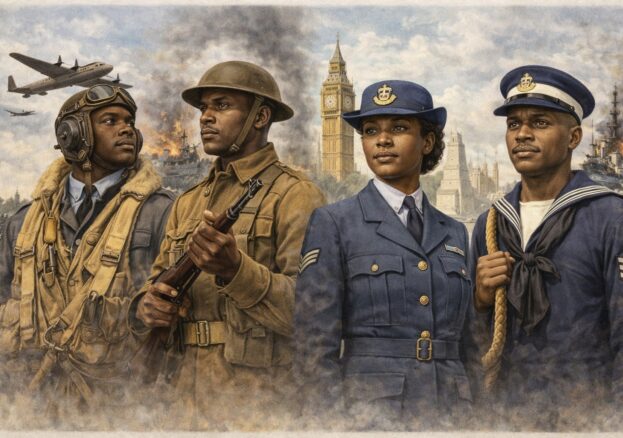
The Second World War was not fought by Britain alone. It was a global conflict, drawing on the people and resources of an empire that stretched across the Caribbean, Africa, and beyond. Among those who served were thousands of Black men and women whose contribution formed an essential part of Britain’s war effort.
Across the war, more than 16,000 men from the Caribbean volunteered for service in British forces, alongside millions from across Africa and other parts of the empire.
Their service often involved significant risk. Whether in the air, at sea, or in support roles behind the front lines, individuals from across the empire took part in a war that demanded endurance, discipline, and, in many cases, personal sacrifice.
For many years, these histories were not widely included in how the war was taught or remembered. Today, they are increasingly recognised as part of the wider story of Britain during the mid-twentieth century, due in part to the work of organisations such as the Royal British Legion, which has supported efforts to acknowledge the contribution of Commonwealth servicemen and women.
Historians and writers have also played an important role in bringing these histories to wider attention. Among them is Stephen Bourne, a British writer and historian specialising in Black British history and culture. Through works such as Black Poppies: Britain’s Black Community and the Great War and Under Fire: Black Britain in Wartime 1939–1945, Bourne has helped document the experiences of Black servicemen and women and highlight stories that were previously overlooked.
Empire and Wartime Commitment
By 1939, Britain depended heavily on its empire. Recruitment extended across the Caribbean and Africa, bringing men and women into military and civilian roles at a time when the outcome of the war was uncertain.
Many volunteered knowing that service could involve danger far from home. Some were motivated by a sense of duty to Britain, shaped by education and imperial ties. Others saw enlistment as an opportunity for work and training. In all cases, service required commitment under conditions that could be demanding and, at times, life-threatening.
Opportunities were not always equal. Racial attitudes influenced how individuals were recruited and deployed. Some were placed in labour or support roles regardless of their abilities. Yet these roles were essential, and the war could not have been sustained without them.
Service in the Royal Air Force
Service in the Royal Air Force (RAF) placed individuals at the centre of some of the most dangerous operations of the war. Around 6,000 Caribbean personnel served in the RAF, alongside many others from across Africa and the wider empire.
Aircrew faced particularly high risks. In Bomber Command, more than 40 per cent of those who served were killed during operations.
Ulric Cross, from Trinidad, served as a navigator on bombing operations. His role required precision under pressure, guiding aircraft through hostile territory while under the risk of enemy fire.
Billy Strachan, born in Jamaica, served as a wireless operator and air gunner. His duties involved defending aircraft during missions, often in conditions where survival depended on coordination and timing.
Women also contributed to RAF operations. Lilian Bader, from Liverpool, joined the Women’s Auxiliary Air Force (WAAF), working in aircraft instrument repair. Her role ensured that aircraft remained operational, supporting missions that placed others directly in danger.
These roles, whether in the air or on the ground, formed part of a system in which each individual’s work carried responsibility and risk.
The Army and the Caribbean Regiment
Many Caribbean men served in the British Army, particularly within the Caribbean Regiment. These units were deployed to regions including the Middle East and Italy, where conditions could be harsh and unfamiliar.
Their work focused on logistics—moving supplies, building infrastructure, and maintaining transport routes. While not always in front-line combat, these roles were essential to sustaining military operations.
Service in these environments involved physical demands, long periods away from home, and exposure to wartime conditions. At the same time, restrictions were placed on how Caribbean soldiers could serve. Many were not permitted to take on combat roles alongside white British troops.
This reflected the social attitudes of the period rather than the realities of wartime need. Even so, their contribution remained critical to the functioning of the army.
Dudley Thompson, who later became a political figure, experienced this system directly, recognising both the responsibility of service and the inequalities within it.
The Merchant Navy and the Risk at Sea
Among the most dangerous roles of the war were those carried out by the Merchant Navy. Seamen from the Caribbean and West Africa worked on ships that transported vital supplies across the Atlantic.
At certain stages of the war, up to one third of the Merchant Navy workforce came from overseas, including large numbers from the Caribbean and West Africa.
These journeys took place under constant threat from German submarines. Ships were torpedoed, and survival rates in cold waters were often low. More than 30,000 Merchant Navy personnel lost their lives during the war.
Their work, however, was indispensable. Britain depended on imported food, fuel, and equipment. Without the Merchant Navy, both civilian life and military operations would have been severely affected.
The risks faced by these seamen represent one of the clearest examples of sacrifice within the wider war effort.
Service in Britain: The Home Front
Service was not limited to overseas operations. Black men and women also contributed within Britain, supporting the war effort in essential roles.
Norma Best, from Belize, served in the Auxiliary Territorial Service (ATS), assisting with the organisation and administration of military activity.
Others worked in factories, transport systems, and hospitals. These roles ensured that equipment was produced, services were maintained, and the wounded were cared for.
While these contributions were less visible than combat roles, they were vital to the overall war effort. They also required endurance and commitment over long periods.
Experience and Inequality
Service during the war took place within a society shaped by racial inequality. Black servicemen and women often encountered barriers in recruitment, promotion, and daily life.
Lilian Bader experienced rejection before being accepted into service, reflecting the limitations placed on individuals even during wartime.
Despite this, many served with professionalism and discipline. In operational environments, cooperation was often essential, and shared conditions could bring individuals together regardless of background.
A full understanding of wartime service must recognise both the contribution made and the conditions under which it was made.
From Service to Post-War Britain
The end of the war did not mark the end of its impact. Many who had served returned to Britain in the years that followed, contributing to post-war reconstruction.
The arrival of the Empire Windrush in 1948 is often seen as a defining moment, but it was shaped in part by earlier wartime service. Individuals who had served Britain during the war had established connections that influenced their decision to return.
Their experiences of service and sacrifice became part of the foundation of modern British society.
Legacy and Recognition
The service of Black men and women during the Second World War involved commitment, responsibility, and, in many cases, personal sacrifice. Their contributions took place across different roles, from combat operations to logistical support and work on the home front.
These efforts were essential to Britain’s ability to sustain the war. They also reflect the wider role of the British Empire in shaping the outcome of the conflict.
Recognising this history provides a clearer understanding of the war and its legacy, while ensuring that the experiences of those who served are properly acknowledged.
Sources and Further Reading
- Imperial War Museums, Black British History and the Second World War
- Royal Air Force Museum, Commonwealth and Empire Personnel in the RAF
- National Archives (UK), Colonial Troops and the Second World War
- Royal British Legion, Remembering Commonwealth Service in the World Wars
- David Olusoga, Black and British: A Forgotten History
- Mark Johnson, Caribbean Volunteers at War
- Stephen Bourne, Under Fire: Black Britain in Wartime 1939–1945
- Stephen Bourne, Black Poppies: Britain’s Black Community and the Great War