
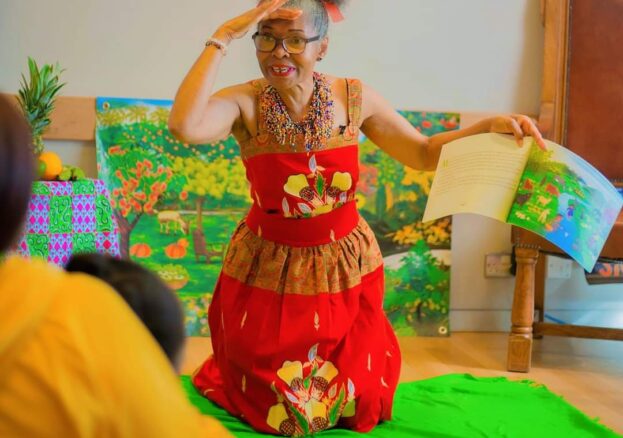
I am proud to celebrate my wonderful mum, Carrol May Nelson, author of the much-loved children’s book series The Dolly May Stories.
Through her books, Mum is helping to improve the positive representation of African-Caribbean and dual-heritage children in literature. Her stories allow children to see themselves, their families and their cultures reflected positively in the books they read.
Carrol was born and raised on the beautiful Caribbean island of Jamaica. She has now lived in Manchester for 57 years, but her childhood memories remain at the heart of her writing.
Her stories were inspired by memories of her grandmother’s mountain garden—a place where nature, creativity, storytelling and imaginative play shaped her early life. That garden became the inspiration for a magical world through which new generations of children could explore their heritage and imaginations.
Mum began writing after struggling to find picture books that reflected her own family and community. She recognised that African-Caribbean and dual-heritage children were still too rarely represented as the central characters in joyful and imaginative stories.
After retiring, she decided to help fill that gap herself.
As a mother of three and a grandmother, she understands how important it is for children to encounter books in which they can recognise something of themselves. She also believes children should have opportunities to learn about families, cultures and experiences that may differ from their own.
“Representation in children’s literature should not be the exception; it should be the norm,” Mum says. “I want children to feel seen and valued, and to be excited to read stories that reflect their own families, cultures and dreams.”
Her stories are written to capture children’s imaginations and encourage a love of reading. Created for children aged three to eleven, they combine playful learning with explorations of nature, family and cultural heritage.
The books are intended to support children’s early literacy development while allowing them to experience the joy and freedom of imaginative storytelling.
Mum’s first book, Dolly May and the Magical Enchanted Garden, was published in 2019. It has since sold more than 2,000 copies and has made a strong impression in classrooms.
Teachers have spoken about its effectiveness in promoting confidence, cultural awareness and creative thinking among young readers. Headteacher Andrea Nelson has described how the book empowers children academically and socially by allowing them to see themselves reflected in a story.
For children who rarely encounter characters who look like them or families resembling their own, that experience can be extremely powerful. A story can tell a child that they matter, that their culture is valued and that their imagination deserves space to grow.
The second book, Dolly May and Mally’s Alphabet Game, was published in 2021. It continued Mum’s mission to make learning playful, inclusive and culturally meaningful. A third book is due to be published for Black History Month 2026.
Her contribution, however, extends far beyond writing the books themselves.
Mum has worked tirelessly to promote greater representation through schools, libraries and community events. She has also used radio, podcasts and other media platforms to raise awareness of the importance of diversity in children’s publishing.
She has partnered with Manchester Museum, part of the University of Manchester, as the coordinator of the Children’s and Authors’ Literary Fanfare Event. The event celebrates African heritage, culture, identity and creativity through books, storytelling and hands-on activities.
Initiatives such as this demonstrate the power of literature to educate, inspire and connect young people. They also give children and families an opportunity to experience stories that celebrate their identities and introduce them to different cultural perspectives.
I believe Mum’s books are making an important contribution to children’s literature locally, nationally and internationally. They are helping parents, teachers and young readers gain access to diverse stories and enjoy cultural experiences that have too often been missing from mainstream publishing.
Her achievements are particularly inspiring because she began this chapter of her life after retirement. Rather than seeing retirement as the end of her working journey, she used it as an opportunity to follow her creativity and address a problem she could see within children’s publishing.
She transformed memories of her Jamaican childhood into stories capable of travelling into homes, classrooms and libraries. In doing so, she has created something that connects generations: the garden of her childhood now inspires the imaginations of children growing up many years later and thousands of miles away.
Mum’s work shows that it is never too late to begin something new or to make a meaningful difference.
Through The Dolly May Stories, Carrol May Nelson is helping children develop their reading skills, explore their imaginations and take pride in who they are. She is also helping to shape a literary landscape in which more children can feel recognised, included and valued.
These are the reasons I believe my mum deserves formal recognition. I could not be prouder of everything she has achieved and the difference her stories continue to make.