
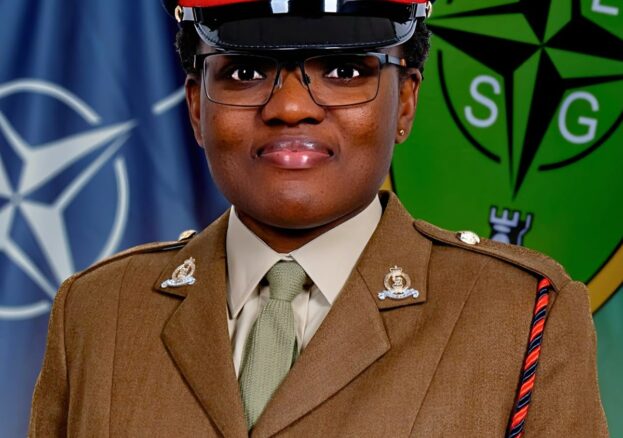
She speaks to Black History Month Magazine about her unexpected journey into the British Army, the importance of representation and helping the next generation believe that they belong.
What first inspired you to join the British Army?
The honest answer is that I never planned to join the Army. I studied Politics, Philosophy and Economics because I wanted to work in politics, government, policy or diplomacy. After university, things did not go according to plan. I kept applying for graduate jobs and being rejected.
One day, while on my way to the library to print CVs, I saw a billboard that said, “Army: Be the Best.” It caught my attention, so I went home, looked into it and thought, “Why not? What have I got to lose?”
I first applied to become an officer and failed the Army Officer Selection Board. That could have been the end of the story, but I was advised to try the soldier route. Suddenly, I was packing up my one-bedroom flat and going to basic training with one suitcase.
I joined because I was trying to find a door that would open. That door took me somewhere I never imagined.
What have you learnt from entering environments where few Black women had gone before?
I have learnt not to limit myself according to what I think I am capable of. I have been in places where there were not many women and even fewer Black women. I was the only woman on the first SpecINF cadre, and I have operated in infantry environments where I knew I was different.
You do not always need to see someone who looks like you before deciding you belong. Sometimes you have to be the first. That can be uncomfortable because there is no blueprint, so you have to figure it out.
I have also learnt that resilience is something you build through rejection, failure and being outside your comfort zone. During basic training, I genuinely considered quitting. I called my mum, and she talked me through it, prayed for me and reminded me why I had started.
I stayed. A difficult moment does not necessarily mean you are on the wrong path. Sometimes it means you are becoming someone you have not met yet.
What stands out about Exercise Haraka Spear in Kenya?
It was one of the biggest learning experiences of my career. I was a relatively new Private, my trade was HR, and I was attached to B Company, 1 SCOTS. These soldiers were fit, experienced and accustomed to the field.
I had to learn quickly while dealing with the heat, little sleep and more than six weeks without everyday comforts. I was also the only woman among more than 60 men.
I did not want to be the person the team had to carry. I listened, watched closely and asked questions. I fitted into the team, not by losing who I was but by understanding its rhythm and culture. I did not want special treatment; I wanted to be useful.
They could see that I was inexperienced, but they could also see that I was willing to learn, work and face the same discomfort. That is how I earned their respect.
Sometimes you do not overcome a challenge by trying to prove you belong. You get stuck in, contribute and let your actions speak for you.
How did your NATO appointment broaden your understanding of leadership?
At NATO, I worked alongside people from different countries, each bringing their own procedures, cultures and ways of thinking. Everyone still had to work towards a common objective.
I learnt that international cooperation is not about everybody doing things the same way. It is about working effectively when they do not. You must listen, communicate clearly, build relationships and understand that your way is not automatically the right way.
You do not have to agree on everything or work in exactly the same way to achieve something together. What matters is finding the common purpose and understanding how each person or organisation contributes to it.
What did your military awards mean to you?
Both were surreal. At NATO, I did not even know the award existed. Then I found myself at SHAPE receiving the Military Member of the Year award from SACEUR, the Supreme Allied Commander Europe.
I was the most junior-ranked recipient, the only woman and the only person of colour. I remember thinking, “How did I get here?”
My role at the Joint Logistics Support Group was new, and I was building it as I went along. I was not seeking recognition; I simply wanted to do my job well.
It taught me to give my best because you never know who is watching or mentioning your name in rooms you do not know exist.
Receiving the Colonel Commandant’s Recommendation in 2025 was another humbling moment. I dedicated it to my Triple A Foundation team. My name was on the recognition, but it represented everybody who believed in the vision and helped make it real.
How do you build trust with young people from underrepresented communities?
The biggest thing I bring to recruitment is representation. Sometimes it is not about telling somebody, “You can do this.” It is allowing them to see somebody who looks like them doing it and think, “Maybe I can too.”
I am honest about my journey. I did not grow up wanting to be a soldier, and I know what rejection feels like.
I am not there to give young people a sales pitch. I explain what the Army can offer, including the opportunities and challenges, and allow them to make an informed decision.
My message is to occupy the space. If you are the only Black person, the only woman or the first person from your background in the room, do not assume you do not belong.
When you occupy that space, you change the picture for the person coming behind you. They can see that someone like them is already there. You do not have to become somebody else to belong. You can occupy the space, be yourself and still succeed.
What inspired you to establish the Triple A Foundation?
It comes down to opportunity and access. Many young people have ability, ambition and potential but lack what they need to move forward.
A child may not have a uniform or stationery. A girl may miss school because she cannot access menstrual products. A young person may be able to learn digital skills but have no computer.
Our work covers education, technology, menstrual health and support for children at risk of becoming street-connected. The projects differ, but the purpose is the same: removing barriers and creating access to opportunity.
Potential without access can remain only potential. We cannot change everything overnight, but if we create one opportunity and that leads to another, we have started something.
What looks small—a school bag, a computer, a scholarship or someone believing in you—can become the access point to something much bigger.
What advice would you give a young Black woman considering the Armed Forces?
Look beyond your gender and colour. They are part of who you are, but they do not define your limits. Do not enter a room, see nobody who looks like you and decide it is not for you. Think, “Maybe I am meant to be here.”
Make the application. Take the opportunity. Do not be afraid of being the first. Do it afraid, but do it anyway.
If you wait for the room to look like you before entering, you may never walk through the door. Sometimes you must be the person who changes what the room looks like.
Do not be discouraged by rejection. I failed the Army Officer Selection Board, but the alternative route gave me opportunities I could never have imagined.
Do the work, ask questions and find people who will support you, but never believe that you must become somebody else to succeed.
Remember that your journey is not only about you. Another young Black woman may be watching and wondering whether she belongs. Be the representation you would have wanted to see, and help her through the door.
That is what Honouring Our Communities means to me. We honour those who came before us, but we must also make the path easier for those coming behind us.
Make the application. Take the space. Do the work. And when you get there, leave the door open for someone else.