
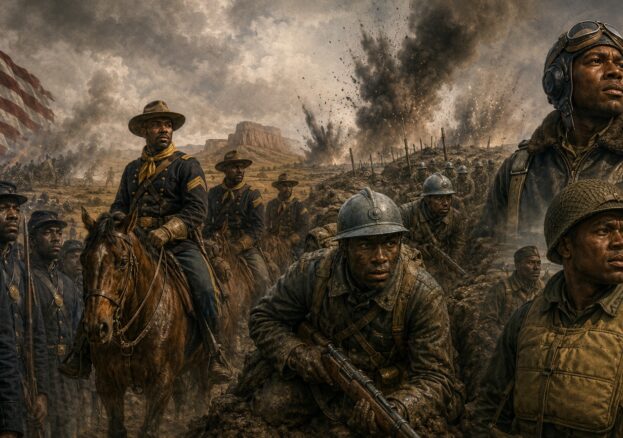
In the spring of 1918, in a churned and muddy section of trench on the Western Front, a regiment of American soldiers held a stretch of line the French Army had come to depend on.
They wore French helmets and carried French rifles, not by preference but because they had been handed over to French command, and it was simpler to supply them from French stocks than to ship American gear across the lines.
They were the men of the 369th Infantry Regiment, soon to be known as the Harlem Hellfighters. Like every other soldier crouched in those trenches, the only thing standing between their bodies and the shrapnel overhead was a curved piece of steel worn on the head.
That detail is easy to miss. We remember units like the 369th for their courage, their record, and sometimes their music.
We rarely stop to ask a plainer question: what actually protected these men? Across the long history of Black American soldiers, the answer is uncomfortable. For generation after generation, the protection available to a fighting man was minimal, unreliable, or simply nonexistent.
And the troops sent into danger with the least support of all were very often Black regiments. This is their history told through that lens, the units, the men, and the body protection of their time.
A Long Line of Service
Black Americans have fought in every major conflict in the nation’s history, usually in segregated units, frequently equipped with whatever remained after white regiments were supplied, and often written out of the popular memory of the wars they helped win. Their valor is, slowly, being returned to the record. Their equipment almost never is.
Yet equipment is part of the story, and not a small part. To ask what protected a soldier in 1863, or 1877, or 1918, is to ask how much the country that sent him into danger was prepared to spend on keeping him alive. For most of this timeline the honest answer is not much, in part because not much existed to spend it on. Body armor as we understand it now is a recent invention. For the soldiers in this story, protection was a patchwork of poor options, abandoned experiments, and, more often than not, nothing at all. The story begins in the one American war that briefly produced a body-armor market of its own.
The Civil War: The Breastplate Nobody Trusted
By the end of the Civil War, roughly 175,000 Black men had served in the Union Army, most of them in regiments organized as the United States Colored Troops. Units such as the 54th Massachusetts Infantry, whose assault on Fort Wagner in 1863 became one of the defining images of Black service in the war, fought with a visibility the army had never before permitted. They also fought, very often, with inferior equipment. Colored Troops regiments were routinely issued older weapons, assigned the heaviest labor, and given less of nearly everything than their white counterparts received.
The Civil War was also, oddly, the first American war with a commercial body-armor industry. As rifled muskets made the battlefield deadlier than anything soldiers had faced before, entrepreneurs saw an opening. Companies such as G. and D. Cook and the Atwater Armor Company began mass-producing steel breastplate vests, and advertisements for a product called “The Soldiers Bullet Proof Vest” ran in publications including Harper’s Weekly, promising to double the value and power of the soldier and to save thousands of lives.
The reality fell well short of the advertising. The plates were heavy and awkward. They might turn a spent round or a pistol ball at distance, but they did little against a rifle at close range and nothing at all against artillery. They were never official issue. Soldiers bought them from peddlers who moved from camp to camp, or ordered them by mail, and most who bought them soon threw them away rather than carry the extra weight on a long march. There was a social cost too. Wearing armor was widely seen as cowardly, so the men who kept their vests tended to hide the steel plate beneath an ordinary coat.
For the soldiers of the United States Colored Troops, the body armor of the era was doubly out of reach. It was a private purchase in an army that already handed them the short end of every supply chain, and it barely functioned even for the men who could afford it. The first time American soldiers had the option to buy protection for their torsos, the product was marginal, and the troops with the fewest resources were the least likely to have it.
The Buffalo Soldiers: An Era With No Answer
After the war, many Black soldiers stayed in uniform and went west. In 1866, Congress authorized the regiments that became known as the Buffalo Soldiers: the 9th and 10th Cavalry and the 24th and 25th Infantry. For the next several decades they served across the western frontier, building roads, escorting settlers and railroad survey crews, guarding mail routes, and fighting in the long campaigns of the period, all while contending with the same discrimination at the edge of the country that they had known at its center.
If the Civil War briefly gave soldiers something to buy, the decades that followed gave them nothing. The armor fad had collapsed almost as fast as it appeared, and nothing replaced it. A cavalry trooper’s protection in the 1870s and 1880s amounted to a wool uniform and a hat. This was true for every soldier of the era, Black or white. The point is not that the Buffalo Soldiers were singled out for poor protection here, but that for an entire generation of American fighting men the question of body protection simply had no answer. The troopers of the 9th and 10th Cavalry rode into hostile country with nothing between them and a bullet but cloth. That gap would persist until the next time American soldiers met industrial warfare, when at least one piece of genuine protection returned to the field.
The Harlem Hellfighters and the Return of the Helmet
The regiment that became the Harlem Hellfighters began as the 15th New York National Guard, raised largely from Harlem after years of lobbying by Black New Yorkers for a unit of their own. When the United States entered the First World War, the regiment shipped to France expecting to fight and was instead assigned to labor duty, unloading ships and digging, the role the American command reserved for most Black troops. Their commander pushed hard to get them into combat. The army’s solution was to hand them over to the French.
The French Army, bled white by years of trench warfare, needed men far more than it needed to enforce another nation’s racial hierarchy. The 369th was attached to a French division, re-equipped, and sent to the front, where it remained for 191 days, longer than any other American unit in the war. The French awarded the entire regiment the Croix de Guerre. One of its soldiers, Henry Johnson, fought off a large German raiding party almost single-handedly while badly wounded, an action that earned him the Croix de Guerre at the time and, nearly a century later in 2015, the Medal of Honor.
The equipment thread runs straight through this story. When the 369th first arrived it carried American gear, including the M1917 helmet, the American version of the British Brodie pattern, a shallow steel bowl meant to shield the head from shrapnel falling from above.
Under French command the men exchanged it for the French Adrian helmet and French weapons, again simply because it eased resupply. But the essential fact of the era is this: the helmet was the protection.
There was no practical body armor for the torso, for any soldier, on any side of the war. Armies experimented with body shields and plate, but the prototypes were too heavy to fight in and far too expensive to issue to men by the million. A soldier in the trenches of 1918 had a steel helmet and nothing more.
The men of the 369th also carried a burden no helmet could deflect. An American staff officer had circulated a now-infamous memorandum, associated with the name Linard, urging French officers to treat Black American soldiers as inferiors and to keep their distance.
The French, long accustomed to soldiers of color in their own ranks, largely ignored it. The Hellfighters fought as equals in the only army that would have them as equals, and they came home with a reputation that the country they had served was not yet prepared to honor.
The Second World War and the First Flak Jackets
A generation later, the Second World War sent Black Americans into combat once more, still in segregated units, and again into roles the military tried to limit until performance forced a reckoning. The Tuskegee Airmen flew escort and combat missions over Europe and built a record that helped dismantle the myth that Black pilots could not handle modern aircraft. The 761st Tank Battalion, nicknamed the Black Panthers, fought across Europe in Sherman tanks, including through the bitter winter fighting around the Battle of the Bulge. The 92nd Infantry Division carried the old Buffalo Soldier name into the mountains of Italy.
This was also the war in which real torso protection finally arrived. The flak jacket, developed first for the crews of heavy bombers, was the first wearable garment issued specifically to protect the body, rather than only the head, from harm. It was designed to stop shrapnel and fragments, the jagged metal thrown by exploding shells and anti-aircraft fire that caused an enormous share of casualties among aircrew. It was heavy. It was not bulletproof, and it could not stop a direct rifle round. But it was a beginning. For the first time, an army had decided that covering a soldier’s torso was worth the weight, and had issued something to do it.
The quiet significance is hard to overstate. The airmen and aircrews of the Second World War, the Tuskegee pilots among them, were among the first soldiers in the whole of military history to go into battle wearing anything that resembled body armor. The technology that would eventually become the modern protective vest was being born in precisely these years, though it would take decades more, and materials that did not yet exist, before it reached the soldiers who needed it.
How Protective Gear Finally Caught Up
Trace the whole arc and a single thread emerges. From the United States Colored Troops to the Buffalo Soldiers to the Hellfighters and the Tuskegee Airmen, the constant was a gap, the distance between the danger these men were sent into and the protection actually available to keep them alive. For most of that history the gap was nearly total. The breastplate of the 1860s barely worked and rarely reached them. The frontier offered nothing. The trenches offered a helmet. Only at the very end of this timeline did the first real body covering appear, and even then it could not stop a bullet.
The protection these soldiers deserved came later, after their time. It emerged from a long chain of invention that started with strange experiments in silk and steel in the late nineteenth century, ran through the flak jackets of the world wars, and finally arrived with the synthetic fibers and modern materials that made a lightweight, genuinely bullet-resistant vest possible. The road from those first attempts to the protective gear of today took more than a century, and for anyone curious about how that technology actually developed, this overview of body armor history traces the lineage from the earliest patented vests to the materials in use now.
It is worth remembering that road, because it measures something. The men in this history fought in eras when the answer to what protected them was usually almost nothing. They went anyway. Honoring their service means remembering not only what they did, but how little stood between them and the weapons turned against them, and how long it took for the country they served to close the gap.