
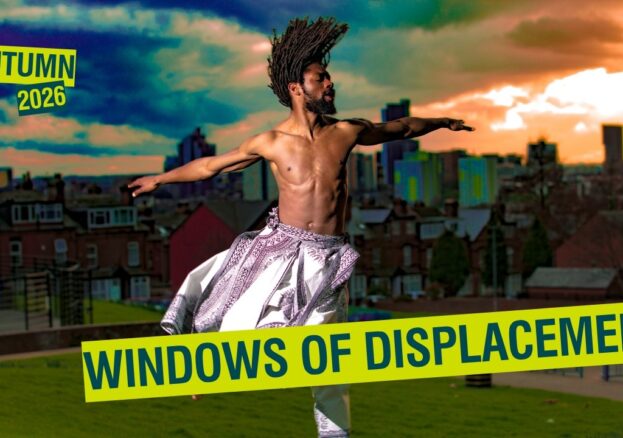
Migration, colonialism, identity and the meaning of home come together in Akeim Toussaint Buck’s Windows of Displacement at Northern Stage.
The dance-theatre solo uses Toussaint Buck’s own experience of migrating from Jamaica to Britain as the starting point for a much wider exploration of movement, borders and belonging.
Combining dance, spoken word and song, the performance moves between an intensely personal story and the historical forces that have displaced people across generations.
The production looks at migration through the wider contexts of imperialism and colonialism, drawing connections between the transatlantic slave trade and contemporary forms of exploitation and displacement, including the experiences of communities in the Congo.
That gives Windows of Displacement a particularly strong relevance during Black History Month.
The history of Black Britain is inseparable from migration. People have arrived in Britain from Africa and the Caribbean for many different reasons and under very different circumstances, creating communities whose stories are now part of British history.
But migration is also an emotional experience.
Questions of where home is, how identity changes after migration and what it means to belong to more than one place can rarely be explained through statistics alone.
Toussaint Buck approaches those questions through the body as well as through language, using movement to communicate experiences that may be difficult to express in conventional historical narratives.
Northern Stage describes the work as connecting oppression across time, moving from the transatlantic slave trade to present-day questions of global power and exploitation.
At just under an hour, Windows of Displacement offers a concentrated and thought-provoking Black History Month experience — one that connects Caribbean migration to Britain with wider histories of colonialism, displacement, identity and resistance.
More Newcastle Upon Tyne Listings MORE
Black Is The Color Of My Voice
Inspired by the life and music of Nina Simone, Apphia Campbell’s acclaimed Black Is The Color Of My…

Beyond Recognition: Structural Racism and the Health of the Black Community
Dr Gwenetta Curry delivers Newcastle University’s INSIGHTS Black History Month Lecture, examining how structural racism continues to affect…

Windows of Displacement
Migration, colonialism, identity and the meaning of home come together in Akeim Toussaint Buck’s Windows of Displacement at…
The Beat – Dance Crazed Too UK Tour
The Beat brings the energy of Britain’s ska and 2 Tone movement to Newcastle. Formed in Birmingham in…

The Dualers
The Dualers bring their blend of ska, reggae and Jamaican rhythm and blues to Newcastle. The South-East London…

Don’t Call Me Scary!
Don’t Call Me Scary! brings author and communications professional Monique Pennie to Newcastle City Library for a Black…
Notice. Name. Navigate.
How do you respond when somebody makes a comment or assumption that feels uncomfortable, prejudiced or simply wrong?…
Soul II Soul
Soul II Soul brings one of the most influential sounds in modern Black British music to Newcastle. Led…