
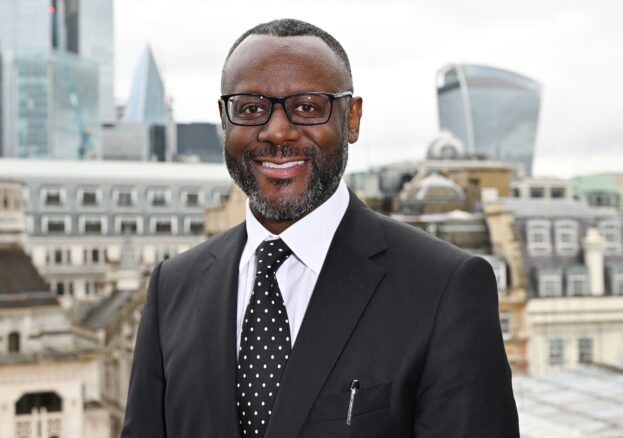
For Black History Month 2026, Jerome Williams, Director of EDI at City Bridge Foundation, speaks with Ian about representation, fairness and opportunity; the generations whose shoulders he stands on; and the responsibility that comes with opening doors for those who follow.
Jerome Williams: As a Black CEO operating at the highest levels of London, what does your presence in that space represent — not only for you, but for the generations coming behind you?
Ian Thomas: I would say it’s absolutely not for me or about me, but I understand that representation is incredibly important. It demonstrates to people that, irrespective of one’s background, you can operate at the highest level in august and significant organisations such as the City of London Corporation. The Corporation is a global institution, an iconic institution.
I was appointed to this role through a thorough, transparent and merit-based process. If meritocracy were truly working as it should in this country, I believe we would see far stronger representation than we do today.
We will always need to work on the supply chain through coaching, mentoring, networking and so on, but there is so much talent out there. The issue leans more towards the glass ceiling, stifling opportunities for exceptional black talent, that unfortunately appears to be omnipresent.
Recruiters, not just the people hiring, but the search agencies too, need to become more comfortable resisting the temptation to recruit in their own image.
JW: Black History Month 2026 is themed “Honouring Our Communities”. Who are the people or communities whose shoulders you stand on, and how have they shaped the leader you are today?
IT: If I talk about individuals, I will inevitably miss key people out. So, I would talk about the Windrush generation, alongside the African and African American movements that have helped make this country what it is today.
The UK is one of the world’s largest economies, and Black communities are integral to that story. Their contribution is evident across every aspect of national life, from helping to meet the needs of the post-war period to serving in civic life, public service, engineering, science, culture, the arts, financial and professional services, entrepreneurship, academia and the NHS. Wherever you look, Black people have played a critical role in shaping the country we know today.
I stand on the shoulders of those who made the extraordinarily brave decision to come here and help rebuild this country after the Second World War. Without their courage, resilience, vision and determination, neither I nor others in similar positions would be here today.
Those are the shoulders I stand on, for sure.
JW: The City of London is synonymous with power, wealth and influence. Where do you believe Black communities are still underrepresented in those conversations, and what needs to change?
IT: In the broadest terms, underrepresentation continues to exist at the highest levels of decision making.
The Corporation’s membership is becoming more diverse, with notable progress on gender representation. However, with 125 Members, there remains more to do to improve Black representation, particularly given the diversity of the communities we serve.
The City of London is much more than the Square Mile. Our services extend across Greater London, including some of its most deprived communities, through City Bridge Foundation’s support, our open spaces such as Hampstead Heath and Epping Forest, education, arts and culture, the Port Health Authority and much more. We also play a national and international role in driving economic growth, representing the financial and professional services sector, and through our City of London Police, providing national leadership in tackling cybercrime and fraud — the fastest growing of all crimes across the globe.
To optimise productivity and performance, we should continue doing more to attract people of colour into senior roles across the Corporation and the sectors we work with. This is not only about the Corporation itself, but also the many firms within the Square Mile and the partners we work with beyond it.
There is broad recognition that people remain underrepresented in the most senior positions, and we must keep working hard to change that.
JW: Can I push you a little on that? What do you see as being effective? What needs to happen to create greater opportunities for underrepresented people?
IT: Me being here is, in itself, a powerful statement.
I became Town Clerk at the start of 2023, and the announcement of my appointment rightly focused on my achievements, because they are what brought me here. But my presence as a Black man in this role also carries significance. It has never happened here before. While I have not had many conversations about that since taking up the role, I fully understand what it means to hold this position.
My presence here should send a clear message: the most senior people in this organisation were prepared to appoint a Black person to its top role. That is exactly what happened.
Great credit should go to the appointment panel and to Chris Hayward, Policy Chairman at the City of London Corporation. I went through seven interviews for this role, so it was not down to Chris alone. But as Chair of the panel, he put meritocracy first and played a pivotal role in ensuring the panel itself was representative.
Some organisations place one Black person on an interview panel and assume the work is done. That can become a box-ticking exercise. This was different. There were people in the room with real influence, whose voices would be heard. I mention Chris because he chaired the panel, but others were equally focused on one thing: appointing the best person for the job.
That is a strong testament to the Corporation and its leadership. They created a process that welcomed an application from someone with my background, regardless of race, and ensured it was fair and transparent.
Throughout my career, Jerome, I have always said that I do not ask for favours, only fairness. It comes back to my earlier point: if meritocracy were truly alive and well, we would not have a representation problem.
JW: Success can create access, but leadership can create opportunity for others. How are you using your position, networks and influence to open doors and ensure others can walk through them?
IT: I do not have a drawbridge. My career has been built on keeping it down.
Throughout my career, I have been inspired by those who came before me, including Linda Bellos OBE, Heather Rabbatts CBE, Dame Sharon White and Derrick Anderson CBE. I have looked up to people who achieved great things, and their example has encouraged me to work harder. Dr Owen Williams, former Chief Executive of Calderdale and, until recently, a prominent NHS chief executive in the North, and Wallace Sampson OBE, former CEO of Harrogate Brough Council are other examples. As someone from the North of England, seeing a Black man achieve what they did in the region, as chief executives, was genuinely inspiring.
Seeing others succeed has been hugely motivating. Growing up, many of us were told by our parents that, as Black children, we would need to work at least twice as hard to make progress and fulfil our potential. That belief gave me the confidence to keep striving too.
Most of the people I have approached for help have been incredibly generous with their time. I learned from that and have tried to do the same. So, no drawbridge. I am open to mentoring and coaching others. I hold a Level 7 qualification in coaching and mentoring and, since gaining it in 2014, I have tried to use it well.
I have had many mentees over the years. The intensity of that coaching and mentoring varies, but I remain in touch with people, and my door is always open if they want to discuss an issue or need advice or support.
JW: How many people do you think you’ve mentored?
IT: It has to be in excess of 50.
JW: 50? Clearly giving back is very important to you.
IT: Absolutely. I’m sitting here thinking I probably mentored 12 or 13 people just in the last year. It’s incredibly rare for me to turn anyone down. When I have, it has generally been because of workload or because I’ve already had too many people to support at once.
I also believe in reverse mentoring. I’ve taken part in reverse mentoring schemes both here at the Corporation and in my previous role as Chief Executive at the Royal Borough of Kingston upon Thames Council. I really enjoyed those programmes, but I also got a lot from them. I believe you can learn from everyone.
JW: When future generations look back at this period of Black British history, what do you hope they will say you did with the platform, power and responsibility you were given?
IT: I didn’t come to the City of London Corporation to exercise power. I’m here to do a job.
I describe myself as a genuinely ordinary bloke, who happens to have an extraordinary job. I’m here to deliver for the Corporation. My legacy should be about what I have delivered, working alongside our elected Members and the amazing staff team we have. That’s what legacy means to me.
It isn’t about saying, “I was here and I did this as a Black man.” It’s about being able to say that I came here and delivered for the Corporation, because ultimately, I’m a professional and that is my job.
When I look back on my time here, I’d like to say that I left the place in a better position than when I found it. But that can only happen through the work you do with others.
When you look at our elected Members, all the institutions we have, our service departments and the eclectic mix of services we deliver, this is a huge endeavour involving a great many people.
I’d like to look back fondly on the sheer volume of what we delivered together during my time here.
JW: And finally, given the theme of this year’s Black History Month, who would you like to honour?
IT: My late mother.
That connects back to your earlier question. Without people of her generation, would we be here celebrating the achievements and contributions of Black people in quite the same way?
Of course, our story did not begin with Windrush. Black people have been part of this country’s history for much longer, and anyone who studies that history properly will see that our contribution began long before then. Even so, the post-war period was undoubtedly significant, alongside the movements taking place from Africa and America.
That is why I would honour my mother.
My father was there too, of course, but she was the driving force. She was the matriarch of our family and the person who set the standards.
What her generation achieved remains, to me, a powerful example of transformational leadership. They left a different country, climate and culture to come here, build families, create networks, put down roots and raise their children.
My parents were not academics, but they had immense ambition for their children’s education and future prospects. They worked hard in the NHS, transport and steel, and carried an extraordinary determination to see the next generation succeed.
They navigated that chapter of their lives with courage and grace, meeting the defining challenges of their time with dignity. I have deep admiration for my mother, and I will always honour her and those like her.
JW: Thank you, Ian. I think that’s a really fitting way to end our conversation.